

6.1 Null Hyperplanes in Space-Times of Constant Curvature
131
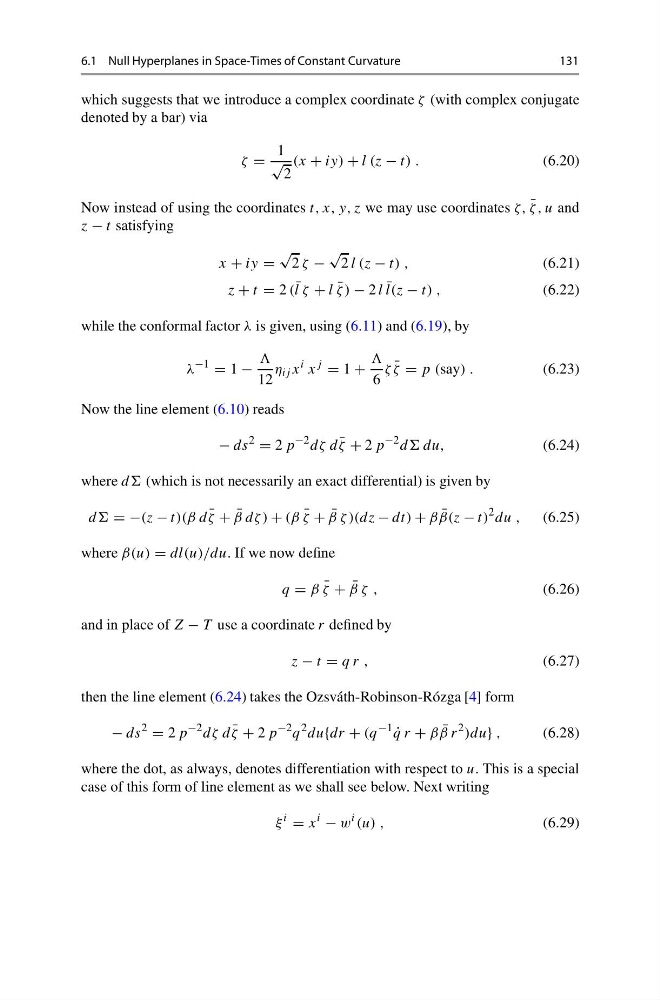
which suggests that we introduce a complex coordinate ζ (with complex conjugate
denoted by a bar) via
ζ =
1
√
2
(x + iy) + l (z − t) .
(6.20)
Now instead of using the coordinates t, x, y, z we may use coordinates ζ, ¯
ζ , u and
z − t satisfying
x + iy =
√
2 ζ −
√
2 l (z − t) ,
(6.21)
z + t = 2 ( ¯
l ζ + l ¯
ζ ) − 2 l ¯
l(z − t) ,
(6.22)
while the conformal factor λ is given, using (6.11) and (6.19), by
λ
−1
= 1 −
12
η ij x
i x
j
= 1 +
6
ζ ¯
ζ = p (say) .
(6.23)
Now the line element (6.10) reads
− ds
2
= 2 p
−2 dζ d ¯
ζ + 2 p
−2 dd du,
(6.24)
where dd (which is not necessarily an exact differential) is given by
dd = −(z − t)(β d ¯
ζ + ¯
β dζ ) + (β ¯
ζ + ¯
β ζ )(dz − dt) + β ¯
β(z − t)
2 du , (6.25)
where β(u) = dl(u)/du. If we now define
q = β ¯
ζ + ¯
β ζ ,
(6.26)
and in place of Z − T use a coordinate r defined by
z − t = q r ,
(6.27)
then the line element (6.24) takes the Ozsváth-Robinson-Rózga [4] form
− ds
2
= 2 p
−2 dζ d ¯
ζ + 2 p
−2 q
2 du{dr + (q
−1
˙
q r + β ¯
β r
2 )du} ,
(6.28)
where the dot, as always, denotes differentiation with respect to u. This is a special
case of this form of line element as we shall see below. Next writing
ξ
i
= x
i
− w
i (u) ,
(6.29)
131
which suggests that we introduce a complex coordinate ζ (with complex conjugate
denoted by a bar) via
ζ =
1
√
2
(x + iy) + l (z − t) .
(6.20)
Now instead of using the coordinates t, x, y, z we may use coordinates ζ, ¯
ζ , u and
z − t satisfying
x + iy =
√
2 ζ −
√
2 l (z − t) ,
(6.21)
z + t = 2 ( ¯
l ζ + l ¯
ζ ) − 2 l ¯
l(z − t) ,
(6.22)
while the conformal factor λ is given, using (6.11) and (6.19), by
λ
−1
= 1 −
12
η ij x
i x
j
= 1 +
6
ζ ¯
ζ = p (say) .
(6.23)
Now the line element (6.10) reads
− ds
2
= 2 p
−2 dζ d ¯
ζ + 2 p
−2 dd du,
(6.24)
where dd (which is not necessarily an exact differential) is given by
dd = −(z − t)(β d ¯
ζ + ¯
β dζ ) + (β ¯
ζ + ¯
β ζ )(dz − dt) + β ¯
β(z − t)
2 du , (6.25)
where β(u) = dl(u)/du. If we now define
q = β ¯
ζ + ¯
β ζ ,
(6.26)
and in place of Z − T use a coordinate r defined by
z − t = q r ,
(6.27)
then the line element (6.24) takes the Ozsváth-Robinson-Rózga [4] form
− ds
2
= 2 p
−2 dζ d ¯
ζ + 2 p
−2 q
2 du{dr + (q
−1
˙
q r + β ¯
β r
2 )du} ,
(6.28)
where the dot, as always, denotes differentiation with respect to u. This is a special
case of this form of line element as we shall see below. Next writing
ξ
i
= x
i
− w
i (u) ,
(6.29)