

4.6 Some ‘Spherical’ Gravitational Waves
93
4.6
Some ‘Spherical’ Gravitational Waves
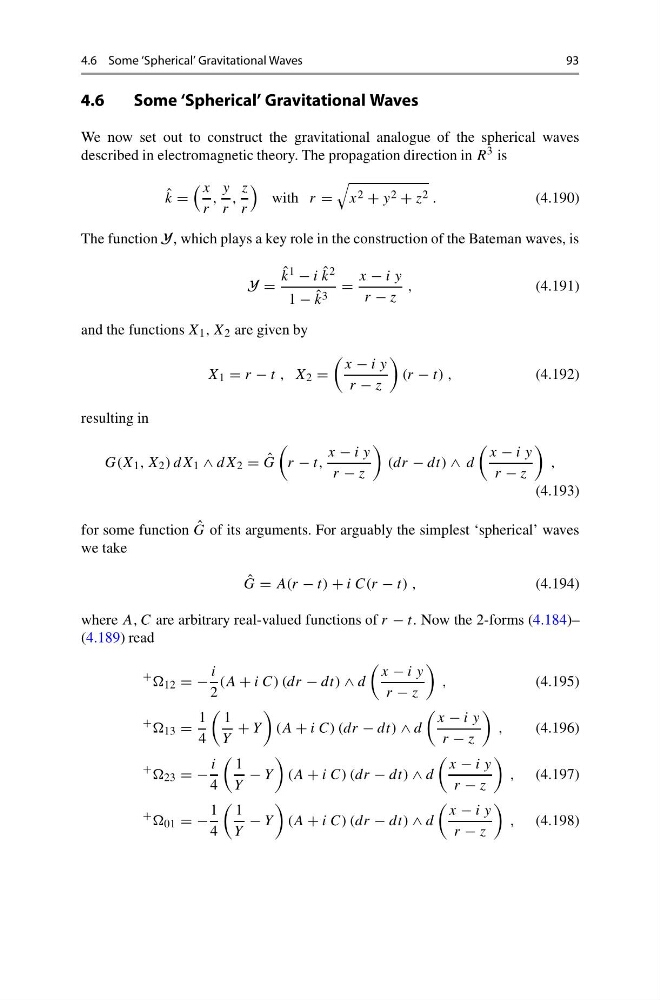
We now set out to construct the gravitational analogue of the spherical waves
described in electromagnetic theory. The propagation direction in R 3 is
ˆ
k =
x
r
,
y
r
,
z
r
with r =
x 2 + y 2 + z 2 .
(4.190)
The function Y, which plays a key role in the construction of the Bateman waves, is
Y =
ˆ
k 1 − i ˆ
k 2
1 − ˆ
k 3
=
x − i y
r − z
,
(4.191)
and the functions X 1 , X 2 are given by
X 1 = r − t , X 2 =
x − i y
r − z
(r − t) ,
(4.192)
resulting in
G(X 1 , X 2 ) dX 1 ∧ dX 2 = ˆ
G
r − t,
x − i y
r − z
(dr − dt) ∧ d
x − i y
r − z
,
(4.193)
for some function ˆ
G of its arguments. For arguably the simplest ‘spherical’ waves
we take
ˆ
G = A(r − t) + i C(r − t) ,
(4.194)
where A, C are arbitrary real-valued functions of r − t. Now the 2-forms (4.184)–
(4.189) read
+ 12 = −
i
2
(A + i C) (dr − dt) ∧ d
x − i y
r − z
,
(4.195)
+ 13 =
1
4
1
Y
+ Y
(A + i C) (dr − dt) ∧ d
x − i y
r − z
,
(4.196)
+ 23 = −
i
4
1
Y
− Y
(A + i C) (dr − dt) ∧ d
x − i y
r − z
, (4.197)
+ 01 = −
1
4
1
Y
− Y
(A + i C) (dr − dt) ∧ d
x − i y
r − z
, (4.198)
93
4.6
Some ‘Spherical’ Gravitational Waves
We now set out to construct the gravitational analogue of the spherical waves
described in electromagnetic theory. The propagation direction in R 3 is
ˆ
k =
x
r
,
y
r
,
z
r
with r =
x 2 + y 2 + z 2 .
(4.190)
The function Y, which plays a key role in the construction of the Bateman waves, is
Y =
ˆ
k 1 − i ˆ
k 2
1 − ˆ
k 3
=
x − i y
r − z
,
(4.191)
and the functions X 1 , X 2 are given by
X 1 = r − t , X 2 =
x − i y
r − z
(r − t) ,
(4.192)
resulting in
G(X 1 , X 2 ) dX 1 ∧ dX 2 = ˆ
G
r − t,
x − i y
r − z
(dr − dt) ∧ d
x − i y
r − z
,
(4.193)
for some function ˆ
G of its arguments. For arguably the simplest ‘spherical’ waves
we take
ˆ
G = A(r − t) + i C(r − t) ,
(4.194)
where A, C are arbitrary real-valued functions of r − t. Now the 2-forms (4.184)–
(4.189) read
+ 12 = −
i
2
(A + i C) (dr − dt) ∧ d
x − i y
r − z
,
(4.195)
+ 13 =
1
4
1
Y
+ Y
(A + i C) (dr − dt) ∧ d
x − i y
r − z
,
(4.196)
+ 23 = −
i
4
1
Y
− Y
(A + i C) (dr − dt) ∧ d
x − i y
r − z
, (4.197)
+ 01 = −
1
4
1
Y
− Y
(A + i C) (dr − dt) ∧ d
x − i y
r − z
, (4.198)