

92
4 Bateman Waves
+ 23 = −
i
4
(Y
−1
− Y) g (du + Y d ¯
ζ ) ∧ (dζ − Y dv) ,
(4.177)
+ 01 = −
1
4
(Y
−1
− Y) g (du + Y d ¯
ζ ) ∧ (dζ − Y dv) ,
(4.178)
+ 02 =
i
4
(Y
−1
+ Y) g (du + Y d ¯
ζ ) ∧ (dζ − Y dv) ,
(4.179)
+ 03 = −
1
2
g (du + Y d ¯
ζ ) ∧ (dζ − Y dv) .
(4.180)
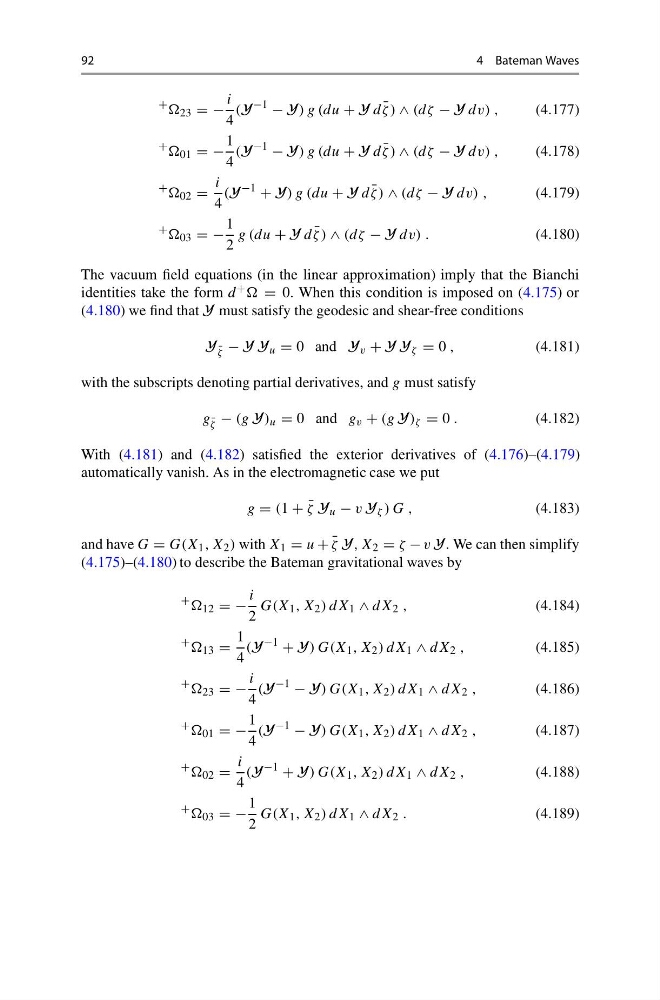
The vacuum field equations (in the linear approximation) imply that the Bianchi
identities take the form d + = 0. When this condition is imposed on (4.175) or
(4.180) we find that Y must satisfy the geodesic and shear-free conditions
Y ¯
ζ − Y Y u = 0 and Y v + Y Y ζ = 0 ,
(4.181)
with the subscripts denoting partial derivatives, and g must satisfy
g ¯
ζ − (g Y) u = 0 and g v + (g Y) ζ = 0 .
(4.182)
With (4.181) and (4.182) satisfied the exterior derivatives of (4.176)–(4.179)
automatically vanish. As in the electromagnetic case we put
g = (1 + ¯
ζ Y u − v Y ζ ) G ,
(4.183)
and have G = G(X 1 , X 2 ) with X 1 = u + ¯
ζ Y, X 2 = ζ − v Y. We can then simplify
(4.175)–(4.180) to describe the Bateman gravitational waves by
+ 12 = −
i
2
G(X 1 , X 2 ) dX 1 ∧ dX 2 ,
(4.184)
+ 13 =
1
4
(Y
−1
+ Y) G(X 1 , X 2 ) dX 1 ∧ dX 2 ,
(4.185)
+ 23 = −
i
4
(Y
−1
− Y) G(X 1 , X 2 ) dX 1 ∧ dX 2 ,
(4.186)
+ 01 = −
1
4
(Y
−1
− Y) G(X 1 , X 2 ) dX 1 ∧ dX 2 ,
(4.187)
+ 02 =
i
4
(Y
−1
+ Y) G(X 1 , X 2 ) dX 1 ∧ dX 2 ,
(4.188)
+ 03 = −
1
2
G(X 1 , X 2 ) dX 1 ∧ dX 2 .
(4.189)
4 Bateman Waves
+ 23 = −
i
4
(Y
−1
− Y) g (du + Y d ¯
ζ ) ∧ (dζ − Y dv) ,
(4.177)
+ 01 = −
1
4
(Y
−1
− Y) g (du + Y d ¯
ζ ) ∧ (dζ − Y dv) ,
(4.178)
+ 02 =
i
4
(Y
−1
+ Y) g (du + Y d ¯
ζ ) ∧ (dζ − Y dv) ,
(4.179)
+ 03 = −
1
2
g (du + Y d ¯
ζ ) ∧ (dζ − Y dv) .
(4.180)
The vacuum field equations (in the linear approximation) imply that the Bianchi
identities take the form d + = 0. When this condition is imposed on (4.175) or
(4.180) we find that Y must satisfy the geodesic and shear-free conditions
Y ¯
ζ − Y Y u = 0 and Y v + Y Y ζ = 0 ,
(4.181)
with the subscripts denoting partial derivatives, and g must satisfy
g ¯
ζ − (g Y) u = 0 and g v + (g Y) ζ = 0 .
(4.182)
With (4.181) and (4.182) satisfied the exterior derivatives of (4.176)–(4.179)
automatically vanish. As in the electromagnetic case we put
g = (1 + ¯
ζ Y u − v Y ζ ) G ,
(4.183)
and have G = G(X 1 , X 2 ) with X 1 = u + ¯
ζ Y, X 2 = ζ − v Y. We can then simplify
(4.175)–(4.180) to describe the Bateman gravitational waves by
+ 12 = −
i
2
G(X 1 , X 2 ) dX 1 ∧ dX 2 ,
(4.184)
+ 13 =
1
4
(Y
−1
+ Y) G(X 1 , X 2 ) dX 1 ∧ dX 2 ,
(4.185)
+ 23 = −
i
4
(Y
−1
− Y) G(X 1 , X 2 ) dX 1 ∧ dX 2 ,
(4.186)
+ 01 = −
1
4
(Y
−1
− Y) G(X 1 , X 2 ) dX 1 ∧ dX 2 ,
(4.187)
+ 02 =
i
4
(Y
−1
+ Y) G(X 1 , X 2 ) dX 1 ∧ dX 2 ,
(4.188)
+ 03 = −
1
2
G(X 1 , X 2 ) dX 1 ∧ dX 2 .
(4.189)