

52
2 RFID System Physical Anti-Collision Experimental Verification
the classification. If p is the corner, it is the real information. Variable K p only
collects the real information. The gain of pixel is determined by the entropy
value of variable K p , and the maximum gain is used as the judgment condition,
that is, whether the point is an Angle point or not.
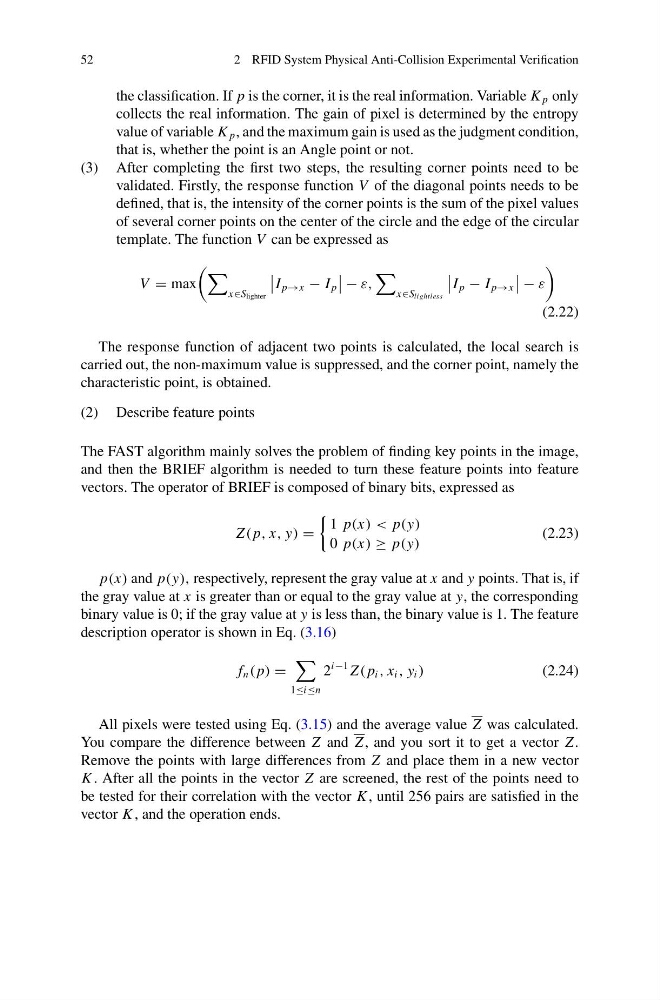
(3) After completing the first two steps, the resulting corner points need to be
validated. Firstly, the response function V of the diagonal points needs to be
defined, that is, the intensity of the corner points is the sum of the pixel values
of several corner points on the center of the circle and the edge of the circular
template. The function V can be expressed as
V = max
x∈S lighter
I p→x − I p
− ε,
x∈S lightless
I p − I p→x
− ε
(2.22)
The response function of adjacent two points is calculated, the local search is
carried out, the non-maximum value is suppressed, and the corner point, namely the
characteristic point, is obtained.
(2) Describe feature points
The FAST algorithm mainly solves the problem of finding key points in the image,
and then the BRIEF algorithm is needed to turn these feature points into feature
vectors. The operator of BRIEF is composed of binary bits, expressed as
Z ( p, x, y) =
1 p(x) < p(y)
0 p(x) ≥ p(y)
(2.23)
p(x) and p(y), respectively, represent the gray value at x and y points. That is, if
the gray value at x is greater than or equal to the gray value at y, the corresponding
binary value is 0; if the gray value at y is less than, the binary value is 1. The feature
description operator is shown in Eq. (3.16)
f n ( p) =
1≤i≤n
2
i−1 Z ( p i , x i , y i )
(2.24)
All pixels were tested using Eq. (3.15) and the average value Z was calculated.
You compare the difference between Z and Z , and you sort it to get a vector Z .
Remove the points with large differences from Z and place them in a new vector
K . After all the points in the vector Z are screened, the rest of the points need to
be tested for their correlation with the vector K , until 256 pairs are satisfied in the
vector K , and the operation ends.
2 RFID System Physical Anti-Collision Experimental Verification
the classification. If p is the corner, it is the real information. Variable K p only
collects the real information. The gain of pixel is determined by the entropy
value of variable K p , and the maximum gain is used as the judgment condition,
that is, whether the point is an Angle point or not.
(3) After completing the first two steps, the resulting corner points need to be
validated. Firstly, the response function V of the diagonal points needs to be
defined, that is, the intensity of the corner points is the sum of the pixel values
of several corner points on the center of the circle and the edge of the circular
template. The function V can be expressed as
V = max
x∈S lighter
I p→x − I p
− ε,
x∈S lightless
I p − I p→x
− ε
(2.22)
The response function of adjacent two points is calculated, the local search is
carried out, the non-maximum value is suppressed, and the corner point, namely the
characteristic point, is obtained.
(2) Describe feature points
The FAST algorithm mainly solves the problem of finding key points in the image,
and then the BRIEF algorithm is needed to turn these feature points into feature
vectors. The operator of BRIEF is composed of binary bits, expressed as
Z ( p, x, y) =
1 p(x) < p(y)
0 p(x) ≥ p(y)
(2.23)
p(x) and p(y), respectively, represent the gray value at x and y points. That is, if
the gray value at x is greater than or equal to the gray value at y, the corresponding
binary value is 0; if the gray value at y is less than, the binary value is 1. The feature
description operator is shown in Eq. (3.16)
f n ( p) =
1≤i≤n
2
i−1 Z ( p i , x i , y i )
(2.24)
All pixels were tested using Eq. (3.15) and the average value Z was calculated.
You compare the difference between Z and Z , and you sort it to get a vector Z .
Remove the points with large differences from Z and place them in a new vector
K . After all the points in the vector Z are screened, the rest of the points need to
be tested for their correlation with the vector K , until 256 pairs are satisfied in the
vector K , and the operation ends.