

2.2 Image Feature Matching Experiment of RFID System Physical Anti-Collision
51
2.2.3 Image Feature Matching Based on ORB Algorithm
ORB algorithm is a feature matching algorithm that combines FAST algorithm and
BRIEF algorithm, two high-performance and low-workload methods. The biggest
advantage of FAST algorithm is its FAST speed, and BRIEF algorithm is used to
describe the direction of feature descriptors. Because of the speedup of the FAST
algorithm, the ORB algorithm runs much faster than SIFT and SURF algorithms,
and the descriptors obtained by using the BRIEF algorithm can effectively save
storage space. The scale variability of the ORB algorithm is not as good as the other
two algorithms. The principles of the ORB algorithm can also be summarized by
generating and describing feature points.
(1) Generate feature point
FAST algorithm is to compare the gray difference between the selected pixel point
and the area around the point. If the difference is greater than a certain threshold, the
point can be used as a feature point. The implementation process of FAST algorithm
consists of three steps:
(1) By detecting all the pixels on the circle with a certain radius, the unqualified
pixels can be preliminarily removed and possible corner points can be left.
Take fast-x–y as an example (X, Y as a number), select Y pixels on the edge
of the circle and make a difference with the grayscale of the pixel at the center
of the circle. If there are continuous X points that satisfy the condition, that is,
the difference between the grayscale of these points and the grayscale of the
center pixel is greater than a certain threshold, then this point can be selected
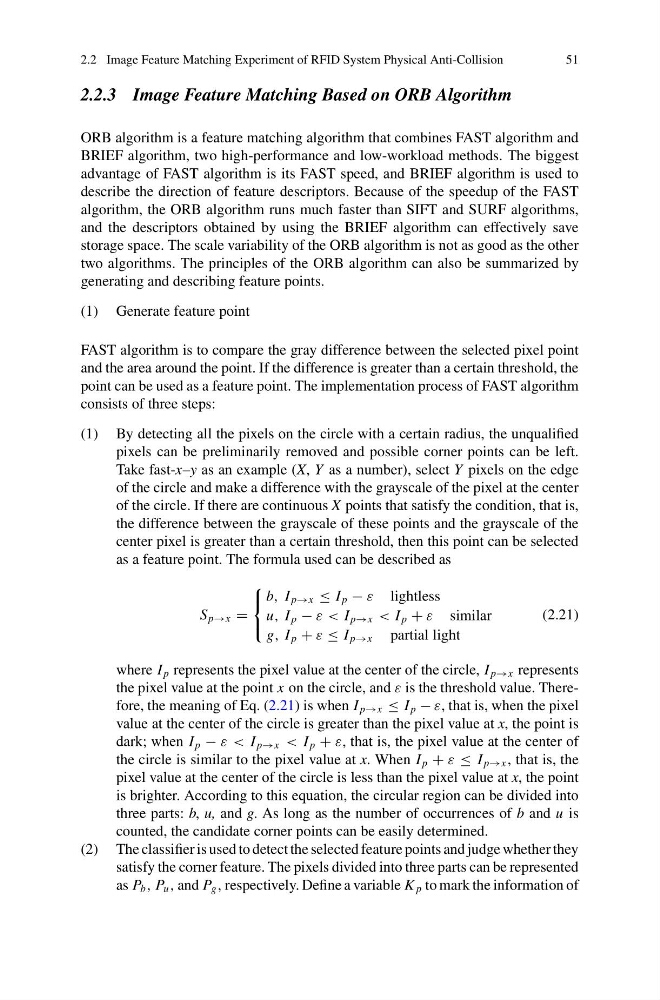
as a feature point. The formula used can be described as
S p→x =
⎧
⎨
⎩
b, I p→x ≤ I p − ε lightless
u, I p − ε < I p→x < I p + ε similar
g, I p + ε ≤ I p→x partial light
(2.21)
where I p represents the pixel value at the center of the circle, I p→x represents
the pixel value at the point x on the circle, and ε is the threshold value. Therefore, the meaning of Eq. (2.21) is when I p→x ≤ I p − ε, that is, when the pixel
value at the center of the circle is greater than the pixel value at x, the point is
dark; when I p − ε < I p→x < I p + ε, that is, the pixel value at the center of
the circle is similar to the pixel value at x. When I p + ε ≤ I p→x , that is, the
pixel value at the center of the circle is less than the pixel value at x, the point
is brighter. According to this equation, the circular region can be divided into
three parts: b, u, and g. As long as the number of occurrences of b and u is
counted, the candidate corner points can be easily determined.
(2) The classifier is used to detect the selected feature points and judge whether they
satisfy the corner feature. The pixels divided into three parts can be represented
as P b , P u , and P g , respectively. Define a variable K p to mark the information of
51
2.2.3 Image Feature Matching Based on ORB Algorithm
ORB algorithm is a feature matching algorithm that combines FAST algorithm and
BRIEF algorithm, two high-performance and low-workload methods. The biggest
advantage of FAST algorithm is its FAST speed, and BRIEF algorithm is used to
describe the direction of feature descriptors. Because of the speedup of the FAST
algorithm, the ORB algorithm runs much faster than SIFT and SURF algorithms,
and the descriptors obtained by using the BRIEF algorithm can effectively save
storage space. The scale variability of the ORB algorithm is not as good as the other
two algorithms. The principles of the ORB algorithm can also be summarized by
generating and describing feature points.
(1) Generate feature point
FAST algorithm is to compare the gray difference between the selected pixel point
and the area around the point. If the difference is greater than a certain threshold, the
point can be used as a feature point. The implementation process of FAST algorithm
consists of three steps:
(1) By detecting all the pixels on the circle with a certain radius, the unqualified
pixels can be preliminarily removed and possible corner points can be left.
Take fast-x–y as an example (X, Y as a number), select Y pixels on the edge
of the circle and make a difference with the grayscale of the pixel at the center
of the circle. If there are continuous X points that satisfy the condition, that is,
the difference between the grayscale of these points and the grayscale of the
center pixel is greater than a certain threshold, then this point can be selected
as a feature point. The formula used can be described as
S p→x =
⎧
⎨
⎩
b, I p→x ≤ I p − ε lightless
u, I p − ε < I p→x < I p + ε similar
g, I p + ε ≤ I p→x partial light
(2.21)
where I p represents the pixel value at the center of the circle, I p→x represents
the pixel value at the point x on the circle, and ε is the threshold value. Therefore, the meaning of Eq. (2.21) is when I p→x ≤ I p − ε, that is, when the pixel
value at the center of the circle is greater than the pixel value at x, the point is
dark; when I p − ε < I p→x < I p + ε, that is, the pixel value at the center of
the circle is similar to the pixel value at x. When I p + ε ≤ I p→x , that is, the
pixel value at the center of the circle is less than the pixel value at x, the point
is brighter. According to this equation, the circular region can be divided into
three parts: b, u, and g. As long as the number of occurrences of b and u is
counted, the candidate corner points can be easily determined.
(2) The classifier is used to detect the selected feature points and judge whether they
satisfy the corner feature. The pixels divided into three parts can be represented
as P b , P u , and P g , respectively. Define a variable K p to mark the information of