

6.3 Image Motion Blur Removal
219
Table 6.3 Results of
different deblurring methods
Deblurring method
SNR/dB
Experimental initial image
15.5170
Wiener filtering method
54.1355
Constrained least square method
13.1889
Lagrange operator method
13.1636
Lucy-Richardson method
15.5645
In order to evaluate the deblurred image, this paper uses SNR. The equation of
SNR is as follows:
SNR = 10 lg
⎡
⎢
⎢
⎢
⎣
M
i=1
N
j=1
g(i, j)
2
M
i=1
N
j=1
[g(i, j) − f (i, j)] 2
⎤
⎥
⎥
⎥
⎦
(6.15)
In Eq. (6.15), M is the number of pixels in the length direction of the image. N
is the number of pixels in the image’s width direction. f (i, j) is the gray value of
position (i,j) in the original image. g(i, j) is the gray value of position (i,j) in the
deblurred image.
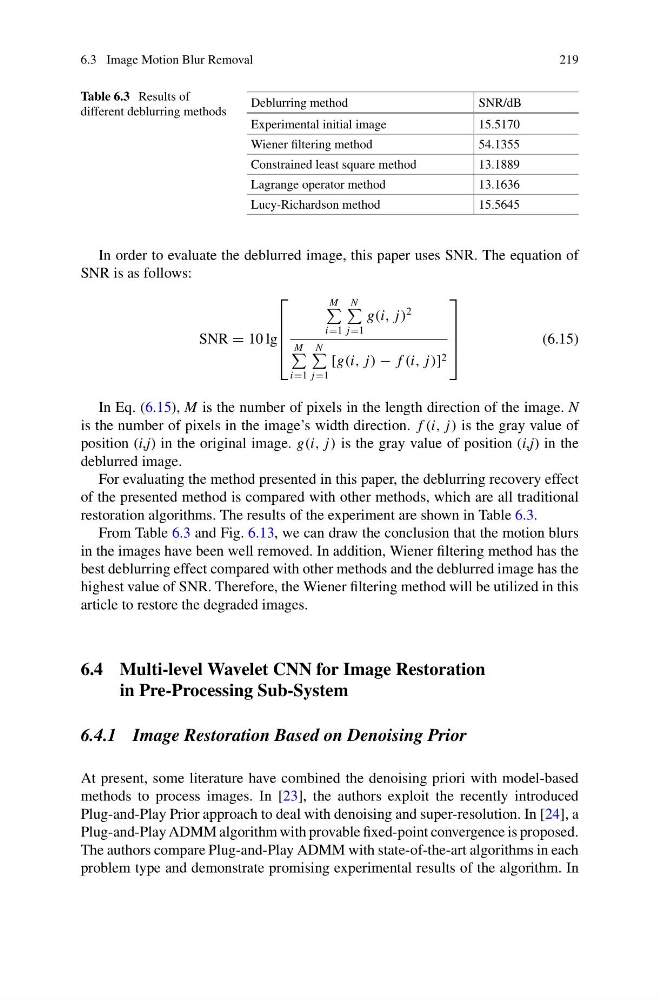
For evaluating the method presented in this paper, the deblurring recovery effect
of the presented method is compared with other methods, which are all traditional
restoration algorithms. The results of the experiment are shown in Table 6.3.
From Table 6.3 and Fig. 6.13, we can draw the conclusion that the motion blurs
in the images have been well removed. In addition, Wiener filtering method has the
best deblurring effect compared with other methods and the deblurred image has the
highest value of SNR. Therefore, the Wiener filtering method will be utilized in this
article to restore the degraded images.
6.4 Multi-level Wavelet CNN for Image Restoration
in Pre-Processing Sub-System
6.4.1 Image Restoration Based on Denoising Prior
At present, some literature have combined the denoising priori with model-based
methods to process images. In [23], the authors exploit the recently introduced
Plug-and-Play Prior approach to deal with denoising and super-resolution. In [24], a
Plug-and-Play ADMM algorithm with provable fixed-point convergence is proposed.
The authors compare Plug-and-Play ADMM with state-of-the-art algorithms in each
problem type and demonstrate promising experimental results of the algorithm. In
219
Table 6.3 Results of
different deblurring methods
Deblurring method
SNR/dB
Experimental initial image
15.5170
Wiener filtering method
54.1355
Constrained least square method
13.1889
Lagrange operator method
13.1636
Lucy-Richardson method
15.5645
In order to evaluate the deblurred image, this paper uses SNR. The equation of
SNR is as follows:
SNR = 10 lg
⎡
⎢
⎢
⎢
⎣
M
i=1
N
j=1
g(i, j)
2
M
i=1
N
j=1
[g(i, j) − f (i, j)] 2
⎤
⎥
⎥
⎥
⎦
(6.15)
In Eq. (6.15), M is the number of pixels in the length direction of the image. N
is the number of pixels in the image’s width direction. f (i, j) is the gray value of
position (i,j) in the original image. g(i, j) is the gray value of position (i,j) in the
deblurred image.
For evaluating the method presented in this paper, the deblurring recovery effect
of the presented method is compared with other methods, which are all traditional
restoration algorithms. The results of the experiment are shown in Table 6.3.
From Table 6.3 and Fig. 6.13, we can draw the conclusion that the motion blurs
in the images have been well removed. In addition, Wiener filtering method has the
best deblurring effect compared with other methods and the deblurred image has the
highest value of SNR. Therefore, the Wiener filtering method will be utilized in this
article to restore the degraded images.
6.4 Multi-level Wavelet CNN for Image Restoration
in Pre-Processing Sub-System
6.4.1 Image Restoration Based on Denoising Prior
At present, some literature have combined the denoising priori with model-based
methods to process images. In [23], the authors exploit the recently introduced
Plug-and-Play Prior approach to deal with denoising and super-resolution. In [24], a
Plug-and-Play ADMM algorithm with provable fixed-point convergence is proposed.
The authors compare Plug-and-Play ADMM with state-of-the-art algorithms in each
problem type and demonstrate promising experimental results of the algorithm. In