

6.3 Image Motion Blur Removal
217
turntable is rotating. So, there will be a certain degree of relative motion between the
horizontal camera and RFID tags, which will result in motion blurs in the acquired
images. Because the tags’ positions are measured by the image matching method,
the motion blurs existing in the acquired images will seriously affect the accuracy of
image matching, which will further affect the measurement accuracy of RFID tags’
3D positions. Therefore, in order to achieve high-precision tag position measurement,
the motion blurs in the acquired images must be removed. In this paper, we propose
the knife-edge and Wiener filtering method to restore the degraded images. First, the
knife-edge method is applied to reckon the PSF, which is also called the motion blur
kernel of the degraded images. Then, we use the Wiener filtering method to restore
the degraded images.
There is a certain angle between the direction of the knife-edge and the image
sampling. In order to obtain an accurate edge spread function (ESF), the region near
the knife-edge must be over-sampled and fitted into the ESF(x) by interpolation. The
ESF(x) is derived to get the line spread function LSF(x), which is shown in Eq. (6.9).
LSF(x) =
dESF(x)
dx
(6.9)
Fourier transform operation is performed on LSF and we get MTF. The equation
is shown in Eq. (6.10).
MTF(ξ ) =
+∞
−∞
LSF(x) exp(−i2πξ x)dx
(6.10)
After that, the MTF is derived to obtain the PSF. The equation of the PSF is shown
in Eq. (6.11). The results are shown in Fig. 6.12.
PSF =
dMTF( f )
d f
(6.11)
After obtaining the PSF of degraded images, we use the Wiener filtering method
to recover the image [22]. Wiener filtering can handle images that are degraded by
degradation functions and noise pollution [33]. The Wiener filtering method is to
seek an estimate ˆ
g of the uncontaminated g(x, y), which is shown in (6.12):
e
2
= E
(g − ˆ
g)
2
(6.12)
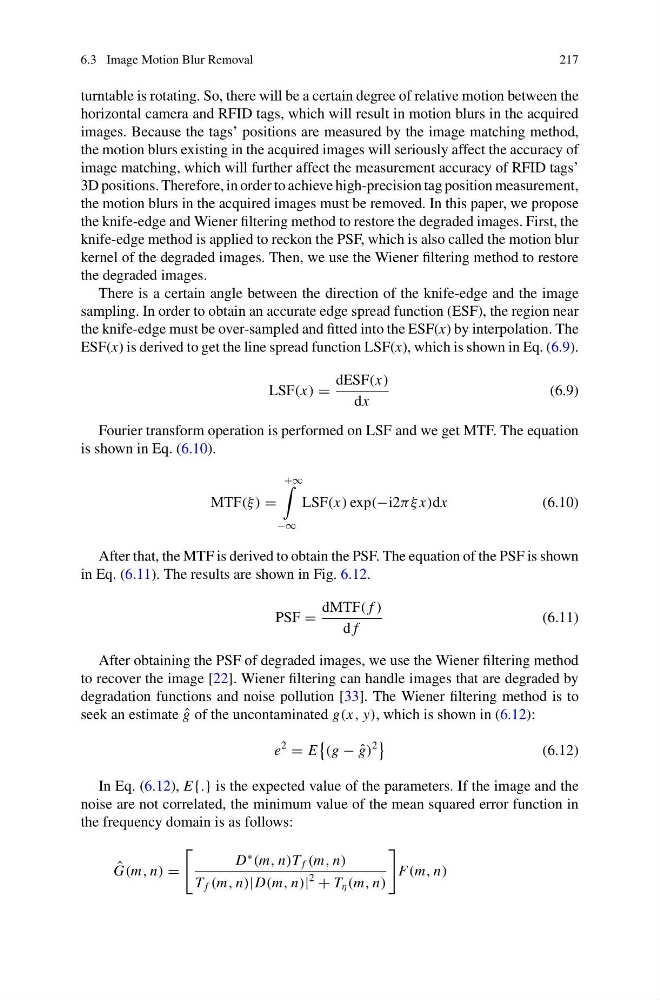
In Eq. (6.12), E{.} is the expected value of the parameters. If the image and the
noise are not correlated, the minimum value of the mean squared error function in
the frequency domain is as follows:
ˆ
G(m, n) =
D
∗
(m, n)T f (m, n)
T f (m, n)|D(m, n)|
2
+ T η (m, n)
F(m, n)
217
turntable is rotating. So, there will be a certain degree of relative motion between the
horizontal camera and RFID tags, which will result in motion blurs in the acquired
images. Because the tags’ positions are measured by the image matching method,
the motion blurs existing in the acquired images will seriously affect the accuracy of
image matching, which will further affect the measurement accuracy of RFID tags’
3D positions. Therefore, in order to achieve high-precision tag position measurement,
the motion blurs in the acquired images must be removed. In this paper, we propose
the knife-edge and Wiener filtering method to restore the degraded images. First, the
knife-edge method is applied to reckon the PSF, which is also called the motion blur
kernel of the degraded images. Then, we use the Wiener filtering method to restore
the degraded images.
There is a certain angle between the direction of the knife-edge and the image
sampling. In order to obtain an accurate edge spread function (ESF), the region near
the knife-edge must be over-sampled and fitted into the ESF(x) by interpolation. The
ESF(x) is derived to get the line spread function LSF(x), which is shown in Eq. (6.9).
LSF(x) =
dESF(x)
dx
(6.9)
Fourier transform operation is performed on LSF and we get MTF. The equation
is shown in Eq. (6.10).
MTF(ξ ) =
+∞
−∞
LSF(x) exp(−i2πξ x)dx
(6.10)
After that, the MTF is derived to obtain the PSF. The equation of the PSF is shown
in Eq. (6.11). The results are shown in Fig. 6.12.
PSF =
dMTF( f )
d f
(6.11)
After obtaining the PSF of degraded images, we use the Wiener filtering method
to recover the image [22]. Wiener filtering can handle images that are degraded by
degradation functions and noise pollution [33]. The Wiener filtering method is to
seek an estimate ˆ
g of the uncontaminated g(x, y), which is shown in (6.12):
e
2
= E
(g − ˆ
g)
2
(6.12)
In Eq. (6.12), E{.} is the expected value of the parameters. If the image and the
noise are not correlated, the minimum value of the mean squared error function in
the frequency domain is as follows:
ˆ
G(m, n) =
D
∗
(m, n)T f (m, n)
T f (m, n)|D(m, n)|
2
+ T η (m, n)
F(m, n)