

208
6 Deep Learning and RFID System Physical Anti-Collision
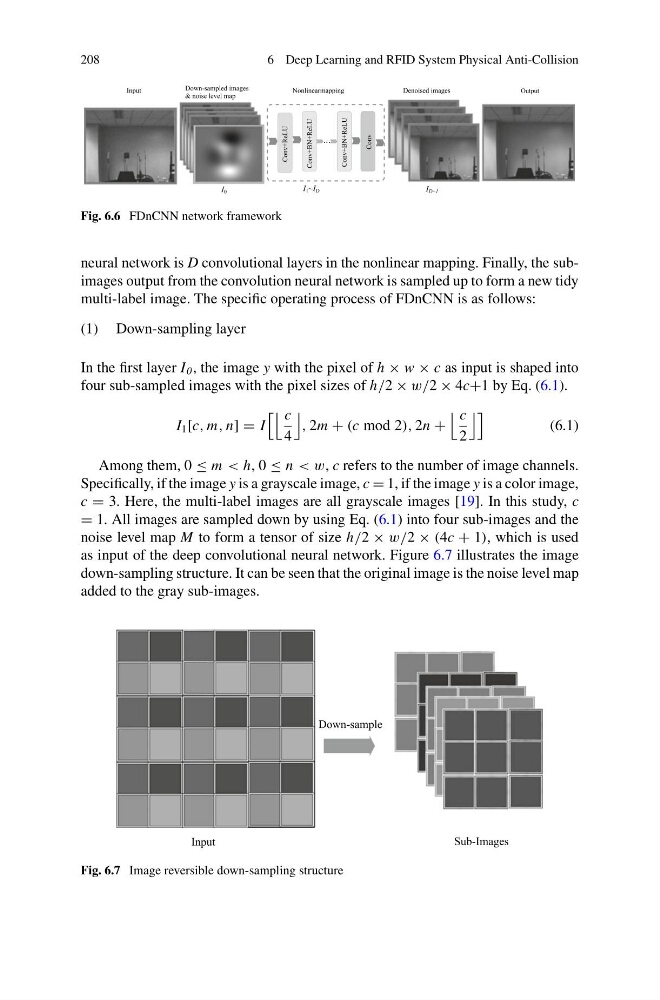
Fig. 6.6 FDnCNN network framework
neural network is D convolutional layers in the nonlinear mapping. Finally, the subimages output from the convolution neural network is sampled up to form a new tidy
multi-label image. The specific operating process of FDnCNN is as follows:
(1) Down-sampling layer
In the first layer I 0 , the image y with the pixel of h × w × c as input is shaped into
four sub-sampled images with the pixel sizes of h/2 × w/2 × 4c+1 by Eq. (6.1).
I 1 [c, m, n] = I
c
4
, 2m + (c mod 2), 2n +
c
2
(6.1)
Among them, 0 ≤ m < h, 0 ≤ n < w, c refers to the number of image channels.
Specifically, if the image y is a grayscale image, c = 1, if the image y is a color image,
c = 3. Here, the multi-label images are all grayscale images [19]. In this study, c
= 1. All images are sampled down by using Eq. (6.1) into four sub-images and the
noise level map M to form a tensor of size h/2 × w/2 × (4c + 1), which is used
as input of the deep convolutional neural network. Figure 6.7 illustrates the image
down-sampling structure. It can be seen that the original image is the noise level map
added to the gray sub-images.
Fig. 6.7 Image reversible down-sampling structure
6 Deep Learning and RFID System Physical Anti-Collision
Fig. 6.6 FDnCNN network framework
neural network is D convolutional layers in the nonlinear mapping. Finally, the subimages output from the convolution neural network is sampled up to form a new tidy
multi-label image. The specific operating process of FDnCNN is as follows:
(1) Down-sampling layer
In the first layer I 0 , the image y with the pixel of h × w × c as input is shaped into
four sub-sampled images with the pixel sizes of h/2 × w/2 × 4c+1 by Eq. (6.1).
I 1 [c, m, n] = I
c
4
, 2m + (c mod 2), 2n +
c
2
(6.1)
Among them, 0 ≤ m < h, 0 ≤ n < w, c refers to the number of image channels.
Specifically, if the image y is a grayscale image, c = 1, if the image y is a color image,
c = 3. Here, the multi-label images are all grayscale images [19]. In this study, c
= 1. All images are sampled down by using Eq. (6.1) into four sub-images and the
noise level map M to form a tensor of size h/2 × w/2 × (4c + 1), which is used
as input of the deep convolutional neural network. Figure 6.7 illustrates the image
down-sampling structure. It can be seen that the original image is the noise level map
added to the gray sub-images.
Fig. 6.7 Image reversible down-sampling structure