

6.2 The Theory RFID Multi-tag Image Denoising by FDnCNN
207
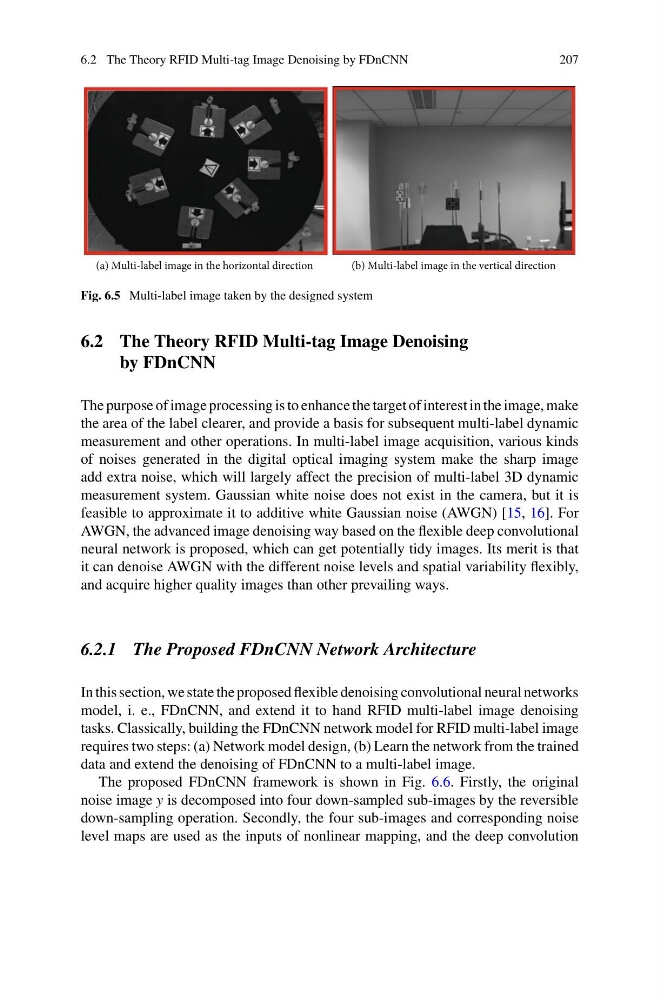
(a) Multi-label image in the horizontal direction
(b) Multi-label image in the vertical direction
Fig. 6.5 Multi-label image taken by the designed system
6.2 The Theory RFID Multi-tag Image Denoising
by FDnCNN
The purpose of image processing is to enhance the target of interest in the image, make
the area of the label clearer, and provide a basis for subsequent multi-label dynamic
measurement and other operations. In multi-label image acquisition, various kinds
of noises generated in the digital optical imaging system make the sharp image
add extra noise, which will largely affect the precision of multi-label 3D dynamic
measurement system. Gaussian white noise does not exist in the camera, but it is
feasible to approximate it to additive white Gaussian noise (AWGN) [15, 16]. For
AWGN, the advanced image denoising way based on the flexible deep convolutional
neural network is proposed, which can get potentially tidy images. Its merit is that
it can denoise AWGN with the different noise levels and spatial variability flexibly,
and acquire higher quality images than other prevailing ways.
6.2.1 The Proposed FDnCNN Network Architecture
In this section, we state the proposed flexible denoising convolutional neural networks
model, i. e., FDnCNN, and extend it to hand RFID multi-label image denoising
tasks. Classically, building the FDnCNN network model for RFID multi-label image
requires two steps: (a) Network model design, (b) Learn the network from the trained
data and extend the denoising of FDnCNN to a multi-label image.
The proposed FDnCNN framework is shown in Fig. 6.6. Firstly, the original
noise image y is decomposed into four down-sampled sub-images by the reversible
down-sampling operation. Secondly, the four sub-images and corresponding noise
level maps are used as the inputs of nonlinear mapping, and the deep convolution
207
(a) Multi-label image in the horizontal direction
(b) Multi-label image in the vertical direction
Fig. 6.5 Multi-label image taken by the designed system
6.2 The Theory RFID Multi-tag Image Denoising
by FDnCNN
The purpose of image processing is to enhance the target of interest in the image, make
the area of the label clearer, and provide a basis for subsequent multi-label dynamic
measurement and other operations. In multi-label image acquisition, various kinds
of noises generated in the digital optical imaging system make the sharp image
add extra noise, which will largely affect the precision of multi-label 3D dynamic
measurement system. Gaussian white noise does not exist in the camera, but it is
feasible to approximate it to additive white Gaussian noise (AWGN) [15, 16]. For
AWGN, the advanced image denoising way based on the flexible deep convolutional
neural network is proposed, which can get potentially tidy images. Its merit is that
it can denoise AWGN with the different noise levels and spatial variability flexibly,
and acquire higher quality images than other prevailing ways.
6.2.1 The Proposed FDnCNN Network Architecture
In this section, we state the proposed flexible denoising convolutional neural networks
model, i. e., FDnCNN, and extend it to hand RFID multi-label image denoising
tasks. Classically, building the FDnCNN network model for RFID multi-label image
requires two steps: (a) Network model design, (b) Learn the network from the trained
data and extend the denoising of FDnCNN to a multi-label image.
The proposed FDnCNN framework is shown in Fig. 6.6. Firstly, the original
noise image y is decomposed into four down-sampled sub-images by the reversible
down-sampling operation. Secondly, the four sub-images and corresponding noise
level maps are used as the inputs of nonlinear mapping, and the deep convolution