

134
4 Image Theory of RFID System Physical Anti-Collision
It can be found from the analysis of the above formula that it belongs to a
scalar function, and the value is always positive. Since this formula will appear
frequently in the following text, it will be referred to as the gradient module in
the subsequent discussion.
(3) Edge detection based on the Canny algorithm
Canny edge detection was proposed by John Canny in 1986. This detection method
can extract valuable structural information from the image. Since the extracted information is less, it can greatly reduce the processing amount. At present, there are many
visual systems. The method is applied. Canny found that the requirements for edge
detection are similar on different vision systems. Therefore, an edge detection technology with broad application significance can be realized. The general standards
for edge detection methods are:
(1) Maintain a low error rate in the process of detecting edges, which means that
you need to find the edges in the image as accurately as possible.
(2) The center of the edge needs to be accurately determined by detection.
(3) The number of times of marking an edge can only be 1 to reduce the interference
of noise on detection as much as possible and to avoid false edges. To meet
these requirements, Canny used a variational method. The optimal function in
the Canny detector is described by the sum of four exponential terms, which
can be approximated by the first derivative of the Gaussian function. Among
the edge detection methods, the most rigorously defined method is the Canny
method, which can detect the edges in the image stably and reliably. Because
this method is not complicated and meets three standards, it has become the
edge in recent years and one of the preferred methods in the detection process.
The gradient of the Canny edge detection operator is calculated using the derivative
of the Gaussian filter, and the edge appears at the local maximum of the gradient.
The steps of the Canny algorithm are as follows:
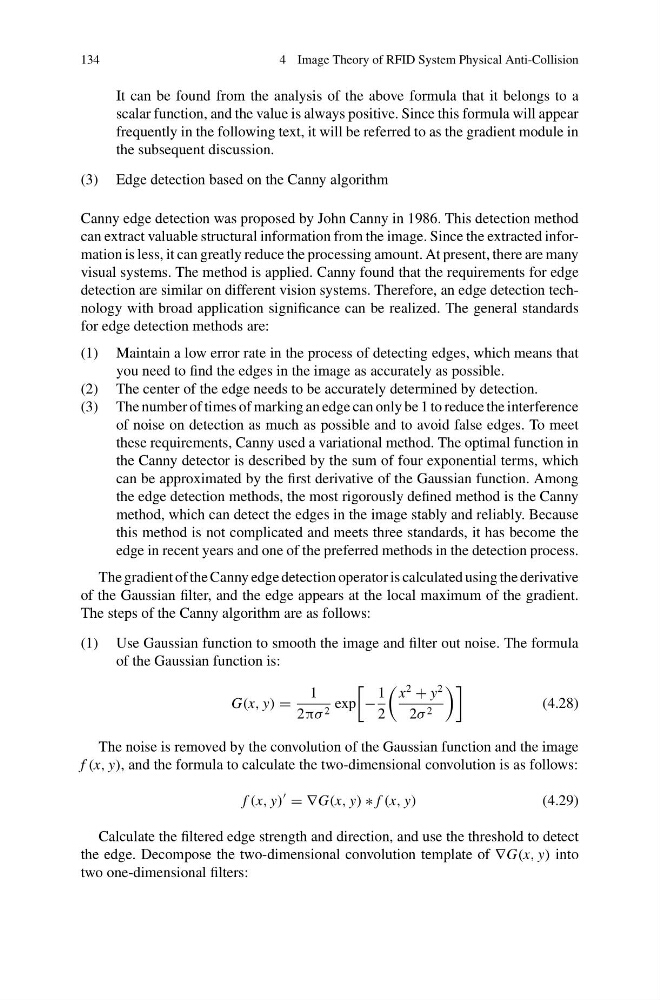
(1) Use Gaussian function to smooth the image and filter out noise. The formula
of the Gaussian function is:
G(x, y) =
1
2πσ 2 exp
−
1
2
x
2
+ y
2
2σ 2
(4.28)
The noise is removed by the convolution of the Gaussian function and the image
f (x, y), and the formula to calculate the two-dimensional convolution is as follows:
f (x, y)
= ∇G(x, y) ∗ f (x, y)
(4.29)
Calculate the filtered edge strength and direction, and use the threshold to detect
the edge. Decompose the two-dimensional convolution template of ∇G(x, y) into
two one-dimensional filters:
4 Image Theory of RFID System Physical Anti-Collision
It can be found from the analysis of the above formula that it belongs to a
scalar function, and the value is always positive. Since this formula will appear
frequently in the following text, it will be referred to as the gradient module in
the subsequent discussion.
(3) Edge detection based on the Canny algorithm
Canny edge detection was proposed by John Canny in 1986. This detection method
can extract valuable structural information from the image. Since the extracted information is less, it can greatly reduce the processing amount. At present, there are many
visual systems. The method is applied. Canny found that the requirements for edge
detection are similar on different vision systems. Therefore, an edge detection technology with broad application significance can be realized. The general standards
for edge detection methods are:
(1) Maintain a low error rate in the process of detecting edges, which means that
you need to find the edges in the image as accurately as possible.
(2) The center of the edge needs to be accurately determined by detection.
(3) The number of times of marking an edge can only be 1 to reduce the interference
of noise on detection as much as possible and to avoid false edges. To meet
these requirements, Canny used a variational method. The optimal function in
the Canny detector is described by the sum of four exponential terms, which
can be approximated by the first derivative of the Gaussian function. Among
the edge detection methods, the most rigorously defined method is the Canny
method, which can detect the edges in the image stably and reliably. Because
this method is not complicated and meets three standards, it has become the
edge in recent years and one of the preferred methods in the detection process.
The gradient of the Canny edge detection operator is calculated using the derivative
of the Gaussian filter, and the edge appears at the local maximum of the gradient.
The steps of the Canny algorithm are as follows:
(1) Use Gaussian function to smooth the image and filter out noise. The formula
of the Gaussian function is:
G(x, y) =
1
2πσ 2 exp
−
1
2
x
2
+ y
2
2σ 2
(4.28)
The noise is removed by the convolution of the Gaussian function and the image
f (x, y), and the formula to calculate the two-dimensional convolution is as follows:
f (x, y)
= ∇G(x, y) ∗ f (x, y)
(4.29)
Calculate the filtered edge strength and direction, and use the threshold to detect
the edge. Decompose the two-dimensional convolution template of ∇G(x, y) into
two one-dimensional filters: