

4.3 RFID Tag Positioning Method
133
segmenting images. The image features of the edges appear as partially discontinuous grayscale, that is, the most obvious changes in brightness. Generally speaking,
the edge has a gentle grayscale change, and the grayscale on both sides has a more
obvious change.
(2) Gradient
The step caused by the change in gray level can be described by the gradient in the
mathematical field.
The edges of objects are caused by discontinuous changes in grayscale. The classic
edge extraction method is called the local operator method. This method selects a
certain range and examines the gray levels of all pixels in the range to determine the
gray change rule. This method is relatively simple.
If there is a certain pixel in the image boundary, then the field of this pixel is also
called a certain gray level change band. The magnitude and direction of the gray
change rate on the gradient vector are the most effective features for this change.
The edge detection operator needs to check all pixel fields, describe the gray
change rate in a quantitative way, and determine the direction of change. The method
used mainly needs to be convolution based on the direction derivative by modulus.
In the process of processing images, if you choose the integration method, you
can’t get a clear edge, but it has the opposite effect on differentiation. Therefore,
differentiation is often used in the process of edge detection. Among the various
differential processing methods, the most widely used is the gradient method. The
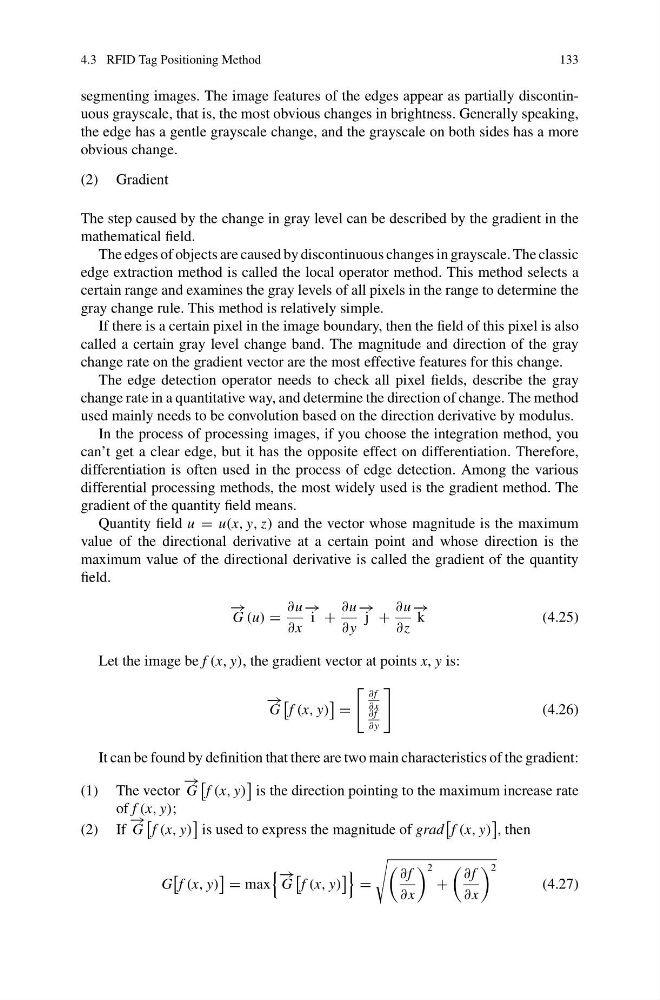
gradient of the quantity field means.
Quantity field u = u(x, y, z) and the vector whose magnitude is the maximum
value of the directional derivative at a certain point and whose direction is the
maximum value of the directional derivative is called the gradient of the quantity
field.
− →
G (u) =
∂u
∂x
− →
i +
∂u
∂y
− →
j +
∂u
∂z
− →
k
(4.25)
Let the image be f (x, y), the gradient vector at points x, y is:
− →
G
f (x, y)
=
∂f
∂x
∂f
∂y
(4.26)
It can be found by definition that there are two main characteristics of the gradient:
(1) The vector
− →
G
f (x, y)
is the direction pointing to the maximum increase rate
of f (x, y);
(2) If
− →
G
f (x, y)
is used to express the magnitude of grad
f (x, y)
, then
G
f (x, y)
= max
− →
G
f (x, y)
=
∂f
∂x
2
+
∂f
∂x
2
(4.27)
133
segmenting images. The image features of the edges appear as partially discontinuous grayscale, that is, the most obvious changes in brightness. Generally speaking,
the edge has a gentle grayscale change, and the grayscale on both sides has a more
obvious change.
(2) Gradient
The step caused by the change in gray level can be described by the gradient in the
mathematical field.
The edges of objects are caused by discontinuous changes in grayscale. The classic
edge extraction method is called the local operator method. This method selects a
certain range and examines the gray levels of all pixels in the range to determine the
gray change rule. This method is relatively simple.
If there is a certain pixel in the image boundary, then the field of this pixel is also
called a certain gray level change band. The magnitude and direction of the gray
change rate on the gradient vector are the most effective features for this change.
The edge detection operator needs to check all pixel fields, describe the gray
change rate in a quantitative way, and determine the direction of change. The method
used mainly needs to be convolution based on the direction derivative by modulus.
In the process of processing images, if you choose the integration method, you
can’t get a clear edge, but it has the opposite effect on differentiation. Therefore,
differentiation is often used in the process of edge detection. Among the various
differential processing methods, the most widely used is the gradient method. The
gradient of the quantity field means.
Quantity field u = u(x, y, z) and the vector whose magnitude is the maximum
value of the directional derivative at a certain point and whose direction is the
maximum value of the directional derivative is called the gradient of the quantity
field.
− →
G (u) =
∂u
∂x
− →
i +
∂u
∂y
− →
j +
∂u
∂z
− →
k
(4.25)
Let the image be f (x, y), the gradient vector at points x, y is:
− →
G
f (x, y)
=
∂f
∂x
∂f
∂y
(4.26)
It can be found by definition that there are two main characteristics of the gradient:
(1) The vector
− →
G
f (x, y)
is the direction pointing to the maximum increase rate
of f (x, y);
(2) If
− →
G
f (x, y)
is used to express the magnitude of grad
f (x, y)
, then
G
f (x, y)
= max
− →
G
f (x, y)
=
∂f
∂x
2
+
∂f
∂x
2
(4.27)