

124
4 Image Theory of RFID System Physical Anti-Collision
y j =
S Nj
S D
, j = 1, 2, . . . , k
(4.18)
To determine the error, the actual output on the output layer is compared with the
desired output. Based on this error value, the weight matrix between the input and
output layers will be updated. Continue to use SUMFC of blurred images as input
to the network.
(2) Generalized regression neural network theory
Unlike traditional networks, the learning algorithm of the generalized regression
neural network does not adjust the connection weights between neurons during
training, but changes the smoothing parameters, thereby adjusting the transfer function of each unit in the model layer to obtain the best regression estimation result.
The generalized regression neural network’s f (x, y) theoretical basis is nonlinear
regression analysis. The regression analysis of the independent variable Y relative to
the independent variable x is actually to calculate y with the largest probability value.
Suppose the joint probability density function of a random variable x and random
variable y is f (x, y). If the observed value of x is X, then the regression of y relative
to X is the conditional mean:
ˆ
Y = E(y/X ) =
∞
−∞ yf (X , y)dy
∞
−∞ f (X , y)dy
(4.19)
ˆ
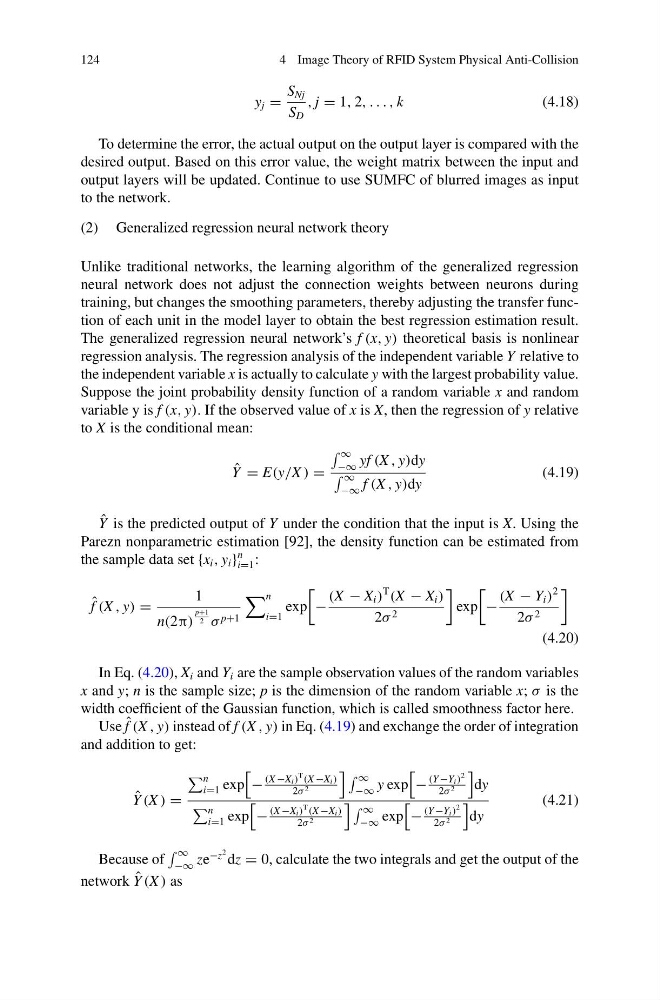
Y is the predicted output of Y under the condition that the input is X. Using the
Parezn nonparametric estimation [92], the density function can be estimated from
the sample data set {x i , y i }
n
i=1 :
ˆ
f (X , y) =
1
n(2π)
p+1
2 σ p+1
n
i=1
exp
−
(X − X i )
T
(X − X i )
2σ 2
exp
−
(X − Y i )
2
2σ 2
(4.20)
In Eq. (4.20), X i and Y i are the sample observation values of the random variables
x and y; n is the sample size; p is the dimension of the random variable x; σ is the
width coefficient of the Gaussian function, which is called smoothness factor here.
Use ˆ
f (X , y) instead of f (X , y) in Eq. (4.19) and exchange the order of integration
and addition to get:
ˆ
Y (X ) =
n
i=1 exp
−
(X −X i )
T (X −X i )
2σ 2
∞
−∞ y exp
−
(Y −Y i )
2
2σ 2
dy
n
i=1 exp
−
(X −X i )
T (X −X i )
2σ 2
∞
−∞ exp
−
(Y −Y i )
2
2σ 2
dy
(4.21)
Because of
∞
−∞ ze
−z
2 dz = 0, calculate the two integrals and get the output of the
network ˆ
Y (X ) as
4 Image Theory of RFID System Physical Anti-Collision
y j =
S Nj
S D
, j = 1, 2, . . . , k
(4.18)
To determine the error, the actual output on the output layer is compared with the
desired output. Based on this error value, the weight matrix between the input and
output layers will be updated. Continue to use SUMFC of blurred images as input
to the network.
(2) Generalized regression neural network theory
Unlike traditional networks, the learning algorithm of the generalized regression
neural network does not adjust the connection weights between neurons during
training, but changes the smoothing parameters, thereby adjusting the transfer function of each unit in the model layer to obtain the best regression estimation result.
The generalized regression neural network’s f (x, y) theoretical basis is nonlinear
regression analysis. The regression analysis of the independent variable Y relative to
the independent variable x is actually to calculate y with the largest probability value.
Suppose the joint probability density function of a random variable x and random
variable y is f (x, y). If the observed value of x is X, then the regression of y relative
to X is the conditional mean:
ˆ
Y = E(y/X ) =
∞
−∞ yf (X , y)dy
∞
−∞ f (X , y)dy
(4.19)
ˆ
Y is the predicted output of Y under the condition that the input is X. Using the
Parezn nonparametric estimation [92], the density function can be estimated from
the sample data set {x i , y i }
n
i=1 :
ˆ
f (X , y) =
1
n(2π)
p+1
2 σ p+1
n
i=1
exp
−
(X − X i )
T
(X − X i )
2σ 2
exp
−
(X − Y i )
2
2σ 2
(4.20)
In Eq. (4.20), X i and Y i are the sample observation values of the random variables
x and y; n is the sample size; p is the dimension of the random variable x; σ is the
width coefficient of the Gaussian function, which is called smoothness factor here.
Use ˆ
f (X , y) instead of f (X , y) in Eq. (4.19) and exchange the order of integration
and addition to get:
ˆ
Y (X ) =
n
i=1 exp
−
(X −X i )
T (X −X i )
2σ 2
∞
−∞ y exp
−
(Y −Y i )
2
2σ 2
dy
n
i=1 exp
−
(X −X i )
T (X −X i )
2σ 2
∞
−∞ exp
−
(Y −Y i )
2
2σ 2
dy
(4.21)
Because of
∞
−∞ ze
−z
2 dz = 0, calculate the two integrals and get the output of the
network ˆ
Y (X ) as