

4.2 Image Processing in Multi-tag Movement
123
(2) Pattern layer
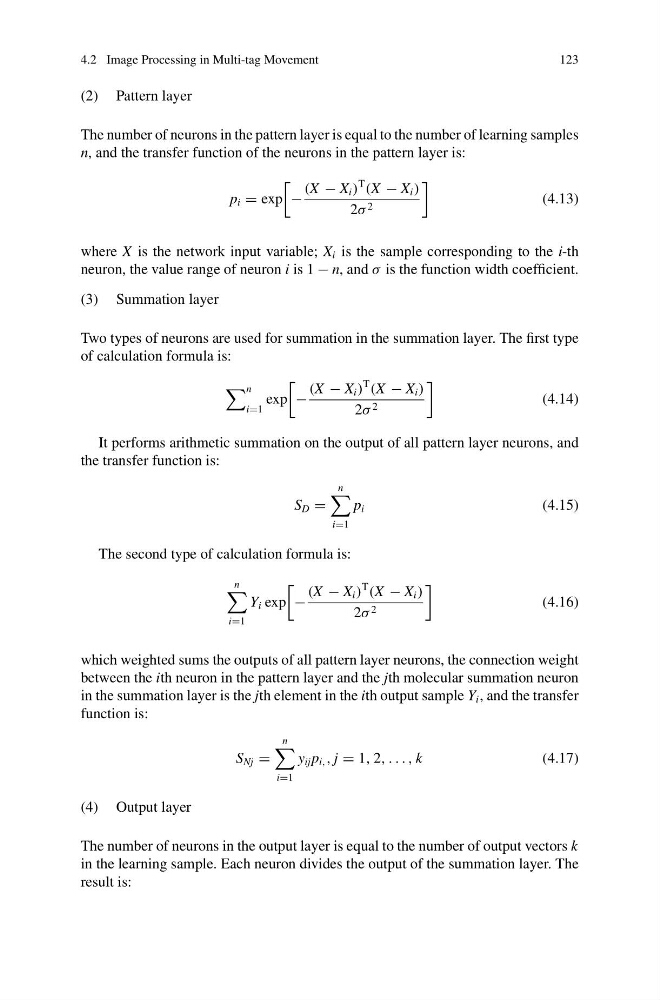
The number of neurons in the pattern layer is equal to the number of learning samples
n, and the transfer function of the neurons in the pattern layer is:
p i = exp
−
(X − X i )
T
(X − X i )
2σ 2
(4.13)
where X is the network input variable; X i is the sample corresponding to the i-th
neuron, the value range of neuron i is 1 − n, and σ is the function width coefficient.
(3) Summation layer
Two types of neurons are used for summation in the summation layer. The first type
of calculation formula is:
n
i=1
exp
−
(X − X i )
T
(X − X i )
2σ 2
(4.14)
It performs arithmetic summation on the output of all pattern layer neurons, and
the transfer function is:
S D =
n
i=1
p i
(4.15)
The second type of calculation formula is:
n
i=1
Y i exp
−
(X − X i )
T
(X − X i )
2σ 2
(4.16)
which weighted sums the outputs of all pattern layer neurons, the connection weight
between the ith neuron in the pattern layer and the jth molecular summation neuron
in the summation layer is the jth element in the ith output sample Y i , and the transfer
function is:
S Nj =
n
i=1
y ij p i, , j = 1, 2, . . . , k
(4.17)
(4) Output layer
The number of neurons in the output layer is equal to the number of output vectors k
in the learning sample. Each neuron divides the output of the summation layer. The
result is:
123
(2) Pattern layer
The number of neurons in the pattern layer is equal to the number of learning samples
n, and the transfer function of the neurons in the pattern layer is:
p i = exp
−
(X − X i )
T
(X − X i )
2σ 2
(4.13)
where X is the network input variable; X i is the sample corresponding to the i-th
neuron, the value range of neuron i is 1 − n, and σ is the function width coefficient.
(3) Summation layer
Two types of neurons are used for summation in the summation layer. The first type
of calculation formula is:
n
i=1
exp
−
(X − X i )
T
(X − X i )
2σ 2
(4.14)
It performs arithmetic summation on the output of all pattern layer neurons, and
the transfer function is:
S D =
n
i=1
p i
(4.15)
The second type of calculation formula is:
n
i=1
Y i exp
−
(X − X i )
T
(X − X i )
2σ 2
(4.16)
which weighted sums the outputs of all pattern layer neurons, the connection weight
between the ith neuron in the pattern layer and the jth molecular summation neuron
in the summation layer is the jth element in the ith output sample Y i , and the transfer
function is:
S Nj =
n
i=1
y ij p i, , j = 1, 2, . . . , k
(4.17)
(4) Output layer
The number of neurons in the output layer is equal to the number of output vectors k
in the learning sample. Each neuron divides the output of the summation layer. The
result is: