

122
4 Image Theory of RFID System Physical Anti-Collision
4.2.3 Estimation of Image Blurred Length Based
on Generalized Regression Neural Network (GRNN)
(1) Generalized regression neural network structure
The second parameter of motion blur is the blurred length. It describes how much
an object or camera has moved during the exposure time. In order to predict the
blurred length of a specific blurred image, the sum of Fourier coefficients (Sum
of the Magnitude of Fourier Coefficients, SUMFC) of the corresponding blurred
image can be used as its input. The Fourier feature of the image is one of the simplest
features in the frequency domain, and it is easy to determine using the FFT algorithm.
According to existing studies, there is a nonlinear relationship between SUMFC and
fuzzy length [91]. This nonlinear relationship can be estimated by GRNN, that is,
the generalized regression neural network is selected for estimation.
In the early 1990s, D. F. Specht first proposed the concept of generalized regression neural networks. GRNN is another variant of radial basis function. GRNN is
extremely robust and fault-tolerant, and it has a flexible network structure and strong
nonlinear reflection capabilities, so it can handle nonlinear problems well. Compared
with RBF, its learning speed and approximation ability are relatively stronger, and the
regression surface of GRNN convergence has a larger sample size. The generalized
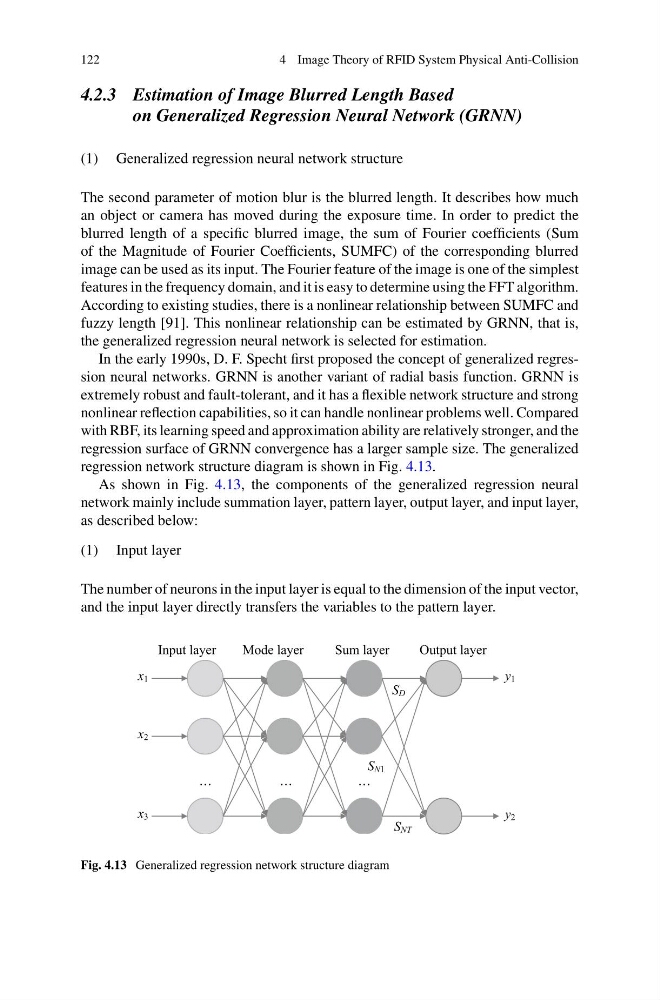
regression network structure diagram is shown in Fig. 4.13.
As shown in Fig. 4.13, the components of the generalized regression neural
network mainly include summation layer, pattern layer, output layer, and input layer,
as described below:
(1) Input layer
The number of neurons in the input layer is equal to the dimension of the input vector,
and the input layer directly transfers the variables to the pattern layer.
Fig. 4.13 Generalized regression network structure diagram
4 Image Theory of RFID System Physical Anti-Collision
4.2.3 Estimation of Image Blurred Length Based
on Generalized Regression Neural Network (GRNN)
(1) Generalized regression neural network structure
The second parameter of motion blur is the blurred length. It describes how much
an object or camera has moved during the exposure time. In order to predict the
blurred length of a specific blurred image, the sum of Fourier coefficients (Sum
of the Magnitude of Fourier Coefficients, SUMFC) of the corresponding blurred
image can be used as its input. The Fourier feature of the image is one of the simplest
features in the frequency domain, and it is easy to determine using the FFT algorithm.
According to existing studies, there is a nonlinear relationship between SUMFC and
fuzzy length [91]. This nonlinear relationship can be estimated by GRNN, that is,
the generalized regression neural network is selected for estimation.
In the early 1990s, D. F. Specht first proposed the concept of generalized regression neural networks. GRNN is another variant of radial basis function. GRNN is
extremely robust and fault-tolerant, and it has a flexible network structure and strong
nonlinear reflection capabilities, so it can handle nonlinear problems well. Compared
with RBF, its learning speed and approximation ability are relatively stronger, and the
regression surface of GRNN convergence has a larger sample size. The generalized
regression network structure diagram is shown in Fig. 4.13.
As shown in Fig. 4.13, the components of the generalized regression neural
network mainly include summation layer, pattern layer, output layer, and input layer,
as described below:
(1) Input layer
The number of neurons in the input layer is equal to the dimension of the input vector,
and the input layer directly transfers the variables to the pattern layer.
Fig. 4.13 Generalized regression network structure diagram