

3.2 Non-destructive Analysis Methods with Irradiation
65
By displaying βcosθ as a function of sinθ, the true grain size can be obtained from
the intercept. Since the graphs thus obtained are often very scattered, it is practical
to fit the entire diffractogram as a whole by including all effects related to the line
broadening simultaneously to all peaks. This method called convolutional multiple
whole profile (CMWP) fitting requires high-resolution devices for recording the
diffractograms that are not commonly available for routine tests.
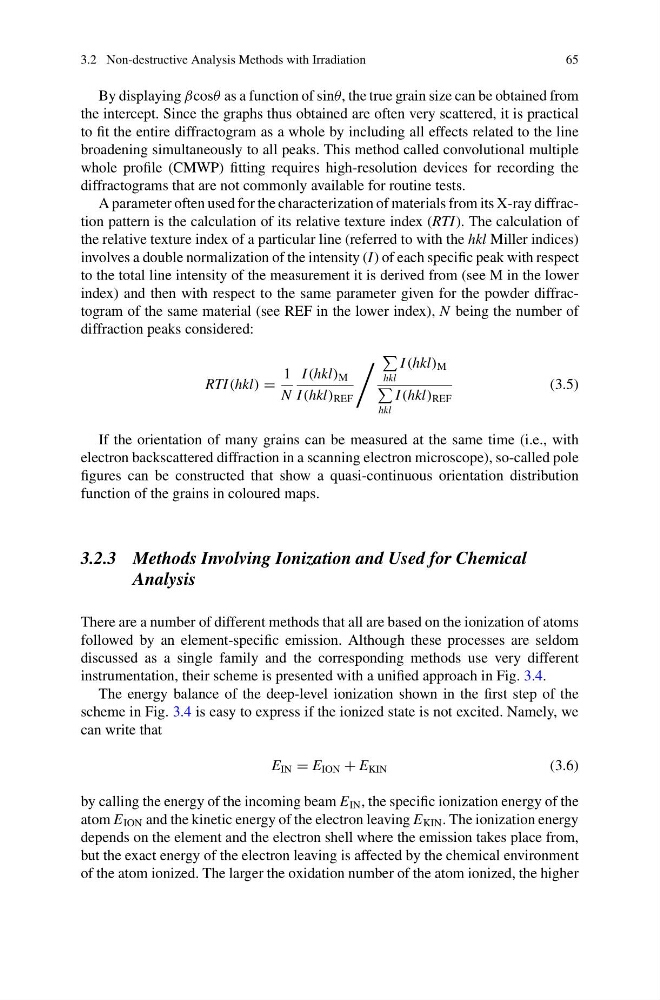
A parameter often used for the characterization of materials from its X-ray diffraction pattern is the calculation of its relative texture index (RTI). The calculation of
the relative texture index of a particular line (referred to with the hkl Miller indices)
involves a double normalization of the intensity (I) of each specific peak with respect
to the total line intensity of the measurement it is derived from (see M in the lower
index) and then with respect to the same parameter given for the powder diffractogram of the same material (see REF in the lower index), N being the number of
diffraction peaks considered:
RTI (hkl) =
1
N
I (hkl) M
I (hkl) REF
hkl
I (hkl) M
hkl
I (hkl) REF
(3.5)
If the orientation of many grains can be measured at the same time (i.e., with
electron backscattered diffraction in a scanning electron microscope), so-called pole
figures can be constructed that show a quasi-continuous orientation distribution
function of the grains in coloured maps.
3.2.3 Methods Involving Ionization and Used for Chemical
Analysis
There are a number of different methods that all are based on the ionization of atoms
followed by an element-specific emission. Although these processes are seldom
discussed as a single family and the corresponding methods use very different
instrumentation, their scheme is presented with a unified approach in Fig. 3.4.
The energy balance of the deep-level ionization shown in the first step of the
scheme in Fig. 3.4 is easy to express if the ionized state is not excited. Namely, we
can write that
E IN = E ION + E KIN
(3.6)
by calling the energy of the incoming beam E IN , the specific ionization energy of the
atom E ION and the kinetic energy of the electron leaving E KIN . The ionization energy
depends on the element and the electron shell where the emission takes place from,
but the exact energy of the electron leaving is affected by the chemical environment
of the atom ionized. The larger the oxidation number of the atom ionized, the higher
65
By displaying βcosθ as a function of sinθ, the true grain size can be obtained from
the intercept. Since the graphs thus obtained are often very scattered, it is practical
to fit the entire diffractogram as a whole by including all effects related to the line
broadening simultaneously to all peaks. This method called convolutional multiple
whole profile (CMWP) fitting requires high-resolution devices for recording the
diffractograms that are not commonly available for routine tests.
A parameter often used for the characterization of materials from its X-ray diffraction pattern is the calculation of its relative texture index (RTI). The calculation of
the relative texture index of a particular line (referred to with the hkl Miller indices)
involves a double normalization of the intensity (I) of each specific peak with respect
to the total line intensity of the measurement it is derived from (see M in the lower
index) and then with respect to the same parameter given for the powder diffractogram of the same material (see REF in the lower index), N being the number of
diffraction peaks considered:
RTI (hkl) =
1
N
I (hkl) M
I (hkl) REF
hkl
I (hkl) M
hkl
I (hkl) REF
(3.5)
If the orientation of many grains can be measured at the same time (i.e., with
electron backscattered diffraction in a scanning electron microscope), so-called pole
figures can be constructed that show a quasi-continuous orientation distribution
function of the grains in coloured maps.
3.2.3 Methods Involving Ionization and Used for Chemical
Analysis
There are a number of different methods that all are based on the ionization of atoms
followed by an element-specific emission. Although these processes are seldom
discussed as a single family and the corresponding methods use very different
instrumentation, their scheme is presented with a unified approach in Fig. 3.4.
The energy balance of the deep-level ionization shown in the first step of the
scheme in Fig. 3.4 is easy to express if the ionized state is not excited. Namely, we
can write that
E IN = E ION + E KIN
(3.6)
by calling the energy of the incoming beam E IN , the specific ionization energy of the
atom E ION and the kinetic energy of the electron leaving E KIN . The ionization energy
depends on the element and the electron shell where the emission takes place from,
but the exact energy of the electron leaving is affected by the chemical environment
of the atom ionized. The larger the oxidation number of the atom ionized, the higher