

62
3 Experimental Methods in Characterization of Nanosystems
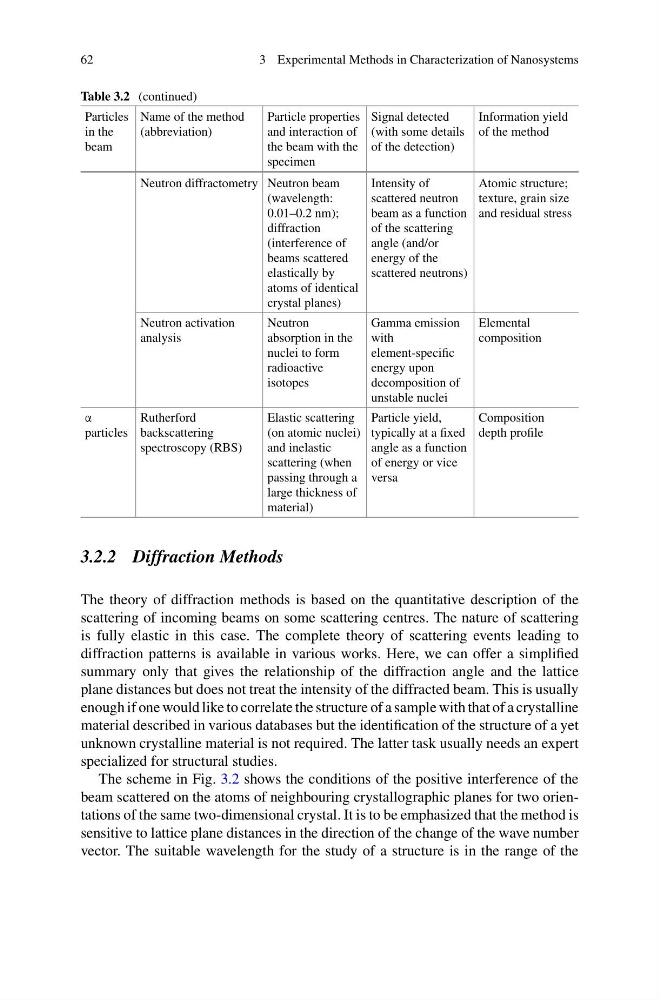
Table 3.2 (continued)
Particles
in the
beam
Name of the method
(abbreviation)
Particle properties
and interaction of
the beam with the
specimen
Signal detected
(with some details
of the detection)
Information yield
of the method
Neutron diffractometry Neutron beam
(wavelength:
0.01–0.2 nm);
diffraction
(interference of
beams scattered
elastically by
atoms of identical
crystal planes)
Intensity of
scattered neutron
beam as a function
of the scattering
angle (and/or
energy of the
scattered neutrons)
Atomic structure;
texture, grain size
and residual stress
Neutron activation
analysis
Neutron
absorption in the
nuclei to form
radioactive
isotopes
Gamma emission
with
element-specific
energy upon
decomposition of
unstable nuclei
Elemental
composition
α
particles
Rutherford
backscattering
spectroscopy (RBS)
Elastic scattering
(on atomic nuclei)
and inelastic
scattering (when
passing through a
large thickness of
material)
Particle yield,
typically at a fixed
angle as a function
of energy or vice
versa
Composition
depth profile
3.2.2 Diffraction Methods
The theory of diffraction methods is based on the quantitative description of the
scattering of incoming beams on some scattering centres. The nature of scattering
is fully elastic in this case. The complete theory of scattering events leading to
diffraction patterns is available in various works. Here, we can offer a simplified
summary only that gives the relationship of the diffraction angle and the lattice
plane distances but does not treat the intensity of the diffracted beam. This is usually
enough if one would like to correlate the structure of a sample with that of a crystalline
material described in various databases but the identification of the structure of a yet
unknown crystalline material is not required. The latter task usually needs an expert
specialized for structural studies.
The scheme in Fig. 3.2 shows the conditions of the positive interference of the
beam scattered on the atoms of neighbouring crystallographic planes for two orientations of the same two-dimensional crystal. It is to be emphasized that the method is
sensitive to lattice plane distances in the direction of the change of the wave number
vector. The suitable wavelength for the study of a structure is in the range of the
3 Experimental Methods in Characterization of Nanosystems
Table 3.2 (continued)
Particles
in the
beam
Name of the method
(abbreviation)
Particle properties
and interaction of
the beam with the
specimen
Signal detected
(with some details
of the detection)
Information yield
of the method
Neutron diffractometry Neutron beam
(wavelength:
0.01–0.2 nm);
diffraction
(interference of
beams scattered
elastically by
atoms of identical
crystal planes)
Intensity of
scattered neutron
beam as a function
of the scattering
angle (and/or
energy of the
scattered neutrons)
Atomic structure;
texture, grain size
and residual stress
Neutron activation
analysis
Neutron
absorption in the
nuclei to form
radioactive
isotopes
Gamma emission
with
element-specific
energy upon
decomposition of
unstable nuclei
Elemental
composition
α
particles
Rutherford
backscattering
spectroscopy (RBS)
Elastic scattering
(on atomic nuclei)
and inelastic
scattering (when
passing through a
large thickness of
material)
Particle yield,
typically at a fixed
angle as a function
of energy or vice
versa
Composition
depth profile
3.2.2 Diffraction Methods
The theory of diffraction methods is based on the quantitative description of the
scattering of incoming beams on some scattering centres. The nature of scattering
is fully elastic in this case. The complete theory of scattering events leading to
diffraction patterns is available in various works. Here, we can offer a simplified
summary only that gives the relationship of the diffraction angle and the lattice
plane distances but does not treat the intensity of the diffracted beam. This is usually
enough if one would like to correlate the structure of a sample with that of a crystalline
material described in various databases but the identification of the structure of a yet
unknown crystalline material is not required. The latter task usually needs an expert
specialized for structural studies.
The scheme in Fig. 3.2 shows the conditions of the positive interference of the
beam scattered on the atoms of neighbouring crystallographic planes for two orientations of the same two-dimensional crystal. It is to be emphasized that the method is
sensitive to lattice plane distances in the direction of the change of the wave number
vector. The suitable wavelength for the study of a structure is in the range of the