

3.2 Non-destructive Analysis Methods with Irradiation
57
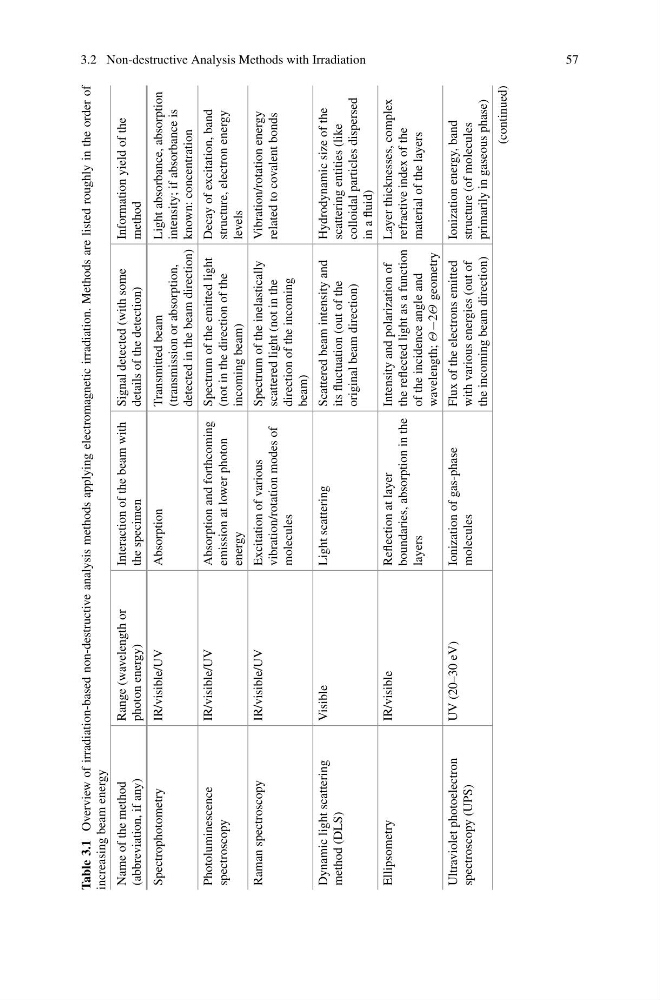
Table 3.1
Overview of irradiation-based non-destructive analysis methods applying electromagnetic irradiation. Methods are listed roughly in the order of
increasing beam energy
Name of the method
(abbreviation, if any)
Range (wavelength or
photon energy)
Interaction of the beam with
the specimen
Signal detected (with some
details of the detection)
Information yield of the
method
Spectrophotometry
IR/visible/UV
Absorption
Transmitted beam
(transmission or absorption,
detected in the beam direction)
Light absorbance, absorption
intensity; if absorbance is
known: concentration
Photoluminescence
spectroscopy
IR/visible/UV
Absorption and forthcoming
emission at lower photon
energy
Spectrum of the emitted light
(not in the direction of the
incoming beam)
Decay of excitation, band
structure, electron energy
levels
Raman spectroscopy
IR/visible/UV
Excitation of various
vibration/rotation modes of
molecules
Spectrum of the inelastically
scattered light (not in the
direction of the incoming
beam)
Vibration/rotation energy
related to covalent bonds
Dynamic light scattering
method (DLS)
Visible
Light scattering
Scattered beam intensity and
its fluctuation (out of the
original beam direction)
Hydrodynamic size of the
scattering entities (like
colloidal particles dispersed
in a fluid)
Ellipsometry
IR/visible
Reflection at layer
boundaries, absorption in the
layers
Intensity and polarization of
the reflected light as a function
of the incidence angle and
wavelength;
Θ−2Θ geometry
Layer thicknesses, complex
refractive index of the
material of the layers
Ultraviolet photoelectron
spectroscopy (UPS)
UV (20–30 eV)
Ionization of gas-phase
molecules
Flux of the electrons emitted
with various energies (out of
the incoming beam direction)
Ionization energy, band
structure (of molecules
primarily in gaseous phase)
(continued)
57
Table 3.1
Overview of irradiation-based non-destructive analysis methods applying electromagnetic irradiation. Methods are listed roughly in the order of
increasing beam energy
Name of the method
(abbreviation, if any)
Range (wavelength or
photon energy)
Interaction of the beam with
the specimen
Signal detected (with some
details of the detection)
Information yield of the
method
Spectrophotometry
IR/visible/UV
Absorption
Transmitted beam
(transmission or absorption,
detected in the beam direction)
Light absorbance, absorption
intensity; if absorbance is
known: concentration
Photoluminescence
spectroscopy
IR/visible/UV
Absorption and forthcoming
emission at lower photon
energy
Spectrum of the emitted light
(not in the direction of the
incoming beam)
Decay of excitation, band
structure, electron energy
levels
Raman spectroscopy
IR/visible/UV
Excitation of various
vibration/rotation modes of
molecules
Spectrum of the inelastically
scattered light (not in the
direction of the incoming
beam)
Vibration/rotation energy
related to covalent bonds
Dynamic light scattering
method (DLS)
Visible
Light scattering
Scattered beam intensity and
its fluctuation (out of the
original beam direction)
Hydrodynamic size of the
scattering entities (like
colloidal particles dispersed
in a fluid)
Ellipsometry
IR/visible
Reflection at layer
boundaries, absorption in the
layers
Intensity and polarization of
the reflected light as a function
of the incidence angle and
wavelength;
Θ−2Θ geometry
Layer thicknesses, complex
refractive index of the
material of the layers
Ultraviolet photoelectron
spectroscopy (UPS)
UV (20–30 eV)
Ionization of gas-phase
molecules
Flux of the electrons emitted
with various energies (out of
the incoming beam direction)
Ionization energy, band
structure (of molecules
primarily in gaseous phase)
(continued)