

2.9 Towards the Electrodeposition of Metals: Crystals and Their Surfaces
35
1
2
3
4
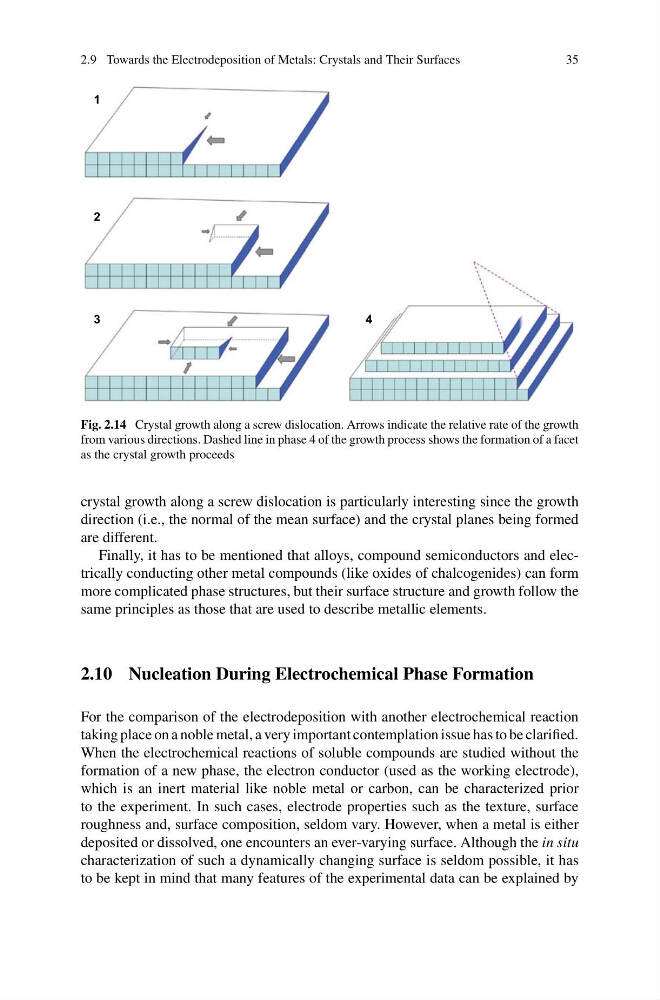
Fig. 2.14 Crystal growth along a screw dislocation. Arrows indicate the relative rate of the growth
from various directions. Dashed line in phase 4 of the growth process shows the formation of a facet
as the crystal growth proceeds
crystal growth along a screw dislocation is particularly interesting since the growth
direction (i.e., the normal of the mean surface) and the crystal planes being formed
are different.
Finally, it has to be mentioned that alloys, compound semiconductors and electrically conducting other metal compounds (like oxides of chalcogenides) can form
more complicated phase structures, but their surface structure and growth follow the
same principles as those that are used to describe metallic elements.
2.10 Nucleation During Electrochemical Phase Formation
For the comparison of the electrodeposition with another electrochemical reaction
taking place on a noble metal, a very important contemplation issue has to be clarified.
When the electrochemical reactions of soluble compounds are studied without the
formation of a new phase, the electron conductor (used as the working electrode),
which is an inert material like noble metal or carbon, can be characterized prior
to the experiment. In such cases, electrode properties such as the texture, surface
roughness and, surface composition, seldom vary. However, when a metal is either
deposited or dissolved, one encounters an ever-varying surface. Although the in situ
characterization of such a dynamically changing surface is seldom possible, it has
to be kept in mind that many features of the experimental data can be explained by
35
1
2
3
4
Fig. 2.14 Crystal growth along a screw dislocation. Arrows indicate the relative rate of the growth
from various directions. Dashed line in phase 4 of the growth process shows the formation of a facet
as the crystal growth proceeds
crystal growth along a screw dislocation is particularly interesting since the growth
direction (i.e., the normal of the mean surface) and the crystal planes being formed
are different.
Finally, it has to be mentioned that alloys, compound semiconductors and electrically conducting other metal compounds (like oxides of chalcogenides) can form
more complicated phase structures, but their surface structure and growth follow the
same principles as those that are used to describe metallic elements.
2.10 Nucleation During Electrochemical Phase Formation
For the comparison of the electrodeposition with another electrochemical reaction
taking place on a noble metal, a very important contemplation issue has to be clarified.
When the electrochemical reactions of soluble compounds are studied without the
formation of a new phase, the electron conductor (used as the working electrode),
which is an inert material like noble metal or carbon, can be characterized prior
to the experiment. In such cases, electrode properties such as the texture, surface
roughness and, surface composition, seldom vary. However, when a metal is either
deposited or dissolved, one encounters an ever-varying surface. Although the in situ
characterization of such a dynamically changing surface is seldom possible, it has
to be kept in mind that many features of the experimental data can be explained by