

34
2 Electrochemistry and Electrodeposition
The surface concentration of the various defect sites on a single-crystal surface in
equilibrium is simply determined by their energy of formation. It is to be emphasized
that the imperfections of the surface of a perfect crystal may move dynamically and
may not be imaged if the time scale of the imaging method used is higher than the
transformation time of the imperfection.
If the crystal itself is also imperfect, it can contain dislocations. The concentration
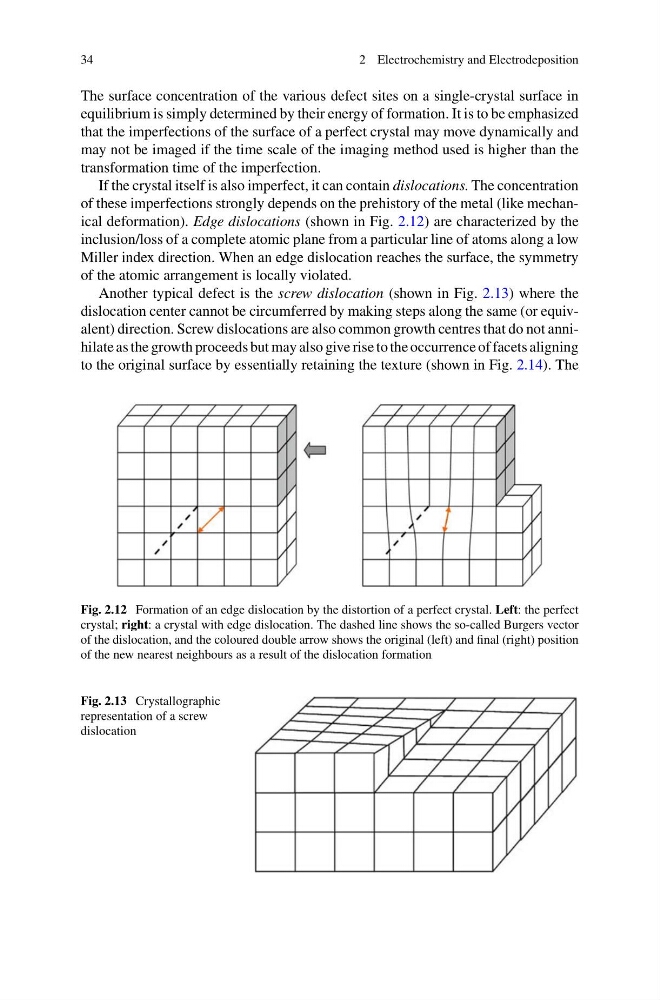
of these imperfections strongly depends on the prehistory of the metal (like mechanical deformation). Edge dislocations (shown in Fig. 2.12) are characterized by the
inclusion/loss of a complete atomic plane from a particular line of atoms along a low
Miller index direction. When an edge dislocation reaches the surface, the symmetry
of the atomic arrangement is locally violated.
Another typical defect is the screw dislocation (shown in Fig. 2.13) where the
dislocation center cannot be circumferred by making steps along the same (or equivalent) direction. Screw dislocations are also common growth centres that do not annihilate as the growth proceeds but may also give rise to the occurrence of facets aligning
to the original surface by essentially retaining the texture (shown in Fig. 2.14). The
Fig. 2.12 Formation of an edge dislocation by the distortion of a perfect crystal. Left: the perfect
crystal; right: a crystal with edge dislocation. The dashed line shows the so-called Burgers vector
of the dislocation, and the coloured double arrow shows the original (left) and final (right) position
of the new nearest neighbours as a result of the dislocation formation
Fig. 2.13 Crystallographic
representation of a screw
dislocation
2 Electrochemistry and Electrodeposition
The surface concentration of the various defect sites on a single-crystal surface in
equilibrium is simply determined by their energy of formation. It is to be emphasized
that the imperfections of the surface of a perfect crystal may move dynamically and
may not be imaged if the time scale of the imaging method used is higher than the
transformation time of the imperfection.
If the crystal itself is also imperfect, it can contain dislocations. The concentration
of these imperfections strongly depends on the prehistory of the metal (like mechanical deformation). Edge dislocations (shown in Fig. 2.12) are characterized by the
inclusion/loss of a complete atomic plane from a particular line of atoms along a low
Miller index direction. When an edge dislocation reaches the surface, the symmetry
of the atomic arrangement is locally violated.
Another typical defect is the screw dislocation (shown in Fig. 2.13) where the
dislocation center cannot be circumferred by making steps along the same (or equivalent) direction. Screw dislocations are also common growth centres that do not annihilate as the growth proceeds but may also give rise to the occurrence of facets aligning
to the original surface by essentially retaining the texture (shown in Fig. 2.14). The
Fig. 2.12 Formation of an edge dislocation by the distortion of a perfect crystal. Left: the perfect
crystal; right: a crystal with edge dislocation. The dashed line shows the so-called Burgers vector
of the dislocation, and the coloured double arrow shows the original (left) and final (right) position
of the new nearest neighbours as a result of the dislocation formation
Fig. 2.13 Crystallographic
representation of a screw
dislocation