

2.9 Towards the Electrodeposition of Metals: Crystals and Their Surfaces
33
2.9.2 Defects on Crystal Surfaces and Within Crystals
Perfect single-crystal surfaces are very difficult to prepare. A miscut of 0.5° means
that a step edge is formed at about every 115th atom; or, in other word, the width
of a terrace is 115 atomic layers along the surface. The atoms at the edge of the
terrace are identical in this case. Although the orientation of a slightly miscut layer
can also be expressed with the usual hkl Miller indices (like 0-1-115 in the above
example), this is never used since the overwhelming majority of the atoms at the
surface are in the same position and show the features of one particular low-index
plane. Such crystals can be used to study the behavior of a crystal plane with nearly
no compromise.
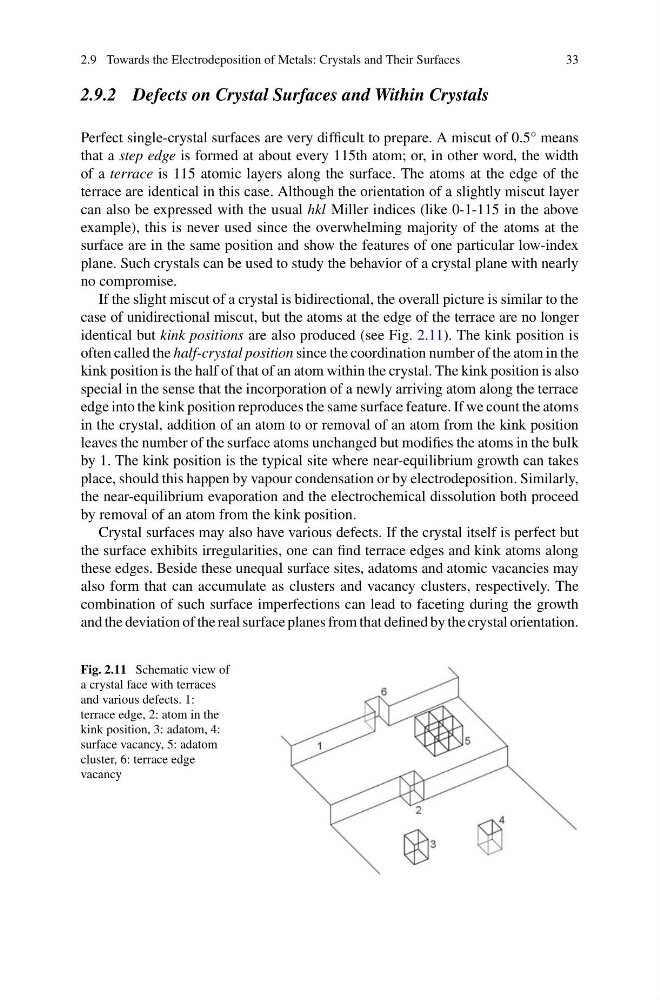
If the slight miscut of a crystal is bidirectional, the overall picture is similar to the
case of unidirectional miscut, but the atoms at the edge of the terrace are no longer
identical but kink positions are also produced (see Fig. 2.11). The kink position is
often called the half-crystal position since the coordination number of the atom in the
kink position is the half of that of an atom within the crystal. The kink position is also
special in the sense that the incorporation of a newly arriving atom along the terrace
edge into the kink position reproduces the same surface feature. If we count the atoms
in the crystal, addition of an atom to or removal of an atom from the kink position
leaves the number of the surface atoms unchanged but modifies the atoms in the bulk
by 1. The kink position is the typical site where near-equilibrium growth can takes
place, should this happen by vapour condensation or by electrodeposition. Similarly,
the near-equilibrium evaporation and the electrochemical dissolution both proceed
by removal of an atom from the kink position.
Crystal surfaces may also have various defects. If the crystal itself is perfect but
the surface exhibits irregularities, one can find terrace edges and kink atoms along
these edges. Beside these unequal surface sites, adatoms and atomic vacancies may
also form that can accumulate as clusters and vacancy clusters, respectively. The
combination of such surface imperfections can lead to faceting during the growth
and the deviation of the real surface planes from that defined by the crystal orientation.
Fig. 2.11 Schematic view of
a crystal face with terraces
and various defects. 1:
terrace edge, 2: atom in the
kink position, 3: adatom, 4:
surface vacancy, 5: adatom
cluster, 6: terrace edge
vacancy
33
2.9.2 Defects on Crystal Surfaces and Within Crystals
Perfect single-crystal surfaces are very difficult to prepare. A miscut of 0.5° means
that a step edge is formed at about every 115th atom; or, in other word, the width
of a terrace is 115 atomic layers along the surface. The atoms at the edge of the
terrace are identical in this case. Although the orientation of a slightly miscut layer
can also be expressed with the usual hkl Miller indices (like 0-1-115 in the above
example), this is never used since the overwhelming majority of the atoms at the
surface are in the same position and show the features of one particular low-index
plane. Such crystals can be used to study the behavior of a crystal plane with nearly
no compromise.
If the slight miscut of a crystal is bidirectional, the overall picture is similar to the
case of unidirectional miscut, but the atoms at the edge of the terrace are no longer
identical but kink positions are also produced (see Fig. 2.11). The kink position is
often called the half-crystal position since the coordination number of the atom in the
kink position is the half of that of an atom within the crystal. The kink position is also
special in the sense that the incorporation of a newly arriving atom along the terrace
edge into the kink position reproduces the same surface feature. If we count the atoms
in the crystal, addition of an atom to or removal of an atom from the kink position
leaves the number of the surface atoms unchanged but modifies the atoms in the bulk
by 1. The kink position is the typical site where near-equilibrium growth can takes
place, should this happen by vapour condensation or by electrodeposition. Similarly,
the near-equilibrium evaporation and the electrochemical dissolution both proceed
by removal of an atom from the kink position.
Crystal surfaces may also have various defects. If the crystal itself is perfect but
the surface exhibits irregularities, one can find terrace edges and kink atoms along
these edges. Beside these unequal surface sites, adatoms and atomic vacancies may
also form that can accumulate as clusters and vacancy clusters, respectively. The
combination of such surface imperfections can lead to faceting during the growth
and the deviation of the real surface planes from that defined by the crystal orientation.
Fig. 2.11 Schematic view of
a crystal face with terraces
and various defects. 1:
terrace edge, 2: atom in the
kink position, 3: adatom, 4:
surface vacancy, 5: adatom
cluster, 6: terrace edge
vacancy