

36
2 Electrochemistry and Electrodeposition
such variations. In the forthcoming chapters, an overview will be given concerning
structural and composition effects that accompany metal deposition and dissolution.
The nucleation of a phase always precedes its growth. In this chapter, two issues
will be dealt with: first, the general features of the nucleation of a deposit on a foreign
substrate at the atomic level; secondly, the evolution of the grain structure from the
substrate-dominated grain structure to the steady-state growth. The major trends in
steady-state electrocrystallization, especially in relation to their solution chemistry
and the current density, will be discussed in Sect. 2.11.
2.10.1 Nucleation and Growth Modes
When a foreign material is deposited onto a crystalline surface, two parameters
together play a crucial role in the determination of the nucleation mode. These parameters are: (i) the interaction strength of the deposit atoms to the substrate atoms, as
referred to the interaction strength between the atoms of the deposit in the bulk; and
(ii) the relationship of the nearest neighbour distances of the atoms of the contacting
phases. The latter is often summarized by a ratio called the relative misfit: d/d S
where d S is the nearest neighbour atomic distance in the bulk of the substrate and
d is the difference of the bulk nearest neighbour distances of the two contacting
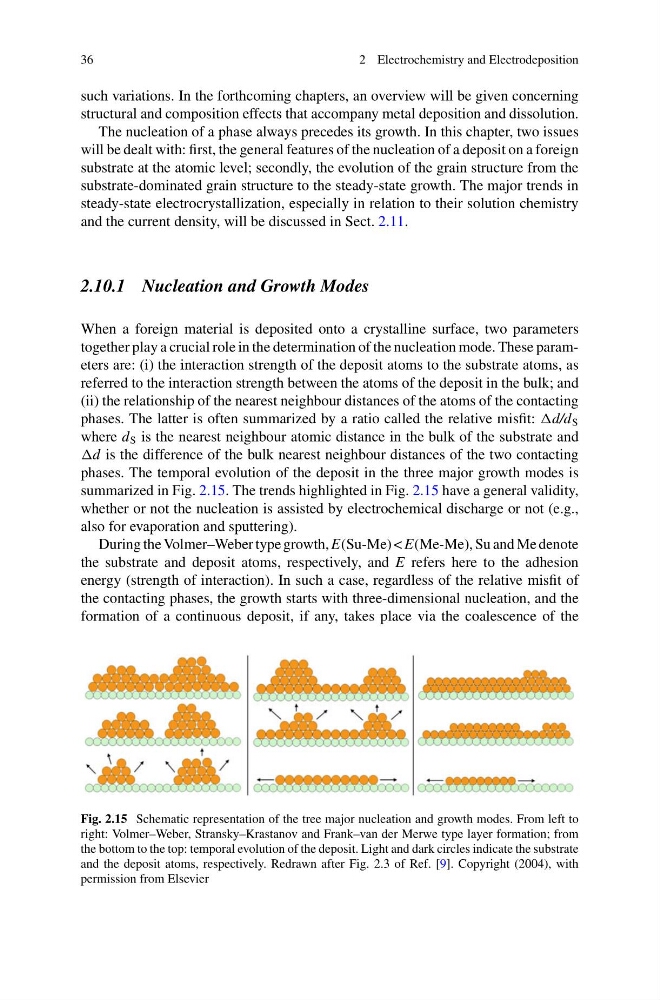
phases. The temporal evolution of the deposit in the three major growth modes is
summarized in Fig. 2.15. The trends highlighted in Fig. 2.15 have a general validity,
whether or not the nucleation is assisted by electrochemical discharge or not (e.g.,
also for evaporation and sputtering).
During the Volmer–Weber type growth, E(Su-Me) < E(Me-Me), Su and Me denote
the substrate and deposit atoms, respectively, and E refers here to the adhesion
energy (strength of interaction). In such a case, regardless of the relative misfit of
the contacting phases, the growth starts with three-dimensional nucleation, and the
formation of a continuous deposit, if any, takes place via the coalescence of the
Fig. 2.15 Schematic representation of the tree major nucleation and growth modes. From left to
right: Volmer–Weber, Stransky–Krastanov and Frank–van der Merwe type layer formation; from
the bottom to the top: temporal evolution of the deposit. Light and dark circles indicate the substrate
and the deposit atoms, respectively. Redrawn after Fig. 2.3 of Ref. [9]. Copyright (2004), with
permission from Elsevier
2 Electrochemistry and Electrodeposition
such variations. In the forthcoming chapters, an overview will be given concerning
structural and composition effects that accompany metal deposition and dissolution.
The nucleation of a phase always precedes its growth. In this chapter, two issues
will be dealt with: first, the general features of the nucleation of a deposit on a foreign
substrate at the atomic level; secondly, the evolution of the grain structure from the
substrate-dominated grain structure to the steady-state growth. The major trends in
steady-state electrocrystallization, especially in relation to their solution chemistry
and the current density, will be discussed in Sect. 2.11.
2.10.1 Nucleation and Growth Modes
When a foreign material is deposited onto a crystalline surface, two parameters
together play a crucial role in the determination of the nucleation mode. These parameters are: (i) the interaction strength of the deposit atoms to the substrate atoms, as
referred to the interaction strength between the atoms of the deposit in the bulk; and
(ii) the relationship of the nearest neighbour distances of the atoms of the contacting
phases. The latter is often summarized by a ratio called the relative misfit: d/d S
where d S is the nearest neighbour atomic distance in the bulk of the substrate and
d is the difference of the bulk nearest neighbour distances of the two contacting
phases. The temporal evolution of the deposit in the three major growth modes is
summarized in Fig. 2.15. The trends highlighted in Fig. 2.15 have a general validity,
whether or not the nucleation is assisted by electrochemical discharge or not (e.g.,
also for evaporation and sputtering).
During the Volmer–Weber type growth, E(Su-Me) < E(Me-Me), Su and Me denote
the substrate and deposit atoms, respectively, and E refers here to the adhesion
energy (strength of interaction). In such a case, regardless of the relative misfit of
the contacting phases, the growth starts with three-dimensional nucleation, and the
formation of a continuous deposit, if any, takes place via the coalescence of the
Fig. 2.15 Schematic representation of the tree major nucleation and growth modes. From left to
right: Volmer–Weber, Stransky–Krastanov and Frank–van der Merwe type layer formation; from
the bottom to the top: temporal evolution of the deposit. Light and dark circles indicate the substrate
and the deposit atoms, respectively. Redrawn after Fig. 2.3 of Ref. [9]. Copyright (2004), with
permission from Elsevier