

2.8 Basic Electrode Kinetics
31
the metal being deposited hinders the deposit formation at the equilibrium potential of the metal ion/metal system, and a significant anomalous hysteresis occurs
in the voltammogram. In contract to the low-concentration case analysed here, at
high metal ion concentration the cathodic current increases exponentially without a
limiting current, and the cathodic part of the voltammogram hence becomes nearly
featureless.
As the cathodic part of the cyclic voltammogram for a metal deposition is different
from the case discussed in connection with Fig. 2.8, there is a deviation in the anodic
part, too. For an actively dissolving metal, the dissolution starts with an exponential
increase in the current since the source of the reactant, i.e., the metal, is not limited
as long as the anion transport can compensate the appearance of the metal cations
in the vicinity of the electrode. However, when a thin metal deposit produced in the
earlier period of the same experiment is fully consumed, the anodic current drops
very suddenly, and the current peak exhibits the shape of the so-called stripping peak
(all graphs in Fig. 2.9). Further cases of the anodic behaviour of the metals and alloys
will be discussed in Sect. 2.13.
2.9 Towards the Electrodeposition of Metals: Crystals
and Their Surfaces
2.9.1 Basic Crystallography
Metal surfaces used in the common practice of electrodeposition are seldom perfect;
rather, technical work pieces are essentially always disordered because of the presence of crystals of different phases and also of different orientation. Nevertheless,
the elucidation of the deposition processes is based on the analysis of single-crystal
faces, both in the theoretical approach and in experiments. Metallic elements can
form face-centred cubic (fcc), hexagonal close-packed (hcp) and body-centred cubic
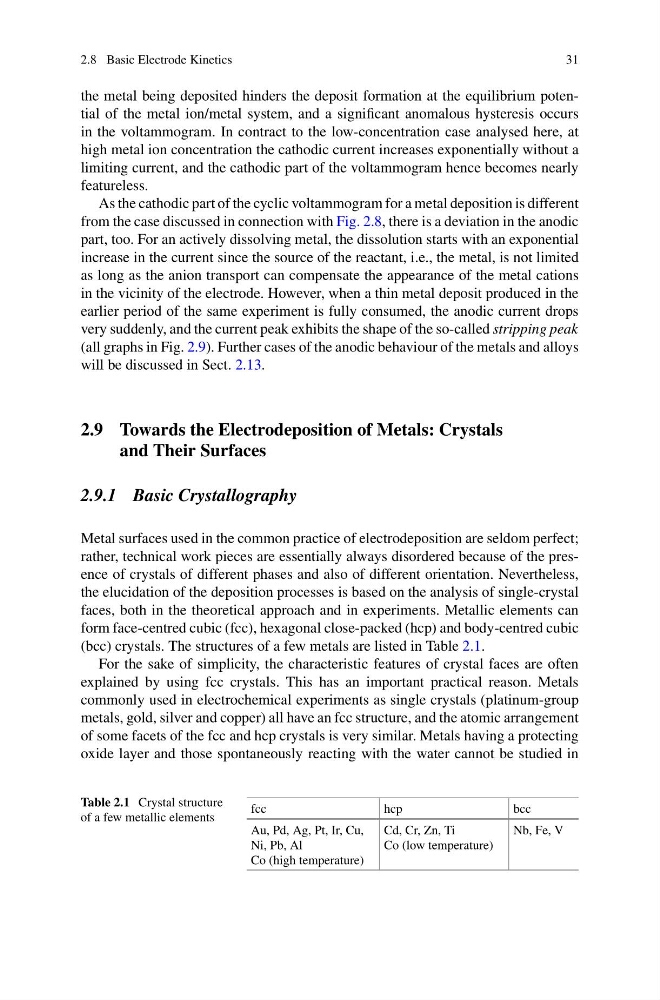
(bcc) crystals. The structures of a few metals are listed in Table 2.1.
For the sake of simplicity, the characteristic features of crystal faces are often
explained by using fcc crystals. This has an important practical reason. Metals
commonly used in electrochemical experiments as single crystals (platinum-group
metals, gold, silver and copper) all have an fcc structure, and the atomic arrangement
of some facets of the fcc and hcp crystals is very similar. Metals having a protecting
oxide layer and those spontaneously reacting with the water cannot be studied in
Table 2.1 Crystal structure
of a few metallic elements
fcc
hcp
bcc
Au, Pd, Ag, Pt, Ir, Cu,
Ni, Pb, Al
Co (high temperature)
Cd, Cr, Zn, Ti
Co (low temperature)
Nb, Fe, V
31
the metal being deposited hinders the deposit formation at the equilibrium potential of the metal ion/metal system, and a significant anomalous hysteresis occurs
in the voltammogram. In contract to the low-concentration case analysed here, at
high metal ion concentration the cathodic current increases exponentially without a
limiting current, and the cathodic part of the voltammogram hence becomes nearly
featureless.
As the cathodic part of the cyclic voltammogram for a metal deposition is different
from the case discussed in connection with Fig. 2.8, there is a deviation in the anodic
part, too. For an actively dissolving metal, the dissolution starts with an exponential
increase in the current since the source of the reactant, i.e., the metal, is not limited
as long as the anion transport can compensate the appearance of the metal cations
in the vicinity of the electrode. However, when a thin metal deposit produced in the
earlier period of the same experiment is fully consumed, the anodic current drops
very suddenly, and the current peak exhibits the shape of the so-called stripping peak
(all graphs in Fig. 2.9). Further cases of the anodic behaviour of the metals and alloys
will be discussed in Sect. 2.13.
2.9 Towards the Electrodeposition of Metals: Crystals
and Their Surfaces
2.9.1 Basic Crystallography
Metal surfaces used in the common practice of electrodeposition are seldom perfect;
rather, technical work pieces are essentially always disordered because of the presence of crystals of different phases and also of different orientation. Nevertheless,
the elucidation of the deposition processes is based on the analysis of single-crystal
faces, both in the theoretical approach and in experiments. Metallic elements can
form face-centred cubic (fcc), hexagonal close-packed (hcp) and body-centred cubic
(bcc) crystals. The structures of a few metals are listed in Table 2.1.
For the sake of simplicity, the characteristic features of crystal faces are often
explained by using fcc crystals. This has an important practical reason. Metals
commonly used in electrochemical experiments as single crystals (platinum-group
metals, gold, silver and copper) all have an fcc structure, and the atomic arrangement
of some facets of the fcc and hcp crystals is very similar. Metals having a protecting
oxide layer and those spontaneously reacting with the water cannot be studied in
Table 2.1 Crystal structure
of a few metallic elements
fcc
hcp
bcc
Au, Pd, Ag, Pt, Ir, Cu,
Ni, Pb, Al
Co (high temperature)
Cd, Cr, Zn, Ti
Co (low temperature)
Nb, Fe, V