

30
2 Electrochemistry and Electrodeposition
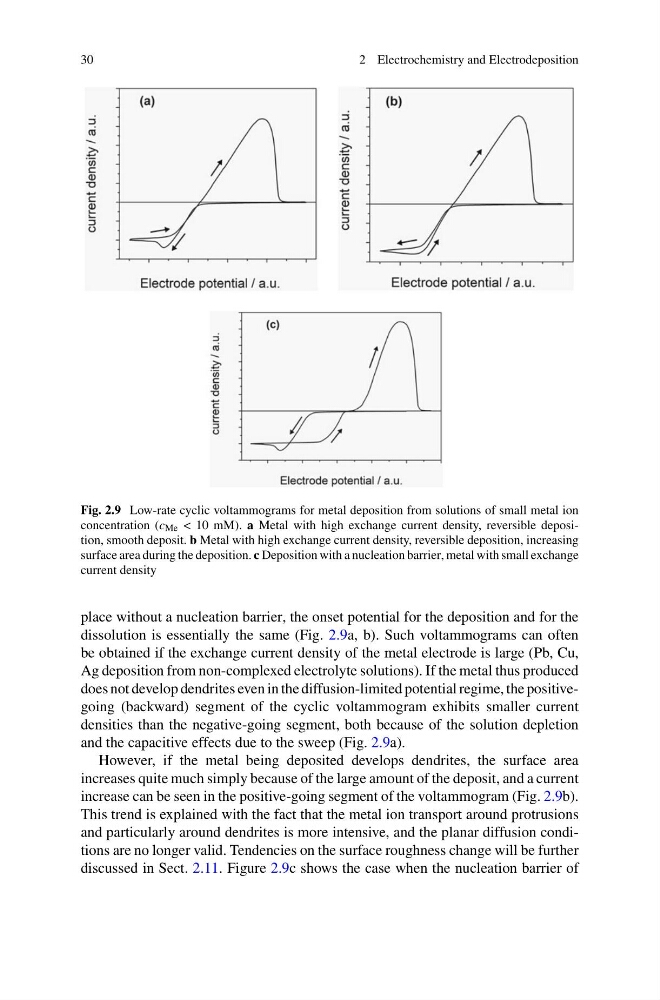
Fig. 2.9 Low-rate cyclic voltammograms for metal deposition from solutions of small metal ion
concentration (c Me < 10 mM). a Metal with high exchange current density, reversible deposition, smooth deposit. b Metal with high exchange current density, reversible deposition, increasing
surface area during the deposition. c Deposition with a nucleation barrier, metal with small exchange
current density
place without a nucleation barrier, the onset potential for the deposition and for the
dissolution is essentially the same (Fig. 2.9a, b). Such voltammograms can often
be obtained if the exchange current density of the metal electrode is large (Pb, Cu,
Ag deposition from non-complexed electrolyte solutions). If the metal thus produced
does not develop dendrites even in the diffusion-limited potential regime, the positivegoing (backward) segment of the cyclic voltammogram exhibits smaller current
densities than the negative-going segment, both because of the solution depletion
and the capacitive effects due to the sweep (Fig. 2.9a).
However, if the metal being deposited develops dendrites, the surface area
increases quite much simply because of the large amount of the deposit, and a current
increase can be seen in the positive-going segment of the voltammogram (Fig. 2.9b).
This trend is explained with the fact that the metal ion transport around protrusions
and particularly around dendrites is more intensive, and the planar diffusion conditions are no longer valid. Tendencies on the surface roughness change will be further
discussed in Sect. 2.11. Figure 2.9c shows the case when the nucleation barrier of
2 Electrochemistry and Electrodeposition
Fig. 2.9 Low-rate cyclic voltammograms for metal deposition from solutions of small metal ion
concentration (c Me < 10 mM). a Metal with high exchange current density, reversible deposition, smooth deposit. b Metal with high exchange current density, reversible deposition, increasing
surface area during the deposition. c Deposition with a nucleation barrier, metal with small exchange
current density
place without a nucleation barrier, the onset potential for the deposition and for the
dissolution is essentially the same (Fig. 2.9a, b). Such voltammograms can often
be obtained if the exchange current density of the metal electrode is large (Pb, Cu,
Ag deposition from non-complexed electrolyte solutions). If the metal thus produced
does not develop dendrites even in the diffusion-limited potential regime, the positivegoing (backward) segment of the cyclic voltammogram exhibits smaller current
densities than the negative-going segment, both because of the solution depletion
and the capacitive effects due to the sweep (Fig. 2.9a).
However, if the metal being deposited develops dendrites, the surface area
increases quite much simply because of the large amount of the deposit, and a current
increase can be seen in the positive-going segment of the voltammogram (Fig. 2.9b).
This trend is explained with the fact that the metal ion transport around protrusions
and particularly around dendrites is more intensive, and the planar diffusion conditions are no longer valid. Tendencies on the surface roughness change will be further
discussed in Sect. 2.11. Figure 2.9c shows the case when the nucleation barrier of