

2.8 Basic Electrode Kinetics
29
2.8.3 Basic Voltammetric Experiments for Metal Deposition
The most commonly applied laboratory method nowadays to obtain a basic picture
on the electrochemical reactions is the cyclic voltammetry. For such experiments,
the solution usually contains only one form of a redox couple. The concept of the
method is based on a potential scan at a fixed rate ν from a potential where no
reaction can take place to a potential where the electrode reaction of the solute
proceeds under diffusion-limited conditions, and then, the sweep is reversed. During
the backward scan, the product can be detected, provided that it does not undergo
any further reaction and the process leading to its formation is reversible. The cyclic
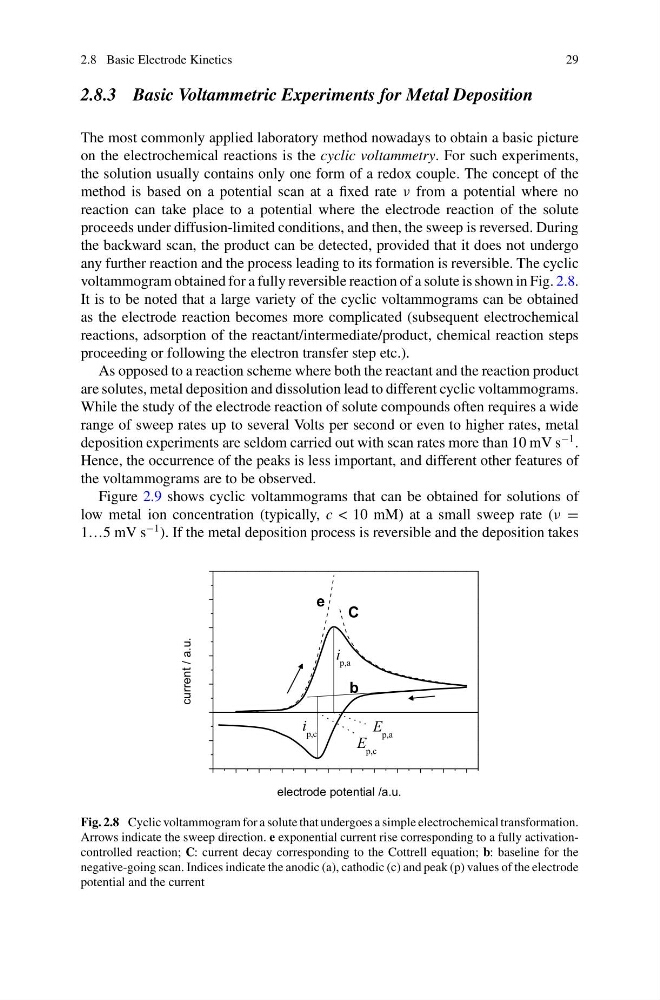
voltammogram obtained for a fully reversible reaction of a solute is shown in Fig. 2.8.
It is to be noted that a large variety of the cyclic voltammograms can be obtained
as the electrode reaction becomes more complicated (subsequent electrochemical
reactions, adsorption of the reactant/intermediate/product, chemical reaction steps
proceeding or following the electron transfer step etc.).
As opposed to a reaction scheme where both the reactant and the reaction product
are solutes, metal deposition and dissolution lead to different cyclic voltammograms.
While the study of the electrode reaction of solute compounds often requires a wide
range of sweep rates up to several Volts per second or even to higher rates, metal
deposition experiments are seldom carried out with scan rates more than 10 mV s
−1 .
Hence, the occurrence of the peaks is less important, and different other features of
the voltammograms are to be observed.
Figure 2.9 shows cyclic voltammograms that can be obtained for solutions of
low metal ion concentration (typically, c < 10 mM) at a small sweep rate (ν =
1…5 mV s
−1 ). If the metal deposition process is reversible and the deposition takes
i p,c
i p,a
E p,c
E p,a
b
C
e
current / a.u.
electrode potential /a.u.
Fig. 2.8 Cyclic voltammogram for a solute that undergoes a simple electrochemical transformation.
Arrows indicate the sweep direction. e exponential current rise corresponding to a fully activationcontrolled reaction; C: current decay corresponding to the Cottrell equation; b: baseline for the
negative-going scan. Indices indicate the anodic (a), cathodic (c) and peak (p) values of the electrode
potential and the current
29
2.8.3 Basic Voltammetric Experiments for Metal Deposition
The most commonly applied laboratory method nowadays to obtain a basic picture
on the electrochemical reactions is the cyclic voltammetry. For such experiments,
the solution usually contains only one form of a redox couple. The concept of the
method is based on a potential scan at a fixed rate ν from a potential where no
reaction can take place to a potential where the electrode reaction of the solute
proceeds under diffusion-limited conditions, and then, the sweep is reversed. During
the backward scan, the product can be detected, provided that it does not undergo
any further reaction and the process leading to its formation is reversible. The cyclic
voltammogram obtained for a fully reversible reaction of a solute is shown in Fig. 2.8.
It is to be noted that a large variety of the cyclic voltammograms can be obtained
as the electrode reaction becomes more complicated (subsequent electrochemical
reactions, adsorption of the reactant/intermediate/product, chemical reaction steps
proceeding or following the electron transfer step etc.).
As opposed to a reaction scheme where both the reactant and the reaction product
are solutes, metal deposition and dissolution lead to different cyclic voltammograms.
While the study of the electrode reaction of solute compounds often requires a wide
range of sweep rates up to several Volts per second or even to higher rates, metal
deposition experiments are seldom carried out with scan rates more than 10 mV s
−1 .
Hence, the occurrence of the peaks is less important, and different other features of
the voltammograms are to be observed.
Figure 2.9 shows cyclic voltammograms that can be obtained for solutions of
low metal ion concentration (typically, c < 10 mM) at a small sweep rate (ν =
1…5 mV s
−1 ). If the metal deposition process is reversible and the deposition takes
i p,c
i p,a
E p,c
E p,a
b
C
e
current / a.u.
electrode potential /a.u.
Fig. 2.8 Cyclic voltammogram for a solute that undergoes a simple electrochemical transformation.
Arrows indicate the sweep direction. e exponential current rise corresponding to a fully activationcontrolled reaction; C: current decay corresponding to the Cottrell equation; b: baseline for the
negative-going scan. Indices indicate the anodic (a), cathodic (c) and peak (p) values of the electrode
potential and the current