

28
2 Electrochemistry and Electrodeposition
c 0 (t) = c
∗
−
2j
zF
t
π D
−1/2
(2.19)
The rearrangement of Eq. 2.19 can yield the time period while galvanostatic
conditions can be maintained until the onset of another electrochemical process.
In contrast to the current regulation, the electrode potential sets a driving force, as
a result of which the flux of the reactant may vary as the electrode reaction proceeds.
The most commonly applied experimental setup is when the electrode is surrounded
with a stagnant solution and the electrode potential is instantaneously set to a value
where the reaction of interest takes place under diffusion-limited conditions. This
results in a current decay in accord with the Cottrell equation:
j (t) = zFc
D
π t
1/2
(2.20)
It is particularly important to remark in a work dealing with micro- and nanostructures that the above analysis is valid for macroscopic and planar electrodes with
characteristic lateral size of at least several tenths of millimetres and above, and the
side effects are negligible. When the electrode size decreases but the electrode is
recessed (i.e., the solution which contains the reactant is a similarly narrow column
as the electrode itself, like in a nanochannel), the above description is still valid.
However, if the electrode size is below about 100 µm and it is not recessed (i.e., the
solution which the reactants can originate from extends to a much larger distance
in both parallel and perpendicular directions relative to the electrode surface), the
diffusion field becomes spherical. For solving such problems, the Fick equations have
to be rewritten in terms of spherical polar co-ordinates. The solution of the relevant
equations is available in the general electrochemistry literature. What is important
to remember for a proper qualitative picture is that a micro- or nanoelectrodes in a
stagnant solution behaves the same way as a macroscopic electrode in a well-stirred
solution in the sense that a well-defined limiting current can be measured for these
electrodes. The shape of the polarization curve on a microelectrode is similar to that
shown in Fig. 2.6, although the concentration profiles are different. It is important
to know about microelectrodes that the limiting current scales with their radius,
unlike for macroscopic electrodes on which the current is surface-proportional. The
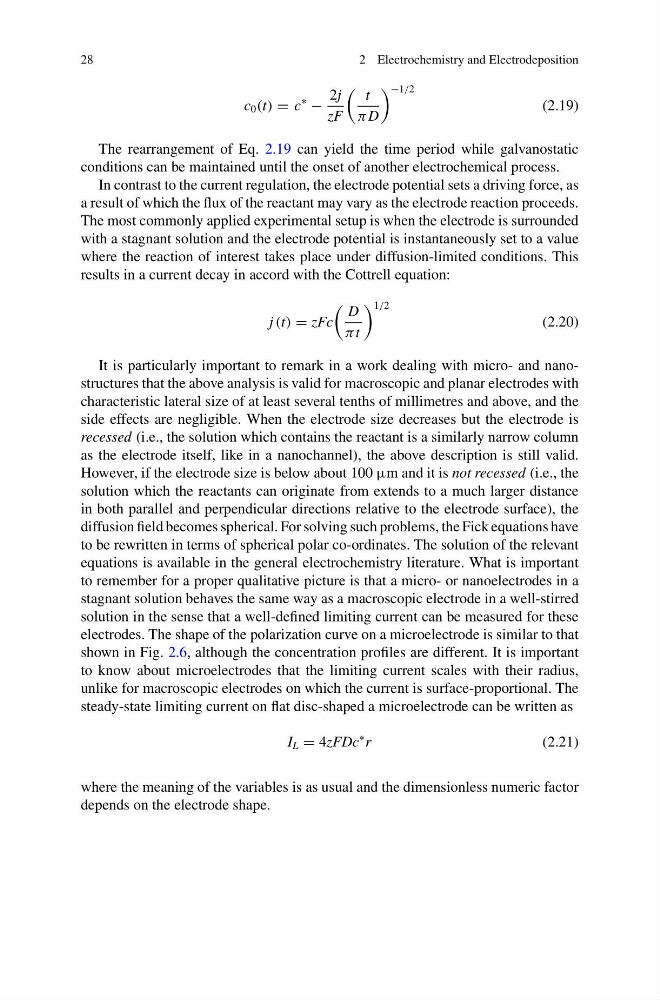
steady-state limiting current on flat disc-shaped a microelectrode can be written as
I L = 4zFDc
∗ r
(2.21)
where the meaning of the variables is as usual and the dimensionless numeric factor
depends on the electrode shape.
2 Electrochemistry and Electrodeposition
c 0 (t) = c
∗
−
2j
zF
t
π D
−1/2
(2.19)
The rearrangement of Eq. 2.19 can yield the time period while galvanostatic
conditions can be maintained until the onset of another electrochemical process.
In contrast to the current regulation, the electrode potential sets a driving force, as
a result of which the flux of the reactant may vary as the electrode reaction proceeds.
The most commonly applied experimental setup is when the electrode is surrounded
with a stagnant solution and the electrode potential is instantaneously set to a value
where the reaction of interest takes place under diffusion-limited conditions. This
results in a current decay in accord with the Cottrell equation:
j (t) = zFc
D
π t
1/2
(2.20)
It is particularly important to remark in a work dealing with micro- and nanostructures that the above analysis is valid for macroscopic and planar electrodes with
characteristic lateral size of at least several tenths of millimetres and above, and the
side effects are negligible. When the electrode size decreases but the electrode is
recessed (i.e., the solution which contains the reactant is a similarly narrow column
as the electrode itself, like in a nanochannel), the above description is still valid.
However, if the electrode size is below about 100 µm and it is not recessed (i.e., the
solution which the reactants can originate from extends to a much larger distance
in both parallel and perpendicular directions relative to the electrode surface), the
diffusion field becomes spherical. For solving such problems, the Fick equations have
to be rewritten in terms of spherical polar co-ordinates. The solution of the relevant
equations is available in the general electrochemistry literature. What is important
to remember for a proper qualitative picture is that a micro- or nanoelectrodes in a
stagnant solution behaves the same way as a macroscopic electrode in a well-stirred
solution in the sense that a well-defined limiting current can be measured for these
electrodes. The shape of the polarization curve on a microelectrode is similar to that
shown in Fig. 2.6, although the concentration profiles are different. It is important
to know about microelectrodes that the limiting current scales with their radius,
unlike for macroscopic electrodes on which the current is surface-proportional. The
steady-state limiting current on flat disc-shaped a microelectrode can be written as
I L = 4zFDc
∗ r
(2.21)
where the meaning of the variables is as usual and the dimensionless numeric factor
depends on the electrode shape.