

13.3 Traditional Laboratory Technique of PAA Preparation
483
are strongly interrelated and depend on the acid used for anodization as well as on
the anodization current density range [34].
13.3.5 Porosity and Degree of Ordering
With the anodization process parameters shown in Table 13.1, the resulting samples
exhibit a nearly uniform 10% overall porosity. This means that the samples prepared
under different conditions are similar, as if they were the “magnified” versions of
each other. The consequence of this similarity is that the pore diameter over pore
axis distance ratio is a uniform parameter of the PAA samples obtained with the
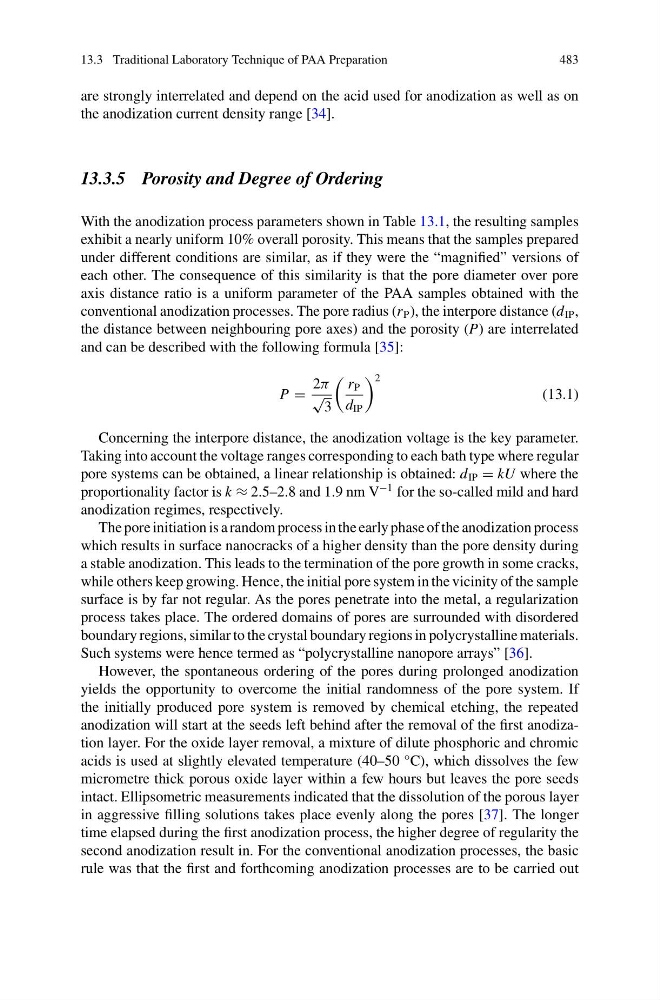
conventional anodization processes. The pore radius (r P ), the interpore distance (d IP ,
the distance between neighbouring pore axes) and the porosity (P) are interrelated
and can be described with the following formula [35]:
P =
2π
√
3
r P
d IP
2
(13.1)
Concerning the interpore distance, the anodization voltage is the key parameter.
Taking into account the voltage ranges corresponding to each bath type where regular
pore systems can be obtained, a linear relationship is obtained: d IP = kU where the
proportionality factor is k ≈ 2.5–2.8 and 1.9 nm V
−1 for the so-called mild and hard
anodization regimes, respectively.
The pore initiation is a random process in the early phase of the anodization process
which results in surface nanocracks of a higher density than the pore density during
a stable anodization. This leads to the termination of the pore growth in some cracks,
while others keep growing. Hence, the initial pore system in the vicinity of the sample
surface is by far not regular. As the pores penetrate into the metal, a regularization
process takes place. The ordered domains of pores are surrounded with disordered
boundary regions, similar to the crystal boundary regions in polycrystalline materials.
Such systems were hence termed as “polycrystalline nanopore arrays” [36].
However, the spontaneous ordering of the pores during prolonged anodization
yields the opportunity to overcome the initial randomness of the pore system. If
the initially produced pore system is removed by chemical etching, the repeated
anodization will start at the seeds left behind after the removal of the first anodization layer. For the oxide layer removal, a mixture of dilute phosphoric and chromic
acids is used at slightly elevated temperature (40–50 °C), which dissolves the few
micrometre thick porous oxide layer within a few hours but leaves the pore seeds
intact. Ellipsometric measurements indicated that the dissolution of the porous layer
in aggressive filling solutions takes place evenly along the pores [37]. The longer
time elapsed during the first anodization process, the higher degree of regularity the
second anodization result in. For the conventional anodization processes, the basic
rule was that the first and forthcoming anodization processes are to be carried out
483
are strongly interrelated and depend on the acid used for anodization as well as on
the anodization current density range [34].
13.3.5 Porosity and Degree of Ordering
With the anodization process parameters shown in Table 13.1, the resulting samples
exhibit a nearly uniform 10% overall porosity. This means that the samples prepared
under different conditions are similar, as if they were the “magnified” versions of
each other. The consequence of this similarity is that the pore diameter over pore
axis distance ratio is a uniform parameter of the PAA samples obtained with the
conventional anodization processes. The pore radius (r P ), the interpore distance (d IP ,
the distance between neighbouring pore axes) and the porosity (P) are interrelated
and can be described with the following formula [35]:
P =
2π
√
3
r P
d IP
2
(13.1)
Concerning the interpore distance, the anodization voltage is the key parameter.
Taking into account the voltage ranges corresponding to each bath type where regular
pore systems can be obtained, a linear relationship is obtained: d IP = kU where the
proportionality factor is k ≈ 2.5–2.8 and 1.9 nm V
−1 for the so-called mild and hard
anodization regimes, respectively.
The pore initiation is a random process in the early phase of the anodization process
which results in surface nanocracks of a higher density than the pore density during
a stable anodization. This leads to the termination of the pore growth in some cracks,
while others keep growing. Hence, the initial pore system in the vicinity of the sample
surface is by far not regular. As the pores penetrate into the metal, a regularization
process takes place. The ordered domains of pores are surrounded with disordered
boundary regions, similar to the crystal boundary regions in polycrystalline materials.
Such systems were hence termed as “polycrystalline nanopore arrays” [36].
However, the spontaneous ordering of the pores during prolonged anodization
yields the opportunity to overcome the initial randomness of the pore system. If
the initially produced pore system is removed by chemical etching, the repeated
anodization will start at the seeds left behind after the removal of the first anodization layer. For the oxide layer removal, a mixture of dilute phosphoric and chromic
acids is used at slightly elevated temperature (40–50 °C), which dissolves the few
micrometre thick porous oxide layer within a few hours but leaves the pore seeds
intact. Ellipsometric measurements indicated that the dissolution of the porous layer
in aggressive filling solutions takes place evenly along the pores [37]. The longer
time elapsed during the first anodization process, the higher degree of regularity the
second anodization result in. For the conventional anodization processes, the basic
rule was that the first and forthcoming anodization processes are to be carried out