

482
13 Preparation of Nanoporous Oxides from Metals by Electrochemical …
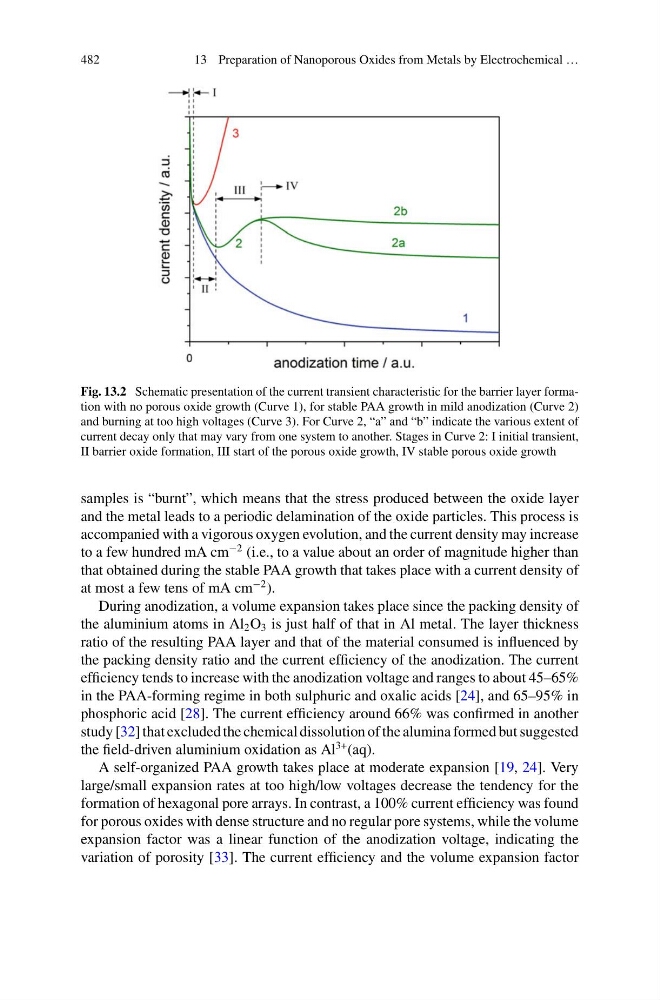
Fig. 13.2 Schematic presentation of the current transient characteristic for the barrier layer formation with no porous oxide growth (Curve 1), for stable PAA growth in mild anodization (Curve 2)
and burning at too high voltages (Curve 3). For Curve 2, “a” and “b” indicate the various extent of
current decay only that may vary from one system to another. Stages in Curve 2: I initial transient,
II barrier oxide formation, III start of the porous oxide growth, IV stable porous oxide growth
samples is “burnt”, which means that the stress produced between the oxide layer
and the metal leads to a periodic delamination of the oxide particles. This process is
accompanied with a vigorous oxygen evolution, and the current density may increase
to a few hundred mA cm
−2 (i.e., to a value about an order of magnitude higher than
that obtained during the stable PAA growth that takes place with a current density of
at most a few tens of mA cm
−2 ).
During anodization, a volume expansion takes place since the packing density of
the aluminium atoms in Al 2 O 3 is just half of that in Al metal. The layer thickness
ratio of the resulting PAA layer and that of the material consumed is influenced by
the packing density ratio and the current efficiency of the anodization. The current
efficiency tends to increase with the anodization voltage and ranges to about 45–65%
in the PAA-forming regime in both sulphuric and oxalic acids [24], and 65–95% in
phosphoric acid [28]. The current efficiency around 66% was confirmed in another
study [32] that excluded the chemical dissolution of the alumina formed but suggested
the field-driven aluminium oxidation as Al
3+ (aq).
A self-organized PAA growth takes place at moderate expansion [19, 24]. Very
large/small expansion rates at too high/low voltages decrease the tendency for the
formation of hexagonal pore arrays. In contrast, a 100% current efficiency was found
for porous oxides with dense structure and no regular pore systems, while the volume
expansion factor was a linear function of the anodization voltage, indicating the
variation of porosity [33]. The current efficiency and the volume expansion factor
13 Preparation of Nanoporous Oxides from Metals by Electrochemical …
Fig. 13.2 Schematic presentation of the current transient characteristic for the barrier layer formation with no porous oxide growth (Curve 1), for stable PAA growth in mild anodization (Curve 2)
and burning at too high voltages (Curve 3). For Curve 2, “a” and “b” indicate the various extent of
current decay only that may vary from one system to another. Stages in Curve 2: I initial transient,
II barrier oxide formation, III start of the porous oxide growth, IV stable porous oxide growth
samples is “burnt”, which means that the stress produced between the oxide layer
and the metal leads to a periodic delamination of the oxide particles. This process is
accompanied with a vigorous oxygen evolution, and the current density may increase
to a few hundred mA cm
−2 (i.e., to a value about an order of magnitude higher than
that obtained during the stable PAA growth that takes place with a current density of
at most a few tens of mA cm
−2 ).
During anodization, a volume expansion takes place since the packing density of
the aluminium atoms in Al 2 O 3 is just half of that in Al metal. The layer thickness
ratio of the resulting PAA layer and that of the material consumed is influenced by
the packing density ratio and the current efficiency of the anodization. The current
efficiency tends to increase with the anodization voltage and ranges to about 45–65%
in the PAA-forming regime in both sulphuric and oxalic acids [24], and 65–95% in
phosphoric acid [28]. The current efficiency around 66% was confirmed in another
study [32] that excluded the chemical dissolution of the alumina formed but suggested
the field-driven aluminium oxidation as Al
3+ (aq).
A self-organized PAA growth takes place at moderate expansion [19, 24]. Very
large/small expansion rates at too high/low voltages decrease the tendency for the
formation of hexagonal pore arrays. In contrast, a 100% current efficiency was found
for porous oxides with dense structure and no regular pore systems, while the volume
expansion factor was a linear function of the anodization voltage, indicating the
variation of porosity [33]. The current efficiency and the volume expansion factor