

13.3 Traditional Laboratory Technique of PAA Preparation
481
to lead away the heat produced in the reaction. Since local overheating often leads
to the burning of the PAA coating, a backside cooling of the Al anode is customary.
The additional heat sink can be a cooled metal block against which the anode is
pressed, but the inclusion of a Peltier element between the cooling media and the
anode improves the thermostation of the reaction zone significantly. The desired
temperature for the preparation of highly ordered PAA samples is between −5 and
+15 °C. The interpore distance tends to increase with temperature.
13.3.3 Common Electrolyte Solutions
Three common electrolyte solutions became widespread in the preparation of PAA
membranes by mild anodization: aqueous sulphuric acid, oxalic acid and phosphoric
acid solutions (the acids are listed in the incremental order of the anodization voltages
corresponding to the growth of PAA with each solution) [19]. The typical solution
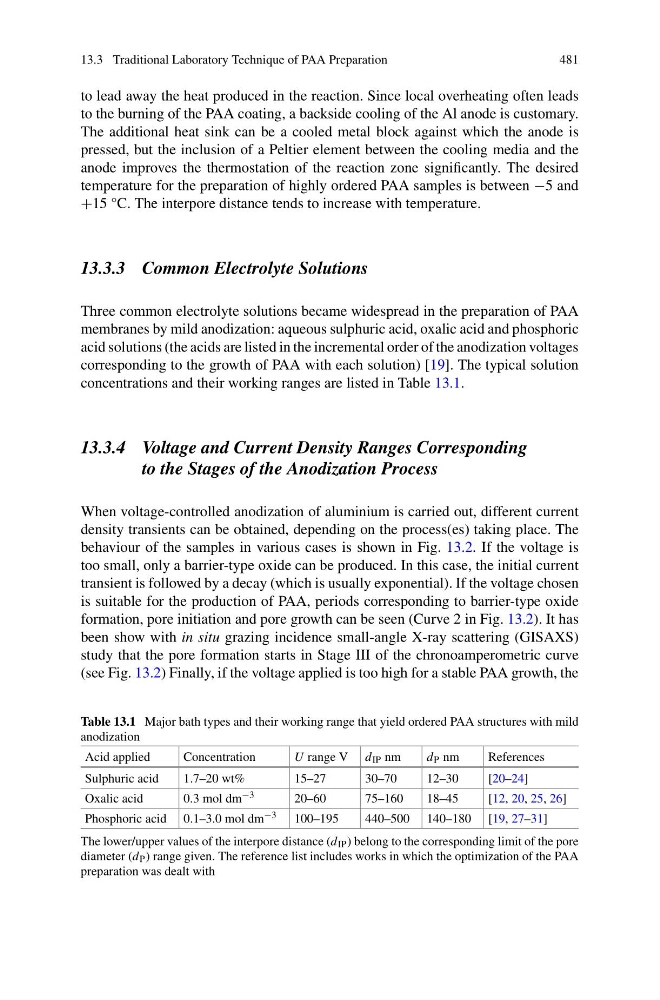
concentrations and their working ranges are listed in Table 13.1.
13.3.4 Voltage and Current Density Ranges Corresponding
to the Stages of the Anodization Process
When voltage-controlled anodization of aluminium is carried out, different current
density transients can be obtained, depending on the process(es) taking place. The
behaviour of the samples in various cases is shown in Fig. 13.2. If the voltage is
too small, only a barrier-type oxide can be produced. In this case, the initial current
transient is followed by a decay (which is usually exponential). If the voltage chosen
is suitable for the production of PAA, periods corresponding to barrier-type oxide
formation, pore initiation and pore growth can be seen (Curve 2 in Fig. 13.2). It has
been show with in situ grazing incidence small-angle X-ray scattering (GISAXS)
study that the pore formation starts in Stage III of the chronoamperometric curve
(see Fig. 13.2) Finally, if the voltage applied is too high for a stable PAA growth, the
Table 13.1 Major bath types and their working range that yield ordered PAA structures with mild
anodization
Acid applied
Concentration
U range V d IP nm
d P nm
References
Sulphuric acid
1.7–20 wt%
15–27
30–70
12–30
[20–24]
Oxalic acid
0.3 mol dm −3
20–60
75–160
18–45
[12, 20, 25, 26]
Phosphoric acid 0.1–3.0 mol dm −3 100–195
440–500 140–180 [19, 27–31]
The lower/upper values of the interpore distance (d IP ) belong to the corresponding limit of the pore
diameter (d P ) range given. The reference list includes works in which the optimization of the PAA
preparation was dealt with
481
to lead away the heat produced in the reaction. Since local overheating often leads
to the burning of the PAA coating, a backside cooling of the Al anode is customary.
The additional heat sink can be a cooled metal block against which the anode is
pressed, but the inclusion of a Peltier element between the cooling media and the
anode improves the thermostation of the reaction zone significantly. The desired
temperature for the preparation of highly ordered PAA samples is between −5 and
+15 °C. The interpore distance tends to increase with temperature.
13.3.3 Common Electrolyte Solutions
Three common electrolyte solutions became widespread in the preparation of PAA
membranes by mild anodization: aqueous sulphuric acid, oxalic acid and phosphoric
acid solutions (the acids are listed in the incremental order of the anodization voltages
corresponding to the growth of PAA with each solution) [19]. The typical solution
concentrations and their working ranges are listed in Table 13.1.
13.3.4 Voltage and Current Density Ranges Corresponding
to the Stages of the Anodization Process
When voltage-controlled anodization of aluminium is carried out, different current
density transients can be obtained, depending on the process(es) taking place. The
behaviour of the samples in various cases is shown in Fig. 13.2. If the voltage is
too small, only a barrier-type oxide can be produced. In this case, the initial current
transient is followed by a decay (which is usually exponential). If the voltage chosen
is suitable for the production of PAA, periods corresponding to barrier-type oxide
formation, pore initiation and pore growth can be seen (Curve 2 in Fig. 13.2). It has
been show with in situ grazing incidence small-angle X-ray scattering (GISAXS)
study that the pore formation starts in Stage III of the chronoamperometric curve
(see Fig. 13.2) Finally, if the voltage applied is too high for a stable PAA growth, the
Table 13.1 Major bath types and their working range that yield ordered PAA structures with mild
anodization
Acid applied
Concentration
U range V d IP nm
d P nm
References
Sulphuric acid
1.7–20 wt%
15–27
30–70
12–30
[20–24]
Oxalic acid
0.3 mol dm −3
20–60
75–160
18–45
[12, 20, 25, 26]
Phosphoric acid 0.1–3.0 mol dm −3 100–195
440–500 140–180 [19, 27–31]
The lower/upper values of the interpore distance (d IP ) belong to the corresponding limit of the pore
diameter (d P ) range given. The reference list includes works in which the optimization of the PAA
preparation was dealt with