

22
2 Electrochemistry and Electrodeposition
elements. The potentiostat ensures that the impedance of the reaction taking place at
the counter electrode does not impact the measurement. However, it is to be noted
that the physical distance of the working and the reference electrode can never be
infinitely small, and the current flowing through the cell always gives rise to a socalled ohmic drop which stems from the resistivity of the media between the two
electrodes. This results in that the potential-controlled cell operation must be treated
with a great care when either the current is relatively large or when the reference
position cannot be chosen close enough to the working electrode. In such cases, in situ
or ex situ corrections of the electrode potential may be necessary. Also, literature data
reporting extreme working electrode potential values should always be scrutinized
for both their origin and meaning.
2.8 Basic Electrode Kinetics
2.8.1 Activation Control
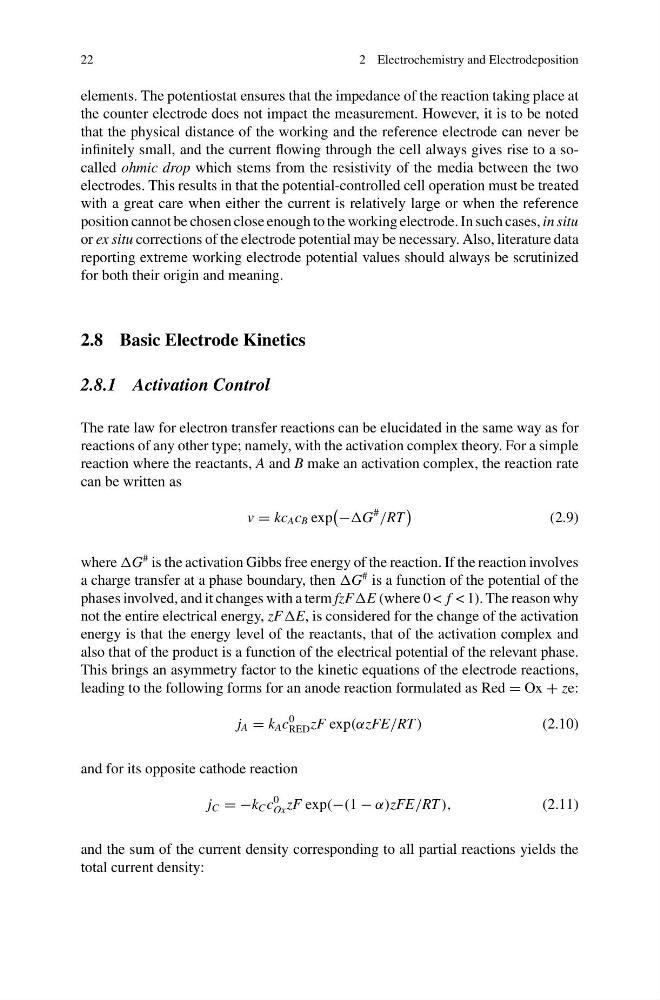
The rate law for electron transfer reactions can be elucidated in the same way as for
reactions of any other type; namely, with the activation complex theory. For a simple
reaction where the reactants, A and B make an activation complex, the reaction rate
can be written as
v = kc A c B exp
−G
#
/RT
(2.9)
where G
# is the activation Gibbs free energy of the reaction. If the reaction involves
a charge transfer at a phase boundary, then G
# is a function of the potential of the
phases involved, and it changes with a term fzFE (where 0 < f < 1). The reason why
not the entire electrical energy, zFE, is considered for the change of the activation
energy is that the energy level of the reactants, that of the activation complex and
also that of the product is a function of the electrical potential of the relevant phase.
This brings an asymmetry factor to the kinetic equations of the electrode reactions,
leading to the following forms for an anode reaction formulated as Red = Ox + ze:
j A = k A c
0
RED zF exp(αzFE/RT )
(2.10)
and for its opposite cathode reaction
j C = −k C c
0
Ox zF exp(−(1 − α)zFE/RT ),
(2.11)
and the sum of the current density corresponding to all partial reactions yields the
total current density:
2 Electrochemistry and Electrodeposition
elements. The potentiostat ensures that the impedance of the reaction taking place at
the counter electrode does not impact the measurement. However, it is to be noted
that the physical distance of the working and the reference electrode can never be
infinitely small, and the current flowing through the cell always gives rise to a socalled ohmic drop which stems from the resistivity of the media between the two
electrodes. This results in that the potential-controlled cell operation must be treated
with a great care when either the current is relatively large or when the reference
position cannot be chosen close enough to the working electrode. In such cases, in situ
or ex situ corrections of the electrode potential may be necessary. Also, literature data
reporting extreme working electrode potential values should always be scrutinized
for both their origin and meaning.
2.8 Basic Electrode Kinetics
2.8.1 Activation Control
The rate law for electron transfer reactions can be elucidated in the same way as for
reactions of any other type; namely, with the activation complex theory. For a simple
reaction where the reactants, A and B make an activation complex, the reaction rate
can be written as
v = kc A c B exp
−G
#
/RT
(2.9)
where G
# is the activation Gibbs free energy of the reaction. If the reaction involves
a charge transfer at a phase boundary, then G
# is a function of the potential of the
phases involved, and it changes with a term fzFE (where 0 < f < 1). The reason why
not the entire electrical energy, zFE, is considered for the change of the activation
energy is that the energy level of the reactants, that of the activation complex and
also that of the product is a function of the electrical potential of the relevant phase.
This brings an asymmetry factor to the kinetic equations of the electrode reactions,
leading to the following forms for an anode reaction formulated as Red = Ox + ze:
j A = k A c
0
RED zF exp(αzFE/RT )
(2.10)
and for its opposite cathode reaction
j C = −k C c
0
Ox zF exp(−(1 − α)zFE/RT ),
(2.11)
and the sum of the current density corresponding to all partial reactions yields the
total current density: