

2.7 Polarization and Electrochemical Devices
21
meaning, the laboratory practice also renamed the set-up of the potential as polarization, even though this can be carried out with a large number of electrodes without
passing a constant current. Especially for beginners, polarization often means something that the potentiostat does, taking advantage of the simplicity of the expression
as compared to the “tuning of the electrode potential”.
The situation might look even more complicated if we take a look at the basic
circuitry and the operation of potentiostats with various internal connection modes.
From the view-point of the electrical engineer, the potentiostat operation can be
described by saying that the device passes so much charge or current through
the system so that the potential of the working electrode achieves the predefined
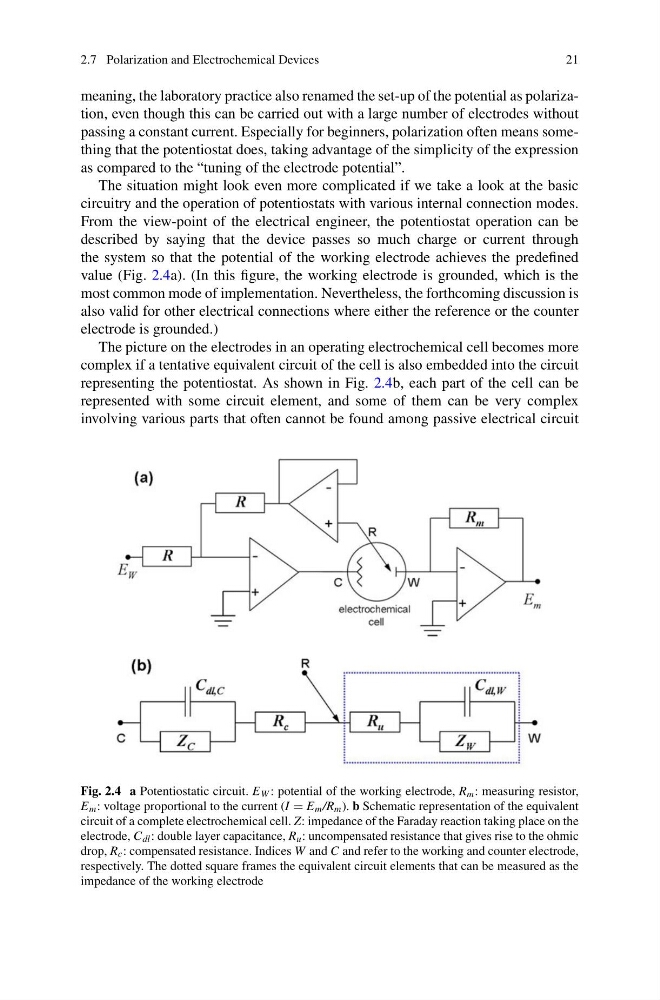
value (Fig. 2.4a). (In this figure, the working electrode is grounded, which is the
most common mode of implementation. Nevertheless, the forthcoming discussion is
also valid for other electrical connections where either the reference or the counter
electrode is grounded.)
The picture on the electrodes in an operating electrochemical cell becomes more
complex if a tentative equivalent circuit of the cell is also embedded into the circuit
representing the potentiostat. As shown in Fig. 2.4b, each part of the cell can be
represented with some circuit element, and some of them can be very complex
involving various parts that often cannot be found among passive electrical circuit
Fig. 2.4 a Potentiostatic circuit. E W : potential of the working electrode, R m : measuring resistor,
E m : voltage proportional to the current (I = E m /R m ). b Schematic representation of the equivalent
circuit of a complete electrochemical cell. Z: impedance of the Faraday reaction taking place on the
electrode, C dl : double layer capacitance, R u : uncompensated resistance that gives rise to the ohmic
drop, R c : compensated resistance. Indices W and C and refer to the working and counter electrode,
respectively. The dotted square frames the equivalent circuit elements that can be measured as the
impedance of the working electrode
21
meaning, the laboratory practice also renamed the set-up of the potential as polarization, even though this can be carried out with a large number of electrodes without
passing a constant current. Especially for beginners, polarization often means something that the potentiostat does, taking advantage of the simplicity of the expression
as compared to the “tuning of the electrode potential”.
The situation might look even more complicated if we take a look at the basic
circuitry and the operation of potentiostats with various internal connection modes.
From the view-point of the electrical engineer, the potentiostat operation can be
described by saying that the device passes so much charge or current through
the system so that the potential of the working electrode achieves the predefined
value (Fig. 2.4a). (In this figure, the working electrode is grounded, which is the
most common mode of implementation. Nevertheless, the forthcoming discussion is
also valid for other electrical connections where either the reference or the counter
electrode is grounded.)
The picture on the electrodes in an operating electrochemical cell becomes more
complex if a tentative equivalent circuit of the cell is also embedded into the circuit
representing the potentiostat. As shown in Fig. 2.4b, each part of the cell can be
represented with some circuit element, and some of them can be very complex
involving various parts that often cannot be found among passive electrical circuit
Fig. 2.4 a Potentiostatic circuit. E W : potential of the working electrode, R m : measuring resistor,
E m : voltage proportional to the current (I = E m /R m ). b Schematic representation of the equivalent
circuit of a complete electrochemical cell. Z: impedance of the Faraday reaction taking place on the
electrode, C dl : double layer capacitance, R u : uncompensated resistance that gives rise to the ohmic
drop, R c : compensated resistance. Indices W and C and refer to the working and counter electrode,
respectively. The dotted square frames the equivalent circuit elements that can be measured as the
impedance of the working electrode