

20
2 Electrochemistry and Electrodeposition
components in batteries are named as “cathode material” or “anode material”. These
notations always refer to the current direction of the battery operation (discharge),
while the roles are exchanged for the charging process.
2.7 Polarization and Electrochemical Devices
The term polarization stems historically from the age when semiconductor-based
devices were not yet available, and a galvanostat could be built only by using a highcapacity power supply and a sufficient serial shunting resistor. Also in this case, the
potential of the electrode of interest could be monitored with respect to a reference
electrode (or indicator electrode), but here, the reference electrode was not a part of
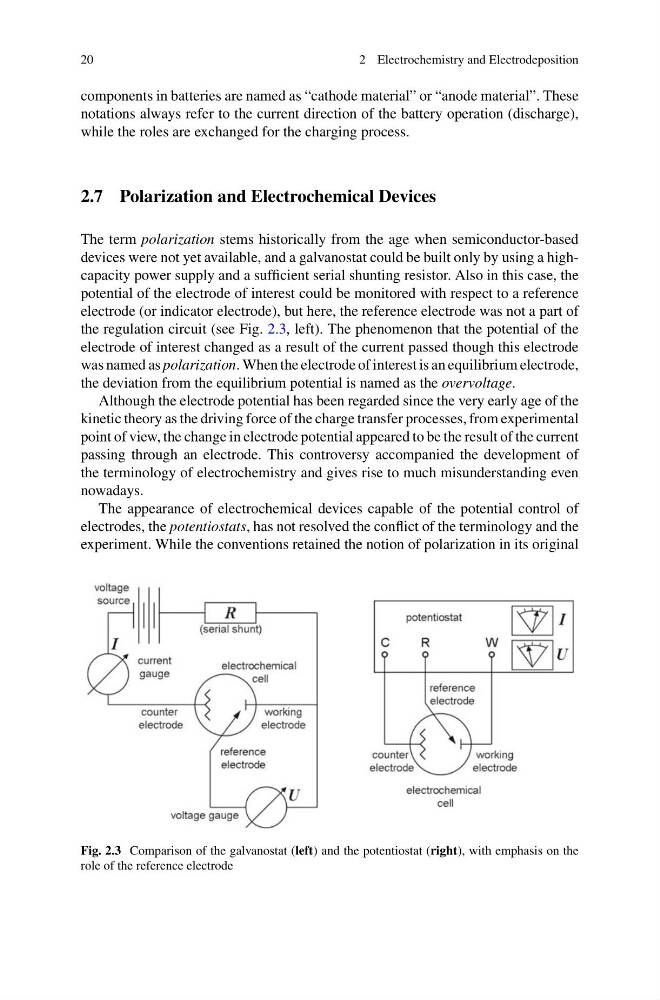
the regulation circuit (see Fig. 2.3, left). The phenomenon that the potential of the
electrode of interest changed as a result of the current passed though this electrode
was named as polarization. When the electrode of interest is an equilibrium electrode,
the deviation from the equilibrium potential is named as the overvoltage.
Although the electrode potential has been regarded since the very early age of the
kinetic theory as the driving force of the charge transfer processes, from experimental
point of view, the change in electrode potential appeared to be the result of the current
passing through an electrode. This controversy accompanied the development of
the terminology of electrochemistry and gives rise to much misunderstanding even
nowadays.
The appearance of electrochemical devices capable of the potential control of
electrodes, the potentiostats, has not resolved the conflict of the terminology and the
experiment. While the conventions retained the notion of polarization in its original
Fig. 2.3 Comparison of the galvanostat (left) and the potentiostat (right), with emphasis on the
role of the reference electrode
2 Electrochemistry and Electrodeposition
components in batteries are named as “cathode material” or “anode material”. These
notations always refer to the current direction of the battery operation (discharge),
while the roles are exchanged for the charging process.
2.7 Polarization and Electrochemical Devices
The term polarization stems historically from the age when semiconductor-based
devices were not yet available, and a galvanostat could be built only by using a highcapacity power supply and a sufficient serial shunting resistor. Also in this case, the
potential of the electrode of interest could be monitored with respect to a reference
electrode (or indicator electrode), but here, the reference electrode was not a part of
the regulation circuit (see Fig. 2.3, left). The phenomenon that the potential of the
electrode of interest changed as a result of the current passed though this electrode
was named as polarization. When the electrode of interest is an equilibrium electrode,
the deviation from the equilibrium potential is named as the overvoltage.
Although the electrode potential has been regarded since the very early age of the
kinetic theory as the driving force of the charge transfer processes, from experimental
point of view, the change in electrode potential appeared to be the result of the current
passing through an electrode. This controversy accompanied the development of
the terminology of electrochemistry and gives rise to much misunderstanding even
nowadays.
The appearance of electrochemical devices capable of the potential control of
electrodes, the potentiostats, has not resolved the conflict of the terminology and the
experiment. While the conventions retained the notion of polarization in its original
Fig. 2.3 Comparison of the galvanostat (left) and the potentiostat (right), with emphasis on the
role of the reference electrode