

11.3 Templates Obtained Through the Self-assembly of Particles
391
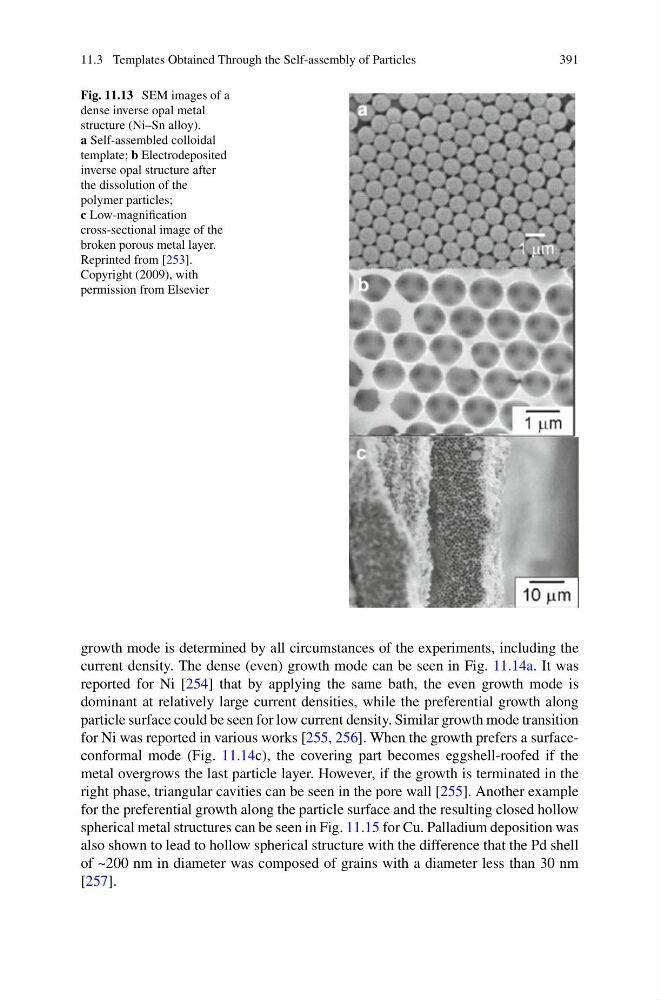
Fig. 11.13 SEM images of a
dense inverse opal metal
structure (Ni–Sn alloy).
a Self-assembled colloidal
template; b Electrodeposited
inverse opal structure after
the dissolution of the
polymer particles;
c Low-magnification
cross-sectional image of the
broken porous metal layer.
Reprinted from [253].
Copyright (2009), with
permission from Elsevier
growth mode is determined by all circumstances of the experiments, including the
current density. The dense (even) growth mode can be seen in Fig. 11.14a. It was
reported for Ni [254] that by applying the same bath, the even growth mode is
dominant at relatively large current densities, while the preferential growth along
particle surface could be seen for low current density. Similar growth mode transition
for Ni was reported in various works [255, 256]. When the growth prefers a surfaceconformal mode (Fig. 11.14c), the covering part becomes eggshell-roofed if the
metal overgrows the last particle layer. However, if the growth is terminated in the
right phase, triangular cavities can be seen in the pore wall [255]. Another example
for the preferential growth along the particle surface and the resulting closed hollow
spherical metal structures can be seen in Fig. 11.15 for Cu. Palladium deposition was
also shown to lead to hollow spherical structure with the difference that the Pd shell
of ~200 nm in diameter was composed of grains with a diameter less than 30 nm
[257].
391
Fig. 11.13 SEM images of a
dense inverse opal metal
structure (Ni–Sn alloy).
a Self-assembled colloidal
template; b Electrodeposited
inverse opal structure after
the dissolution of the
polymer particles;
c Low-magnification
cross-sectional image of the
broken porous metal layer.
Reprinted from [253].
Copyright (2009), with
permission from Elsevier
growth mode is determined by all circumstances of the experiments, including the
current density. The dense (even) growth mode can be seen in Fig. 11.14a. It was
reported for Ni [254] that by applying the same bath, the even growth mode is
dominant at relatively large current densities, while the preferential growth along
particle surface could be seen for low current density. Similar growth mode transition
for Ni was reported in various works [255, 256]. When the growth prefers a surfaceconformal mode (Fig. 11.14c), the covering part becomes eggshell-roofed if the
metal overgrows the last particle layer. However, if the growth is terminated in the
right phase, triangular cavities can be seen in the pore wall [255]. Another example
for the preferential growth along the particle surface and the resulting closed hollow
spherical metal structures can be seen in Fig. 11.15 for Cu. Palladium deposition was
also shown to lead to hollow spherical structure with the difference that the Pd shell
of ~200 nm in diameter was composed of grains with a diameter less than 30 nm
[257].