

392
11 Templated Systems
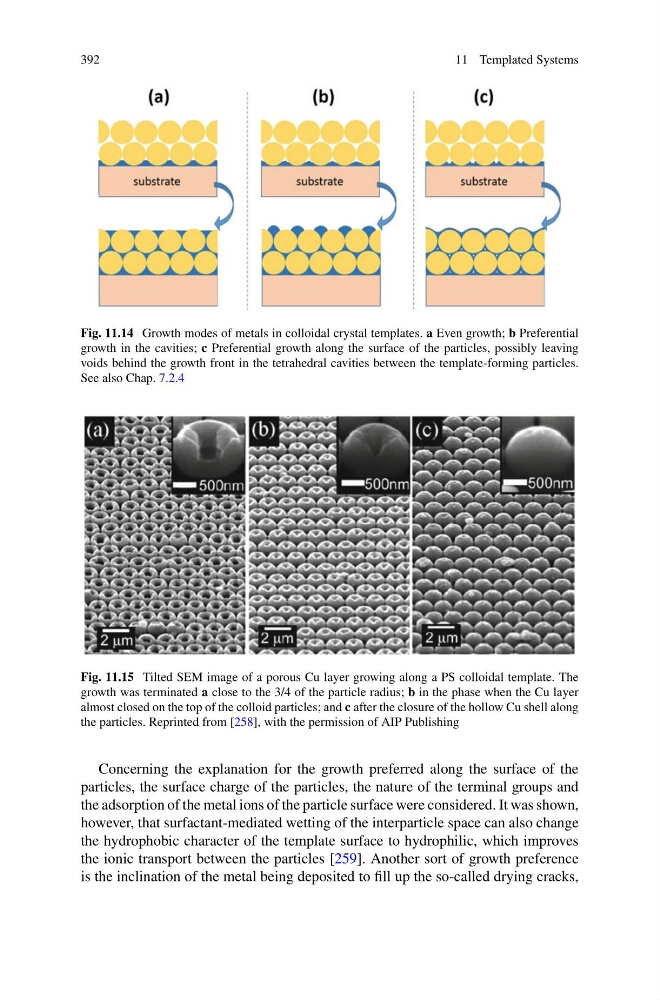
Fig. 11.14 Growth modes of metals in colloidal crystal templates. a Even growth; b Preferential
growth in the cavities; c Preferential growth along the surface of the particles, possibly leaving
voids behind the growth front in the tetrahedral cavities between the template-forming particles.
See also Chap. 7.2.4
Fig. 11.15 Tilted SEM image of a porous Cu layer growing along a PS colloidal template. The
growth was terminated a close to the 3/4 of the particle radius; b in the phase when the Cu layer
almost closed on the top of the colloid particles; and c after the closure of the hollow Cu shell along
the particles. Reprinted from [258], with the permission of AIP Publishing
Concerning the explanation for the growth preferred along the surface of the
particles, the surface charge of the particles, the nature of the terminal groups and
the adsorption of the metal ions of the particle surface were considered. It was shown,
however, that surfactant-mediated wetting of the interparticle space can also change
the hydrophobic character of the template surface to hydrophilic, which improves
the ionic transport between the particles [259]. Another sort of growth preference
is the inclination of the metal being deposited to fill up the so-called drying cracks,
11 Templated Systems
Fig. 11.14 Growth modes of metals in colloidal crystal templates. a Even growth; b Preferential
growth in the cavities; c Preferential growth along the surface of the particles, possibly leaving
voids behind the growth front in the tetrahedral cavities between the template-forming particles.
See also Chap. 7.2.4
Fig. 11.15 Tilted SEM image of a porous Cu layer growing along a PS colloidal template. The
growth was terminated a close to the 3/4 of the particle radius; b in the phase when the Cu layer
almost closed on the top of the colloid particles; and c after the closure of the hollow Cu shell along
the particles. Reprinted from [258], with the permission of AIP Publishing
Concerning the explanation for the growth preferred along the surface of the
particles, the surface charge of the particles, the nature of the terminal groups and
the adsorption of the metal ions of the particle surface were considered. It was shown,
however, that surfactant-mediated wetting of the interparticle space can also change
the hydrophobic character of the template surface to hydrophilic, which improves
the ionic transport between the particles [259]. Another sort of growth preference
is the inclination of the metal being deposited to fill up the so-called drying cracks,