

11.2 Nanochannel Templates Obtained with Top-Down Synthesis Methods
367
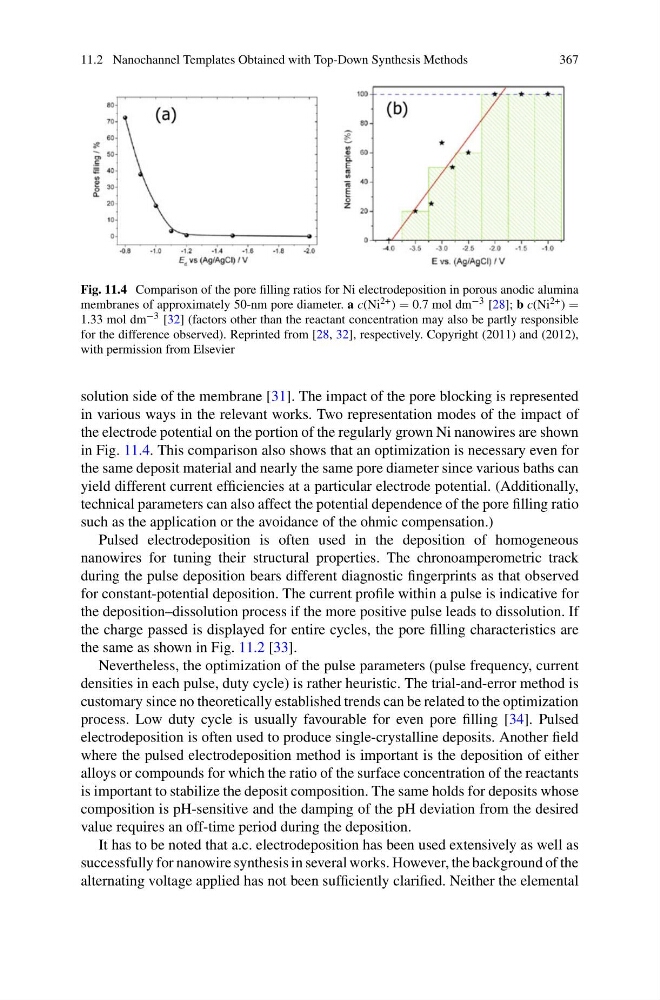
Fig. 11.4 Comparison of the pore filling ratios for Ni electrodeposition in porous anodic alumina
membranes of approximately 50-nm pore diameter. a c(Ni 2+ ) = 0.7 mol dm −3 [28]; b c(Ni 2+ ) =
1.33 mol dm −3 [32] (factors other than the reactant concentration may also be partly responsible
for the difference observed). Reprinted from [28, 32], respectively. Copyright (2011) and (2012),
with permission from Elsevier
solution side of the membrane [31]. The impact of the pore blocking is represented
in various ways in the relevant works. Two representation modes of the impact of
the electrode potential on the portion of the regularly grown Ni nanowires are shown
in Fig. 11.4. This comparison also shows that an optimization is necessary even for
the same deposit material and nearly the same pore diameter since various baths can
yield different current efficiencies at a particular electrode potential. (Additionally,
technical parameters can also affect the potential dependence of the pore filling ratio
such as the application or the avoidance of the ohmic compensation.)
Pulsed electrodeposition is often used in the deposition of homogeneous
nanowires for tuning their structural properties. The chronoamperometric track
during the pulse deposition bears different diagnostic fingerprints as that observed
for constant-potential deposition. The current profile within a pulse is indicative for
the deposition–dissolution process if the more positive pulse leads to dissolution. If
the charge passed is displayed for entire cycles, the pore filling characteristics are
the same as shown in Fig. 11.2 [33].
Nevertheless, the optimization of the pulse parameters (pulse frequency, current
densities in each pulse, duty cycle) is rather heuristic. The trial-and-error method is
customary since no theoretically established trends can be related to the optimization
process. Low duty cycle is usually favourable for even pore filling [34]. Pulsed
electrodeposition is often used to produce single-crystalline deposits. Another field
where the pulsed electrodeposition method is important is the deposition of either
alloys or compounds for which the ratio of the surface concentration of the reactants
is important to stabilize the deposit composition. The same holds for deposits whose
composition is pH-sensitive and the damping of the pH deviation from the desired
value requires an off-time period during the deposition.
It has to be noted that a.c. electrodeposition has been used extensively as well as
successfully for nanowire synthesis in several works. However, the background of the
alternating voltage applied has not been sufficiently clarified. Neither the elemental
367
Fig. 11.4 Comparison of the pore filling ratios for Ni electrodeposition in porous anodic alumina
membranes of approximately 50-nm pore diameter. a c(Ni 2+ ) = 0.7 mol dm −3 [28]; b c(Ni 2+ ) =
1.33 mol dm −3 [32] (factors other than the reactant concentration may also be partly responsible
for the difference observed). Reprinted from [28, 32], respectively. Copyright (2011) and (2012),
with permission from Elsevier
solution side of the membrane [31]. The impact of the pore blocking is represented
in various ways in the relevant works. Two representation modes of the impact of
the electrode potential on the portion of the regularly grown Ni nanowires are shown
in Fig. 11.4. This comparison also shows that an optimization is necessary even for
the same deposit material and nearly the same pore diameter since various baths can
yield different current efficiencies at a particular electrode potential. (Additionally,
technical parameters can also affect the potential dependence of the pore filling ratio
such as the application or the avoidance of the ohmic compensation.)
Pulsed electrodeposition is often used in the deposition of homogeneous
nanowires for tuning their structural properties. The chronoamperometric track
during the pulse deposition bears different diagnostic fingerprints as that observed
for constant-potential deposition. The current profile within a pulse is indicative for
the deposition–dissolution process if the more positive pulse leads to dissolution. If
the charge passed is displayed for entire cycles, the pore filling characteristics are
the same as shown in Fig. 11.2 [33].
Nevertheless, the optimization of the pulse parameters (pulse frequency, current
densities in each pulse, duty cycle) is rather heuristic. The trial-and-error method is
customary since no theoretically established trends can be related to the optimization
process. Low duty cycle is usually favourable for even pore filling [34]. Pulsed
electrodeposition is often used to produce single-crystalline deposits. Another field
where the pulsed electrodeposition method is important is the deposition of either
alloys or compounds for which the ratio of the surface concentration of the reactants
is important to stabilize the deposit composition. The same holds for deposits whose
composition is pH-sensitive and the damping of the pH deviation from the desired
value requires an off-time period during the deposition.
It has to be noted that a.c. electrodeposition has been used extensively as well as
successfully for nanowire synthesis in several works. However, the background of the
alternating voltage applied has not been sufficiently clarified. Neither the elemental