

368
11 Templated Systems
processes taking place in each half-cycle could be elucidated, nor the voltage amplitudes applied fall in the classical regime of the electrochemical measurements (10 V <
U < 50 V). Therefore, the discussion of the alternating current method was completely
excluded from the present work.
11.2.3 Electrodeposition into Nanocavities of High Aspect
Ratio: Models and Calculations
The basic assumption for the calculation of the temporal evolution of the nanowire
growth process is as follows. A cavity with its open environment at the pore ending
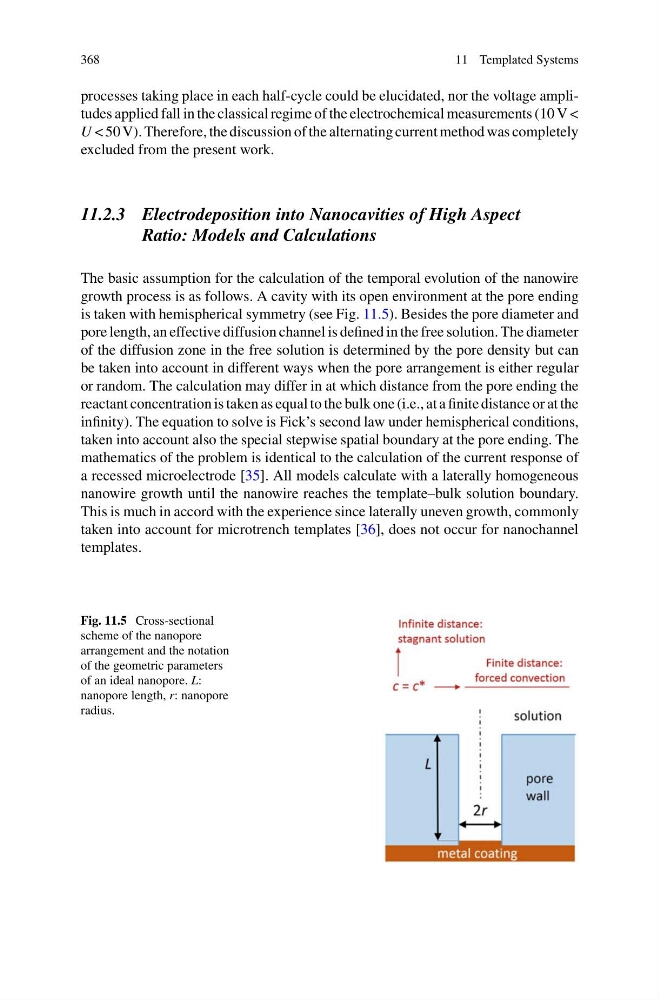
is taken with hemispherical symmetry (see Fig. 11.5). Besides the pore diameter and
pore length, an effective diffusion channel is defined in the free solution. The diameter
of the diffusion zone in the free solution is determined by the pore density but can
be taken into account in different ways when the pore arrangement is either regular
or random. The calculation may differ in at which distance from the pore ending the
reactant concentration is taken as equal to the bulk one (i.e., at a finite distance or at the
infinity). The equation to solve is Fick’s second law under hemispherical conditions,
taken into account also the special stepwise spatial boundary at the pore ending. The
mathematics of the problem is identical to the calculation of the current response of
a recessed microelectrode [35]. All models calculate with a laterally homogeneous
nanowire growth until the nanowire reaches the template–bulk solution boundary.
This is much in accord with the experience since laterally uneven growth, commonly
taken into account for microtrench templates [36], does not occur for nanochannel
templates.
Fig. 11.5 Cross-sectional
scheme of the nanopore
arrangement and the notation
of the geometric parameters
of an ideal nanopore. L:
nanopore length, r: nanopore
radius.
11 Templated Systems
processes taking place in each half-cycle could be elucidated, nor the voltage amplitudes applied fall in the classical regime of the electrochemical measurements (10 V <
U < 50 V). Therefore, the discussion of the alternating current method was completely
excluded from the present work.
11.2.3 Electrodeposition into Nanocavities of High Aspect
Ratio: Models and Calculations
The basic assumption for the calculation of the temporal evolution of the nanowire
growth process is as follows. A cavity with its open environment at the pore ending
is taken with hemispherical symmetry (see Fig. 11.5). Besides the pore diameter and
pore length, an effective diffusion channel is defined in the free solution. The diameter
of the diffusion zone in the free solution is determined by the pore density but can
be taken into account in different ways when the pore arrangement is either regular
or random. The calculation may differ in at which distance from the pore ending the
reactant concentration is taken as equal to the bulk one (i.e., at a finite distance or at the
infinity). The equation to solve is Fick’s second law under hemispherical conditions,
taken into account also the special stepwise spatial boundary at the pore ending. The
mathematics of the problem is identical to the calculation of the current response of
a recessed microelectrode [35]. All models calculate with a laterally homogeneous
nanowire growth until the nanowire reaches the template–bulk solution boundary.
This is much in accord with the experience since laterally uneven growth, commonly
taken into account for microtrench templates [36], does not occur for nanochannel
templates.
Fig. 11.5 Cross-sectional
scheme of the nanopore
arrangement and the notation
of the geometric parameters
of an ideal nanopore. L:
nanopore length, r: nanopore
radius.