

366
11 Templated Systems
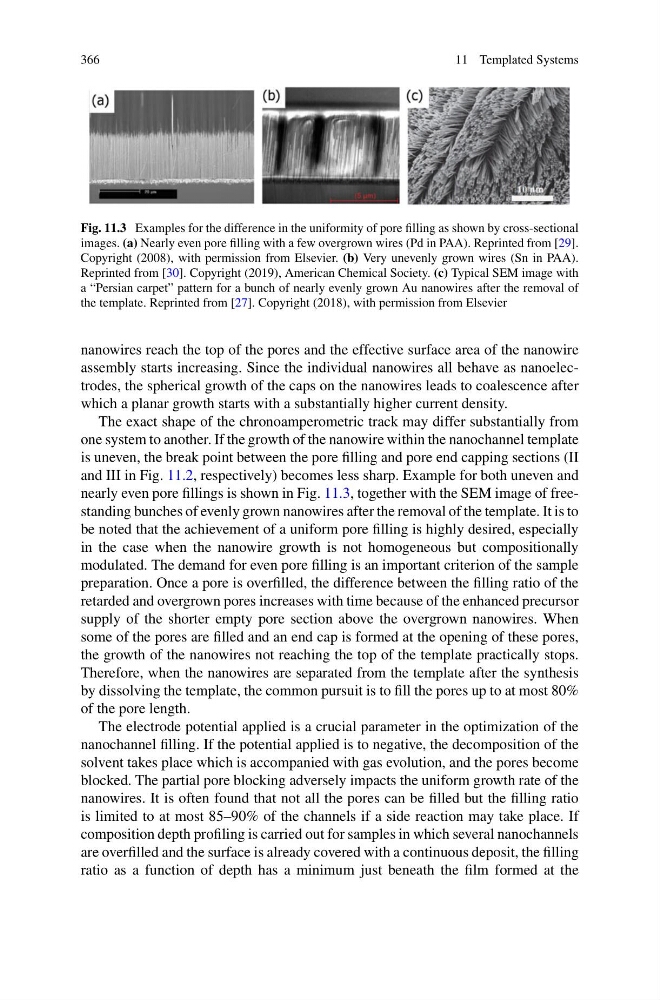
Fig. 11.3 Examples for the difference in the uniformity of pore filling as shown by cross-sectional
images. (a) Nearly even pore filling with a few overgrown wires (Pd in PAA). Reprinted from [29].
Copyright (2008), with permission from Elsevier. (b) Very unevenly grown wires (Sn in PAA).
Reprinted from [30]. Copyright (2019), American Chemical Society. (c) Typical SEM image with
a “Persian carpet” pattern for a bunch of nearly evenly grown Au nanowires after the removal of
the template. Reprinted from [27]. Copyright (2018), with permission from Elsevier
nanowires reach the top of the pores and the effective surface area of the nanowire
assembly starts increasing. Since the individual nanowires all behave as nanoelectrodes, the spherical growth of the caps on the nanowires leads to coalescence after
which a planar growth starts with a substantially higher current density.
The exact shape of the chronoamperometric track may differ substantially from
one system to another. If the growth of the nanowire within the nanochannel template
is uneven, the break point between the pore filling and pore end capping sections (II
and III in Fig. 11.2, respectively) becomes less sharp. Example for both uneven and
nearly even pore fillings is shown in Fig. 11.3, together with the SEM image of freestanding bunches of evenly grown nanowires after the removal of the template. It is to
be noted that the achievement of a uniform pore filling is highly desired, especially
in the case when the nanowire growth is not homogeneous but compositionally
modulated. The demand for even pore filling is an important criterion of the sample
preparation. Once a pore is overfilled, the difference between the filling ratio of the
retarded and overgrown pores increases with time because of the enhanced precursor
supply of the shorter empty pore section above the overgrown nanowires. When
some of the pores are filled and an end cap is formed at the opening of these pores,
the growth of the nanowires not reaching the top of the template practically stops.
Therefore, when the nanowires are separated from the template after the synthesis
by dissolving the template, the common pursuit is to fill the pores up to at most 80%
of the pore length.
The electrode potential applied is a crucial parameter in the optimization of the
nanochannel filling. If the potential applied is to negative, the decomposition of the
solvent takes place which is accompanied with gas evolution, and the pores become
blocked. The partial pore blocking adversely impacts the uniform growth rate of the
nanowires. It is often found that not all the pores can be filled but the filling ratio
is limited to at most 85–90% of the channels if a side reaction may take place. If
composition depth profiling is carried out for samples in which several nanochannels
are overfilled and the surface is already covered with a continuous deposit, the filling
ratio as a function of depth has a minimum just beneath the film formed at the
11 Templated Systems
Fig. 11.3 Examples for the difference in the uniformity of pore filling as shown by cross-sectional
images. (a) Nearly even pore filling with a few overgrown wires (Pd in PAA). Reprinted from [29].
Copyright (2008), with permission from Elsevier. (b) Very unevenly grown wires (Sn in PAA).
Reprinted from [30]. Copyright (2019), American Chemical Society. (c) Typical SEM image with
a “Persian carpet” pattern for a bunch of nearly evenly grown Au nanowires after the removal of
the template. Reprinted from [27]. Copyright (2018), with permission from Elsevier
nanowires reach the top of the pores and the effective surface area of the nanowire
assembly starts increasing. Since the individual nanowires all behave as nanoelectrodes, the spherical growth of the caps on the nanowires leads to coalescence after
which a planar growth starts with a substantially higher current density.
The exact shape of the chronoamperometric track may differ substantially from
one system to another. If the growth of the nanowire within the nanochannel template
is uneven, the break point between the pore filling and pore end capping sections (II
and III in Fig. 11.2, respectively) becomes less sharp. Example for both uneven and
nearly even pore fillings is shown in Fig. 11.3, together with the SEM image of freestanding bunches of evenly grown nanowires after the removal of the template. It is to
be noted that the achievement of a uniform pore filling is highly desired, especially
in the case when the nanowire growth is not homogeneous but compositionally
modulated. The demand for even pore filling is an important criterion of the sample
preparation. Once a pore is overfilled, the difference between the filling ratio of the
retarded and overgrown pores increases with time because of the enhanced precursor
supply of the shorter empty pore section above the overgrown nanowires. When
some of the pores are filled and an end cap is formed at the opening of these pores,
the growth of the nanowires not reaching the top of the template practically stops.
Therefore, when the nanowires are separated from the template after the synthesis
by dissolving the template, the common pursuit is to fill the pores up to at most 80%
of the pore length.
The electrode potential applied is a crucial parameter in the optimization of the
nanochannel filling. If the potential applied is to negative, the decomposition of the
solvent takes place which is accompanied with gas evolution, and the pores become
blocked. The partial pore blocking adversely impacts the uniform growth rate of the
nanowires. It is often found that not all the pores can be filled but the filling ratio
is limited to at most 85–90% of the channels if a side reaction may take place. If
composition depth profiling is carried out for samples in which several nanochannels
are overfilled and the surface is already covered with a continuous deposit, the filling
ratio as a function of depth has a minimum just beneath the film formed at the