

11.2 Nanochannel Templates Obtained with Top-Down Synthesis Methods
365
11.2.2 Deposition into Nanochannel Templates:
Electrochemistry
Potential-controlled electrodeposition is used for nanochannel template filling
processes in most of the studies. The advantage of the potential control is twofold.
First, the control of the driving force helps avoid the onset of a side reaction when
the deposition of the component of interest approaches the diffusion-controlled limit.
Secondly, the chronoamperometric curves recorded during the electrodeposition are
indicative of the advancement of the channel filling process, and hence, it can be
used in the regulation of the pore filling ratio.
When the deposition of compact nanowires is aimed, it is important that a continuous metal layer coating is produced on one side of the membranes. This can be
usually achieved with the seeding of a metal layer on the ending of the pore walls
and thickening of this layer by electrodeposition until the pores are fully closed. The
deposition of a well-adhering metal layer seems to be a prerequisite. If a membrane is
only pressed against a metal, the growth starts with a metal layer in the gap between
the metal electrode and the membrane [18].
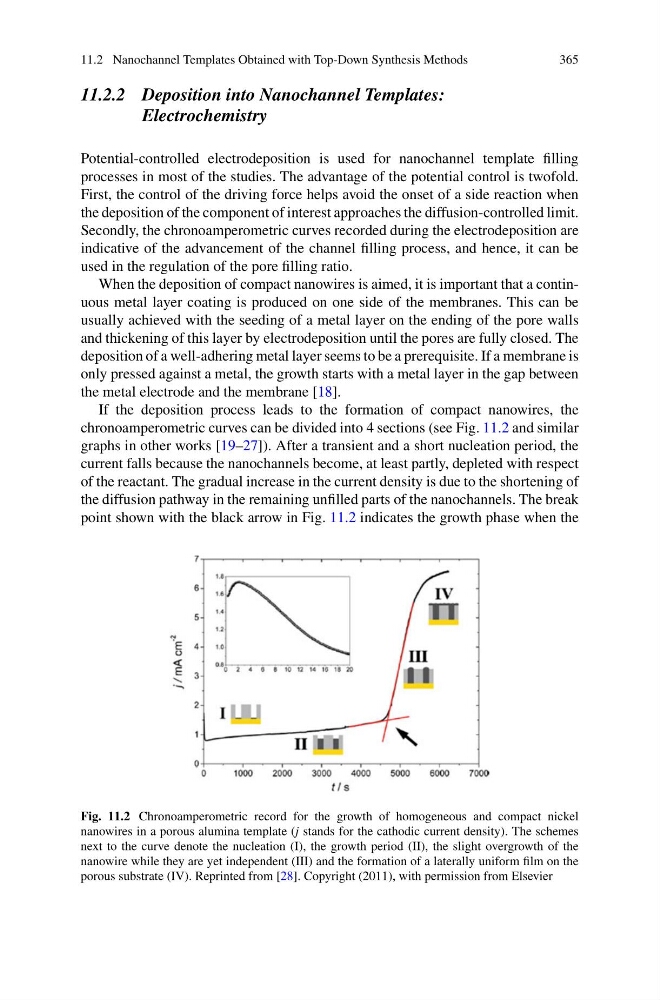
If the deposition process leads to the formation of compact nanowires, the
chronoamperometric curves can be divided into 4 sections (see Fig. 11.2 and similar
graphs in other works [19–27]). After a transient and a short nucleation period, the
current falls because the nanochannels become, at least partly, depleted with respect
of the reactant. The gradual increase in the current density is due to the shortening of
the diffusion pathway in the remaining unfilled parts of the nanochannels. The break
point shown with the black arrow in Fig. 11.2 indicates the growth phase when the
Fig. 11.2 Chronoamperometric record for the growth of homogeneous and compact nickel
nanowires in a porous alumina template (j stands for the cathodic current density). The schemes
next to the curve denote the nucleation (I), the growth period (II), the slight overgrowth of the
nanowire while they are yet independent (III) and the formation of a laterally uniform film on the
porous substrate (IV). Reprinted from [28]. Copyright (2011), with permission from Elsevier
365
11.2.2 Deposition into Nanochannel Templates:
Electrochemistry
Potential-controlled electrodeposition is used for nanochannel template filling
processes in most of the studies. The advantage of the potential control is twofold.
First, the control of the driving force helps avoid the onset of a side reaction when
the deposition of the component of interest approaches the diffusion-controlled limit.
Secondly, the chronoamperometric curves recorded during the electrodeposition are
indicative of the advancement of the channel filling process, and hence, it can be
used in the regulation of the pore filling ratio.
When the deposition of compact nanowires is aimed, it is important that a continuous metal layer coating is produced on one side of the membranes. This can be
usually achieved with the seeding of a metal layer on the ending of the pore walls
and thickening of this layer by electrodeposition until the pores are fully closed. The
deposition of a well-adhering metal layer seems to be a prerequisite. If a membrane is
only pressed against a metal, the growth starts with a metal layer in the gap between
the metal electrode and the membrane [18].
If the deposition process leads to the formation of compact nanowires, the
chronoamperometric curves can be divided into 4 sections (see Fig. 11.2 and similar
graphs in other works [19–27]). After a transient and a short nucleation period, the
current falls because the nanochannels become, at least partly, depleted with respect
of the reactant. The gradual increase in the current density is due to the shortening of
the diffusion pathway in the remaining unfilled parts of the nanochannels. The break
point shown with the black arrow in Fig. 11.2 indicates the growth phase when the
Fig. 11.2 Chronoamperometric record for the growth of homogeneous and compact nickel
nanowires in a porous alumina template (j stands for the cathodic current density). The schemes
next to the curve denote the nucleation (I), the growth period (II), the slight overgrowth of the
nanowire while they are yet independent (III) and the formation of a laterally uniform film on the
porous substrate (IV). Reprinted from [28]. Copyright (2011), with permission from Elsevier