

10.6 Molten Salt Electrolysis Methods for the Synthesis of Nanostructures
355
Tin is a metal with low melting point (more than 300 K below the melting
point of LiCl) that forms molten droplets during the synthesis process. While this
property makes tin particularly suitable for a dynamic shape transformation during
the nanowire synthesis, no similar process with another metallic element has been
exemplified so far.
10.6.3 Carbon Nanostructures Obtained by CO 2 Reduction
in Molten Salts
Although it is not related to any surface inhomogeneity, the preparation of carbon
nanostructures in inorganic molten salts by carbon dioxide reduction belongs to this
chapter due to the relatively large commonality with other molten salt processes.
This research field was born as the size branch of the pursuits or the electrochemical
recycling of carbon dioxide to carbon. The field is reviewed below on the basis of a
few recent papers [137–140] whose literature list offers rich further readings.
The salt mixtures suitable for CO 2 reduction contain at least an alkali/alkali earth
metal chloride (LiCl, NaCl, KCl, MgCl 2 , CaCl 2 ). A mixture of suitable chlorides
reduces the working temperature because of the lowering of the melting point.
Another typical (though not compulsory) component of the salt mixture is either
a carbonate (Na 2 CO 3 , Li 2 CO 3 , CaCO 3 ) or an oxide (CaO) that forms carbonate with
CO 2 . A CO 2 gas stream is provided above the molten salt mixture with a pressure
up to a few bars. The cell voltage is usually in the range of the 3–10 V interval, and
the current is up to 2 A (depending on the size of the electrodes).
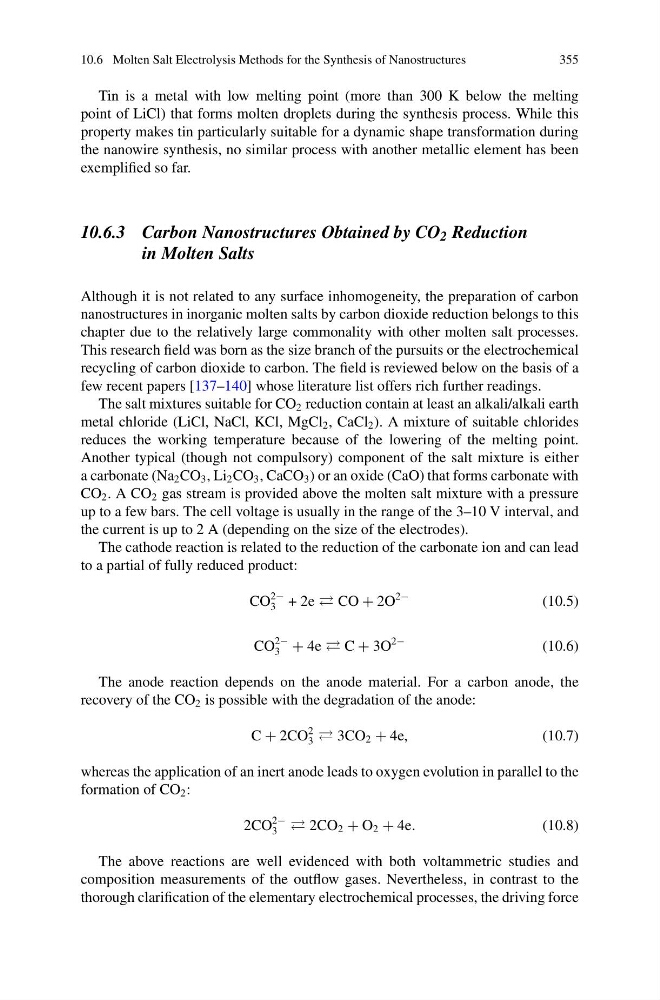
The cathode reaction is related to the reduction of the carbonate ion and can lead
to a partial of fully reduced product:
CO
2−
3 + 2e CO + 2O
2−
(10.5)
CO
2−
3 + 4e C + 3O
2−
(10.6)
The anode reaction depends on the anode material. For a carbon anode, the
recovery of the CO 2 is possible with the degradation of the anode:
C + 2CO
2
3 3CO 2 + 4e,
(10.7)
whereas the application of an inert anode leads to oxygen evolution in parallel to the
formation of CO 2 :
2CO
2−
3 2CO 2 + O 2 + 4e.
(10.8)
The above reactions are well evidenced with both voltammetric studies and
composition measurements of the outflow gases. Nevertheless, in contrast to the
thorough clarification of the elementary electrochemical processes, the driving force
355
Tin is a metal with low melting point (more than 300 K below the melting
point of LiCl) that forms molten droplets during the synthesis process. While this
property makes tin particularly suitable for a dynamic shape transformation during
the nanowire synthesis, no similar process with another metallic element has been
exemplified so far.
10.6.3 Carbon Nanostructures Obtained by CO 2 Reduction
in Molten Salts
Although it is not related to any surface inhomogeneity, the preparation of carbon
nanostructures in inorganic molten salts by carbon dioxide reduction belongs to this
chapter due to the relatively large commonality with other molten salt processes.
This research field was born as the size branch of the pursuits or the electrochemical
recycling of carbon dioxide to carbon. The field is reviewed below on the basis of a
few recent papers [137–140] whose literature list offers rich further readings.
The salt mixtures suitable for CO 2 reduction contain at least an alkali/alkali earth
metal chloride (LiCl, NaCl, KCl, MgCl 2 , CaCl 2 ). A mixture of suitable chlorides
reduces the working temperature because of the lowering of the melting point.
Another typical (though not compulsory) component of the salt mixture is either
a carbonate (Na 2 CO 3 , Li 2 CO 3 , CaCO 3 ) or an oxide (CaO) that forms carbonate with
CO 2 . A CO 2 gas stream is provided above the molten salt mixture with a pressure
up to a few bars. The cell voltage is usually in the range of the 3–10 V interval, and
the current is up to 2 A (depending on the size of the electrodes).
The cathode reaction is related to the reduction of the carbonate ion and can lead
to a partial of fully reduced product:
CO
2−
3 + 2e CO + 2O
2−
(10.5)
CO
2−
3 + 4e C + 3O
2−
(10.6)
The anode reaction depends on the anode material. For a carbon anode, the
recovery of the CO 2 is possible with the degradation of the anode:
C + 2CO
2
3 3CO 2 + 4e,
(10.7)
whereas the application of an inert anode leads to oxygen evolution in parallel to the
formation of CO 2 :
2CO
2−
3 2CO 2 + O 2 + 4e.
(10.8)
The above reactions are well evidenced with both voltammetric studies and
composition measurements of the outflow gases. Nevertheless, in contrast to the
thorough clarification of the elementary electrochemical processes, the driving force