

354
10 Electrochemical Manufacturing Methods Based on Surface …
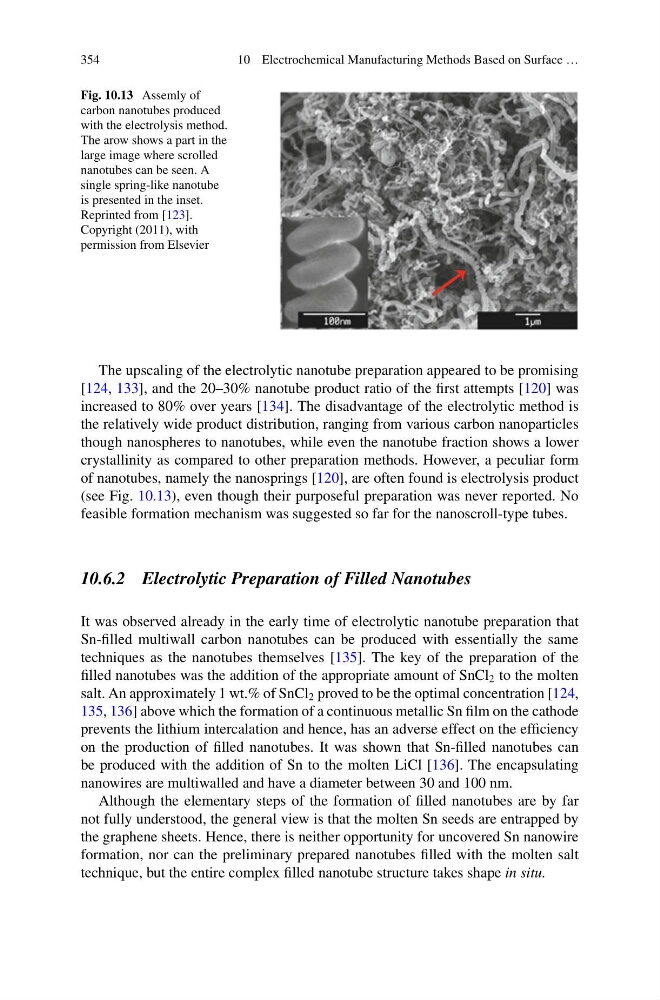
Fig. 10.13 Assemly of
carbon nanotubes produced
with the electrolysis method.
The arow shows a part in the
large image where scrolled
nanotubes can be seen. A
single spring-like nanotube
is presented in the inset.
Reprinted from [123].
Copyright (2011), with
permission from Elsevier
The upscaling of the electrolytic nanotube preparation appeared to be promising
[124, 133], and the 20–30% nanotube product ratio of the first attempts [120] was
increased to 80% over years [134]. The disadvantage of the electrolytic method is
the relatively wide product distribution, ranging from various carbon nanoparticles
though nanospheres to nanotubes, while even the nanotube fraction shows a lower
crystallinity as compared to other preparation methods. However, a peculiar form
of nanotubes, namely the nanosprings [120], are often found is electrolysis product
(see Fig. 10.13), even though their purposeful preparation was never reported. No
feasible formation mechanism was suggested so far for the nanoscroll-type tubes.
10.6.2 Electrolytic Preparation of Filled Nanotubes
It was observed already in the early time of electrolytic nanotube preparation that
Sn-filled multiwall carbon nanotubes can be produced with essentially the same
techniques as the nanotubes themselves [135]. The key of the preparation of the
filled nanotubes was the addition of the appropriate amount of SnCl 2 to the molten
salt. An approximately 1 wt.% of SnCl 2 proved to be the optimal concentration [124,
135, 136] above which the formation of a continuous metallic Sn film on the cathode
prevents the lithium intercalation and hence, has an adverse effect on the efficiency
on the production of filled nanotubes. It was shown that Sn-filled nanotubes can
be produced with the addition of Sn to the molten LiCl [136]. The encapsulating
nanowires are multiwalled and have a diameter between 30 and 100 nm.
Although the elementary steps of the formation of filled nanotubes are by far
not fully understood, the general view is that the molten Sn seeds are entrapped by
the graphene sheets. Hence, there is neither opportunity for uncovered Sn nanowire
formation, nor can the preliminary prepared nanotubes filled with the molten salt
technique, but the entire complex filled nanotube structure takes shape in situ.
10 Electrochemical Manufacturing Methods Based on Surface …
Fig. 10.13 Assemly of
carbon nanotubes produced
with the electrolysis method.
The arow shows a part in the
large image where scrolled
nanotubes can be seen. A
single spring-like nanotube
is presented in the inset.
Reprinted from [123].
Copyright (2011), with
permission from Elsevier
The upscaling of the electrolytic nanotube preparation appeared to be promising
[124, 133], and the 20–30% nanotube product ratio of the first attempts [120] was
increased to 80% over years [134]. The disadvantage of the electrolytic method is
the relatively wide product distribution, ranging from various carbon nanoparticles
though nanospheres to nanotubes, while even the nanotube fraction shows a lower
crystallinity as compared to other preparation methods. However, a peculiar form
of nanotubes, namely the nanosprings [120], are often found is electrolysis product
(see Fig. 10.13), even though their purposeful preparation was never reported. No
feasible formation mechanism was suggested so far for the nanoscroll-type tubes.
10.6.2 Electrolytic Preparation of Filled Nanotubes
It was observed already in the early time of electrolytic nanotube preparation that
Sn-filled multiwall carbon nanotubes can be produced with essentially the same
techniques as the nanotubes themselves [135]. The key of the preparation of the
filled nanotubes was the addition of the appropriate amount of SnCl 2 to the molten
salt. An approximately 1 wt.% of SnCl 2 proved to be the optimal concentration [124,
135, 136] above which the formation of a continuous metallic Sn film on the cathode
prevents the lithium intercalation and hence, has an adverse effect on the efficiency
on the production of filled nanotubes. It was shown that Sn-filled nanotubes can
be produced with the addition of Sn to the molten LiCl [136]. The encapsulating
nanowires are multiwalled and have a diameter between 30 and 100 nm.
Although the elementary steps of the formation of filled nanotubes are by far
not fully understood, the general view is that the molten Sn seeds are entrapped by
the graphene sheets. Hence, there is neither opportunity for uncovered Sn nanowire
formation, nor can the preliminary prepared nanotubes filled with the molten salt
technique, but the entire complex filled nanotube structure takes shape in situ.