

14
2 Electrochemistry and Electrodeposition
or
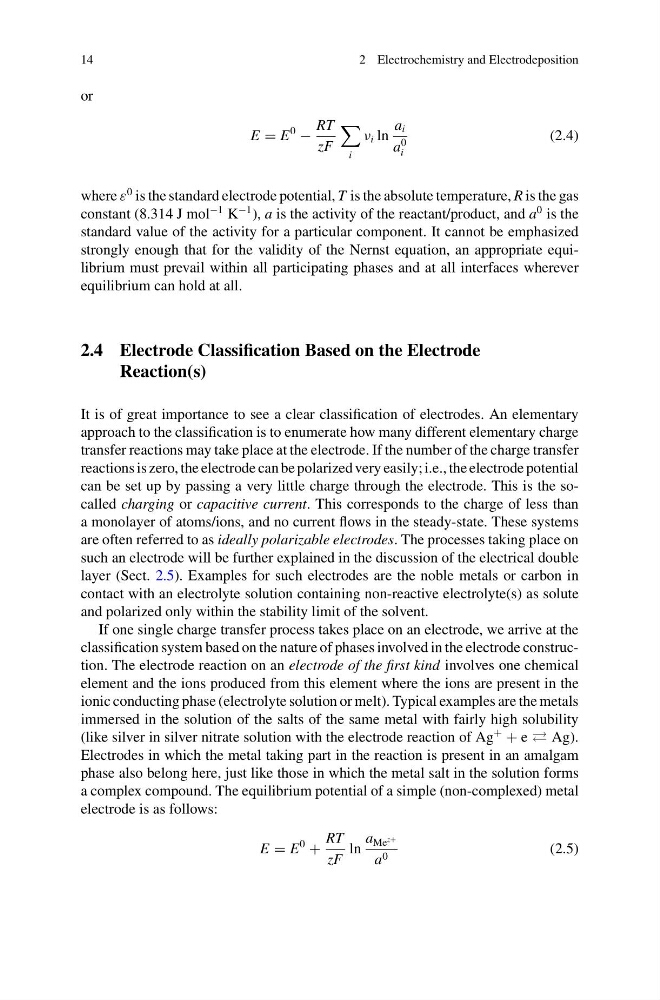
E = E
0
−
RT
zF
i
ν i ln
a i
a
0
i
(2.4)
where ε
0 is the standard electrode potential, T is the absolute temperature, R is the gas
constant (8.314 J mol
−1 K
−1 ), a is the activity of the reactant/product, and a
0 is the
standard value of the activity for a particular component. It cannot be emphasized
strongly enough that for the validity of the Nernst equation, an appropriate equilibrium must prevail within all participating phases and at all interfaces wherever
equilibrium can hold at all.
2.4 Electrode Classification Based on the Electrode
Reaction(s)
It is of great importance to see a clear classification of electrodes. An elementary
approach to the classification is to enumerate how many different elementary charge
transfer reactions may take place at the electrode. If the number of the charge transfer
reactions is zero, the electrode can be polarized very easily; i.e., the electrode potential
can be set up by passing a very little charge through the electrode. This is the socalled charging or capacitive current. This corresponds to the charge of less than
a monolayer of atoms/ions, and no current flows in the steady-state. These systems
are often referred to as ideally polarizable electrodes. The processes taking place on
such an electrode will be further explained in the discussion of the electrical double
layer (Sect. 2.5). Examples for such electrodes are the noble metals or carbon in
contact with an electrolyte solution containing non-reactive electrolyte(s) as solute
and polarized only within the stability limit of the solvent.
If one single charge transfer process takes place on an electrode, we arrive at the
classification system based on the nature of phases involved in the electrode construction. The electrode reaction on an electrode of the first kind involves one chemical
element and the ions produced from this element where the ions are present in the
ionic conducting phase (electrolyte solution or melt). Typical examples are the metals
immersed in the solution of the salts of the same metal with fairly high solubility
(like silver in silver nitrate solution with the electrode reaction of Ag
+
+ e Ag).
Electrodes in which the metal taking part in the reaction is present in an amalgam
phase also belong here, just like those in which the metal salt in the solution forms
a complex compound. The equilibrium potential of a simple (non-complexed) metal
electrode is as follows:
E = E
0
+
RT
zF
ln
a Me
z+
a 0
(2.5)
2 Electrochemistry and Electrodeposition
or
E = E
0
−
RT
zF
i
ν i ln
a i
a
0
i
(2.4)
where ε
0 is the standard electrode potential, T is the absolute temperature, R is the gas
constant (8.314 J mol
−1 K
−1 ), a is the activity of the reactant/product, and a
0 is the
standard value of the activity for a particular component. It cannot be emphasized
strongly enough that for the validity of the Nernst equation, an appropriate equilibrium must prevail within all participating phases and at all interfaces wherever
equilibrium can hold at all.
2.4 Electrode Classification Based on the Electrode
Reaction(s)
It is of great importance to see a clear classification of electrodes. An elementary
approach to the classification is to enumerate how many different elementary charge
transfer reactions may take place at the electrode. If the number of the charge transfer
reactions is zero, the electrode can be polarized very easily; i.e., the electrode potential
can be set up by passing a very little charge through the electrode. This is the socalled charging or capacitive current. This corresponds to the charge of less than
a monolayer of atoms/ions, and no current flows in the steady-state. These systems
are often referred to as ideally polarizable electrodes. The processes taking place on
such an electrode will be further explained in the discussion of the electrical double
layer (Sect. 2.5). Examples for such electrodes are the noble metals or carbon in
contact with an electrolyte solution containing non-reactive electrolyte(s) as solute
and polarized only within the stability limit of the solvent.
If one single charge transfer process takes place on an electrode, we arrive at the
classification system based on the nature of phases involved in the electrode construction. The electrode reaction on an electrode of the first kind involves one chemical
element and the ions produced from this element where the ions are present in the
ionic conducting phase (electrolyte solution or melt). Typical examples are the metals
immersed in the solution of the salts of the same metal with fairly high solubility
(like silver in silver nitrate solution with the electrode reaction of Ag
+
+ e Ag).
Electrodes in which the metal taking part in the reaction is present in an amalgam
phase also belong here, just like those in which the metal salt in the solution forms
a complex compound. The equilibrium potential of a simple (non-complexed) metal
electrode is as follows:
E = E
0
+
RT
zF
ln
a Me
z+
a 0
(2.5)