

2.4 Electrode Classification Based on the Electrode Reaction(s)
15
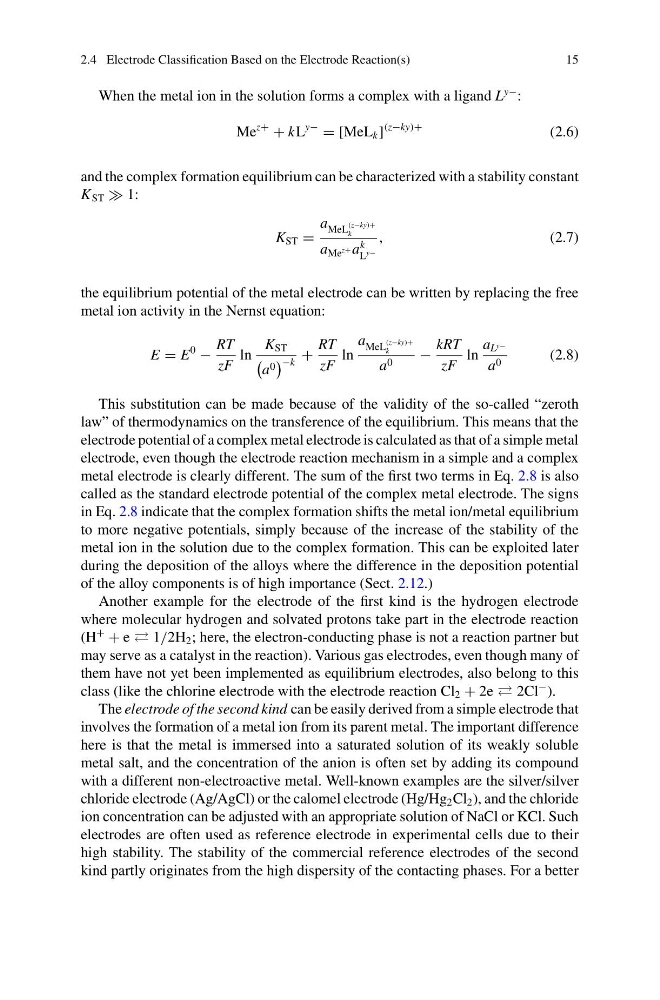
When the metal ion in the solution forms a complex with a ligand L
y− :
Me
z+
+ kL
y−
= [MeL k ]
(z−ky)+
(2.6)
and the complex formation equilibrium can be characterized with a stability constant
K ST 1:
K ST =
a MeL
(z−ky)+
k
a Me
z+ a
k
L
y−
,
(2.7)
the equilibrium potential of the metal electrode can be written by replacing the free
metal ion activity in the Nernst equation:
E = E
0
−
RT
zF
ln
K ST
a 0
−k +
RT
zF
ln
a MeL
(z−ky)+
k
a 0
−
kRT
zF
ln
a L y−
a 0
(2.8)
This substitution can be made because of the validity of the so-called “zeroth
law” of thermodynamics on the transference of the equilibrium. This means that the
electrode potential of a complex metal electrode is calculated as that of a simple metal
electrode, even though the electrode reaction mechanism in a simple and a complex
metal electrode is clearly different. The sum of the first two terms in Eq. 2.8 is also
called as the standard electrode potential of the complex metal electrode. The signs
in Eq. 2.8 indicate that the complex formation shifts the metal ion/metal equilibrium
to more negative potentials, simply because of the increase of the stability of the
metal ion in the solution due to the complex formation. This can be exploited later
during the deposition of the alloys where the difference in the deposition potential
of the alloy components is of high importance (Sect. 2.12.)
Another example for the electrode of the first kind is the hydrogen electrode
where molecular hydrogen and solvated protons take part in the electrode reaction
(H
+
+ e 1/2H 2 ; here, the electron-conducting phase is not a reaction partner but
may serve as a catalyst in the reaction). Various gas electrodes, even though many of
them have not yet been implemented as equilibrium electrodes, also belong to this
class (like the chlorine electrode with the electrode reaction Cl 2 + 2e 2Cl
− ).
The electrode of the second kind can be easily derived from a simple electrode that
involves the formation of a metal ion from its parent metal. The important difference
here is that the metal is immersed into a saturated solution of its weakly soluble
metal salt, and the concentration of the anion is often set by adding its compound
with a different non-electroactive metal. Well-known examples are the silver/silver
chloride electrode (Ag/AgCl) or the calomel electrode (Hg/Hg 2 Cl 2 ), and the chloride
ion concentration can be adjusted with an appropriate solution of NaCl or KCl. Such
electrodes are often used as reference electrode in experimental cells due to their
high stability. The stability of the commercial reference electrodes of the second
kind partly originates from the high dispersity of the contacting phases. For a better
15
When the metal ion in the solution forms a complex with a ligand L
y− :
Me
z+
+ kL
y−
= [MeL k ]
(z−ky)+
(2.6)
and the complex formation equilibrium can be characterized with a stability constant
K ST 1:
K ST =
a MeL
(z−ky)+
k
a Me
z+ a
k
L
y−
,
(2.7)
the equilibrium potential of the metal electrode can be written by replacing the free
metal ion activity in the Nernst equation:
E = E
0
−
RT
zF
ln
K ST
a 0
−k +
RT
zF
ln
a MeL
(z−ky)+
k
a 0
−
kRT
zF
ln
a L y−
a 0
(2.8)
This substitution can be made because of the validity of the so-called “zeroth
law” of thermodynamics on the transference of the equilibrium. This means that the
electrode potential of a complex metal electrode is calculated as that of a simple metal
electrode, even though the electrode reaction mechanism in a simple and a complex
metal electrode is clearly different. The sum of the first two terms in Eq. 2.8 is also
called as the standard electrode potential of the complex metal electrode. The signs
in Eq. 2.8 indicate that the complex formation shifts the metal ion/metal equilibrium
to more negative potentials, simply because of the increase of the stability of the
metal ion in the solution due to the complex formation. This can be exploited later
during the deposition of the alloys where the difference in the deposition potential
of the alloy components is of high importance (Sect. 2.12.)
Another example for the electrode of the first kind is the hydrogen electrode
where molecular hydrogen and solvated protons take part in the electrode reaction
(H
+
+ e 1/2H 2 ; here, the electron-conducting phase is not a reaction partner but
may serve as a catalyst in the reaction). Various gas electrodes, even though many of
them have not yet been implemented as equilibrium electrodes, also belong to this
class (like the chlorine electrode with the electrode reaction Cl 2 + 2e 2Cl
− ).
The electrode of the second kind can be easily derived from a simple electrode that
involves the formation of a metal ion from its parent metal. The important difference
here is that the metal is immersed into a saturated solution of its weakly soluble
metal salt, and the concentration of the anion is often set by adding its compound
with a different non-electroactive metal. Well-known examples are the silver/silver
chloride electrode (Ag/AgCl) or the calomel electrode (Hg/Hg 2 Cl 2 ), and the chloride
ion concentration can be adjusted with an appropriate solution of NaCl or KCl. Such
electrodes are often used as reference electrode in experimental cells due to their
high stability. The stability of the commercial reference electrodes of the second
kind partly originates from the high dispersity of the contacting phases. For a better