

8.3 Porous Structures Electrodeposited from Dilute Solutions
277
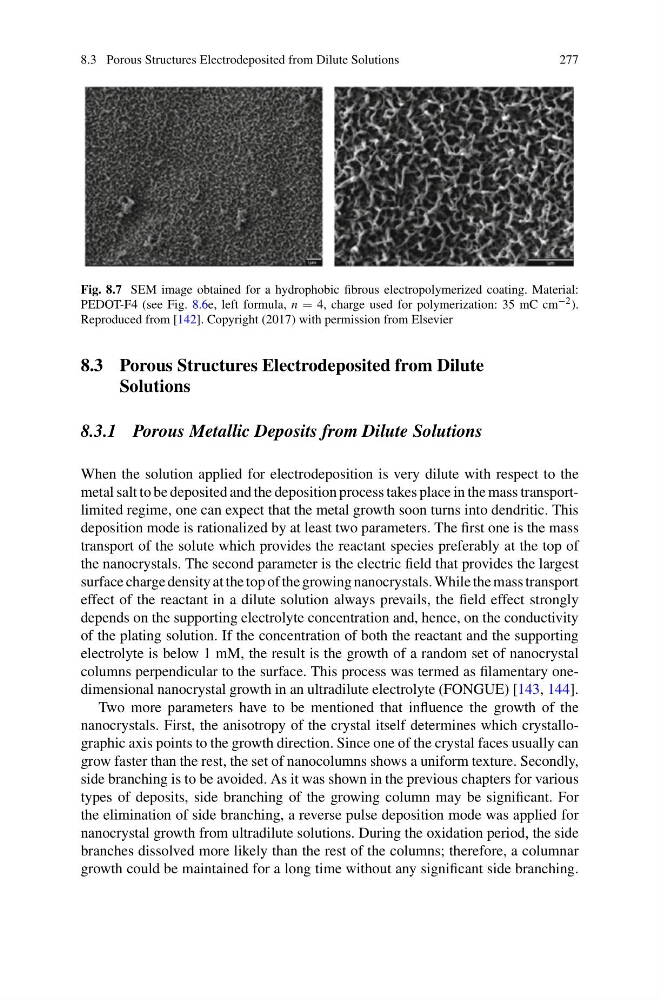
Fig. 8.7 SEM image obtained for a hydrophobic fibrous electropolymerized coating. Material:
PEDOT-F4 (see Fig. 8.6e, left formula, n = 4, charge used for polymerization: 35 mC cm −2 ).
Reproduced from [142]. Copyright (2017) with permission from Elsevier
8.3 Porous Structures Electrodeposited from Dilute
Solutions
8.3.1 Porous Metallic Deposits from Dilute Solutions
When the solution applied for electrodeposition is very dilute with respect to the
metal salt to be deposited and the deposition process takes place in the mass transportlimited regime, one can expect that the metal growth soon turns into dendritic. This
deposition mode is rationalized by at least two parameters. The first one is the mass
transport of the solute which provides the reactant species preferably at the top of
the nanocrystals. The second parameter is the electric field that provides the largest
surface charge density at the top of the growing nanocrystals. While the mass transport
effect of the reactant in a dilute solution always prevails, the field effect strongly
depends on the supporting electrolyte concentration and, hence, on the conductivity
of the plating solution. If the concentration of both the reactant and the supporting
electrolyte is below 1 mM, the result is the growth of a random set of nanocrystal
columns perpendicular to the surface. This process was termed as filamentary onedimensional nanocrystal growth in an ultradilute electrolyte (FONGUE) [143, 144].
Two more parameters have to be mentioned that influence the growth of the
nanocrystals. First, the anisotropy of the crystal itself determines which crystallographic axis points to the growth direction. Since one of the crystal faces usually can
grow faster than the rest, the set of nanocolumns shows a uniform texture. Secondly,
side branching is to be avoided. As it was shown in the previous chapters for various
types of deposits, side branching of the growing column may be significant. For
the elimination of side branching, a reverse pulse deposition mode was applied for
nanocrystal growth from ultradilute solutions. During the oxidation period, the side
branches dissolved more likely than the rest of the columns; therefore, a columnar
growth could be maintained for a long time without any significant side branching.
277
Fig. 8.7 SEM image obtained for a hydrophobic fibrous electropolymerized coating. Material:
PEDOT-F4 (see Fig. 8.6e, left formula, n = 4, charge used for polymerization: 35 mC cm −2 ).
Reproduced from [142]. Copyright (2017) with permission from Elsevier
8.3 Porous Structures Electrodeposited from Dilute
Solutions
8.3.1 Porous Metallic Deposits from Dilute Solutions
When the solution applied for electrodeposition is very dilute with respect to the
metal salt to be deposited and the deposition process takes place in the mass transportlimited regime, one can expect that the metal growth soon turns into dendritic. This
deposition mode is rationalized by at least two parameters. The first one is the mass
transport of the solute which provides the reactant species preferably at the top of
the nanocrystals. The second parameter is the electric field that provides the largest
surface charge density at the top of the growing nanocrystals. While the mass transport
effect of the reactant in a dilute solution always prevails, the field effect strongly
depends on the supporting electrolyte concentration and, hence, on the conductivity
of the plating solution. If the concentration of both the reactant and the supporting
electrolyte is below 1 mM, the result is the growth of a random set of nanocrystal
columns perpendicular to the surface. This process was termed as filamentary onedimensional nanocrystal growth in an ultradilute electrolyte (FONGUE) [143, 144].
Two more parameters have to be mentioned that influence the growth of the
nanocrystals. First, the anisotropy of the crystal itself determines which crystallographic axis points to the growth direction. Since one of the crystal faces usually can
grow faster than the rest, the set of nanocolumns shows a uniform texture. Secondly,
side branching is to be avoided. As it was shown in the previous chapters for various
types of deposits, side branching of the growing column may be significant. For
the elimination of side branching, a reverse pulse deposition mode was applied for
nanocrystal growth from ultradilute solutions. During the oxidation period, the side
branches dissolved more likely than the rest of the columns; therefore, a columnar
growth could be maintained for a long time without any significant side branching.