

278
8 Porous Nanostructured Materials
The application of the reverse potential mode was also thought to lead to a unimodal
and narrow crystal diameter distribution. The increase in the reverse pulse potential
resulted in narrower crystals and higher porosity at the same time [144], which indicates that sidewise dissolution also may take place during this pulse. The addition
of sulphuric acid to the bath as small-concentration supporting electrolyte was also
found beneficial in avoiding the formation of side branches.
Here, the attention has to be drawn to the fact that the electrode potentials given for
the reverse pulse method (either for the deposition or the dissolution pulse) have to
be treated with some care. Since the conductivity of the low-concentration solutions
is a few tens of µS cm
−1 , the potentials ranging to ±15 V account for a huge ohmic
drop, and the values given cannot be directly compared to the usual potential scale.
Metal nanocolumns thus obtained are as follows (with the solution composition):
Ag (20 µM AgNO 3 + various supporting electrolytes [144] or 20 µM AgNO 3 [145]),
Cu (50 µM CuSO 4 + 26 µM H 2 SO 4 [143]), Au (650 µM HAuCl 4 [143]) and Ag–
Cu (20 µM AgNO 3 + 15 µM CuSO 4 + 26 µM H 2 SO 4 [143]). Due to the small
reactant concentration, the deposition time ranges to hours (if the time is too short,
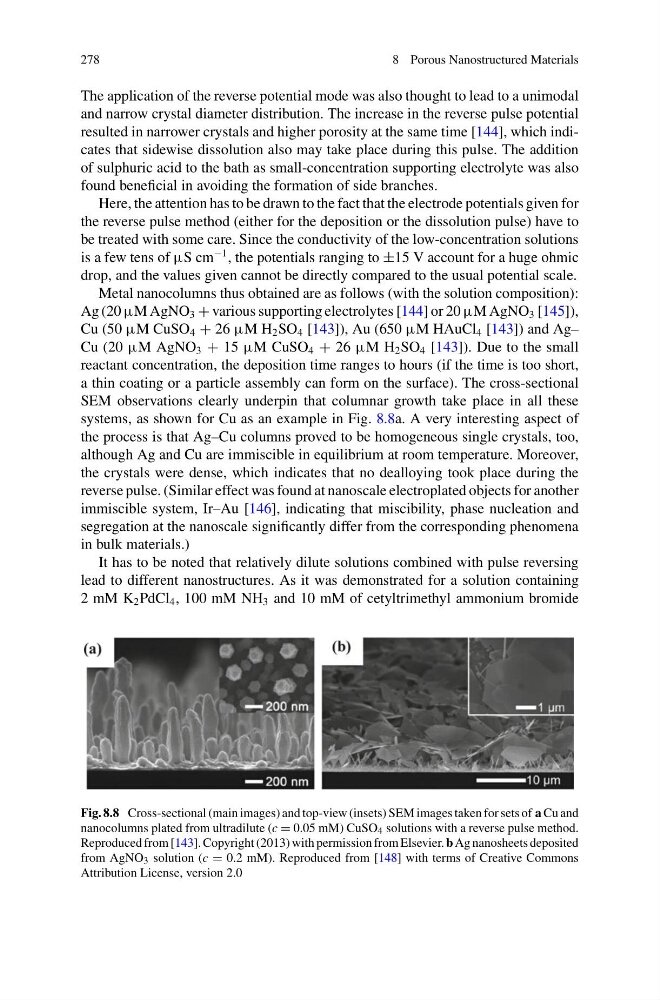
a thin coating or a particle assembly can form on the surface). The cross-sectional
SEM observations clearly underpin that columnar growth take place in all these
systems, as shown for Cu as an example in Fig. 8.8a. A very interesting aspect of
the process is that Ag–Cu columns proved to be homogeneous single crystals, too,
although Ag and Cu are immiscible in equilibrium at room temperature. Moreover,
the crystals were dense, which indicates that no dealloying took place during the
reverse pulse. (Similar effect was found at nanoscale electroplated objects for another
immiscible system, Ir–Au [146], indicating that miscibility, phase nucleation and
segregation at the nanoscale significantly differ from the corresponding phenomena
in bulk materials.)
It has to be noted that relatively dilute solutions combined with pulse reversing
lead to different nanostructures. As it was demonstrated for a solution containing
2 mM K 2 PdCl 4 , 100 mM NH 3 and 10 mM of cetyltrimethyl ammonium bromide
Fig. 8.8 Cross-sectional (main images) and top-view (insets) SEM images taken for sets of a Cu and
nanocolumns plated from ultradilute (c = 0.05 mM) CuSO 4 solutions with a reverse pulse method.
Reproduced from [143]. Copyright (2013) with permission from Elsevier. b Ag nanosheets deposited
from AgNO 3 solution (c = 0.2 mM). Reproduced from [148] with terms of Creative Commons
Attribution License, version 2.0
8 Porous Nanostructured Materials
The application of the reverse potential mode was also thought to lead to a unimodal
and narrow crystal diameter distribution. The increase in the reverse pulse potential
resulted in narrower crystals and higher porosity at the same time [144], which indicates that sidewise dissolution also may take place during this pulse. The addition
of sulphuric acid to the bath as small-concentration supporting electrolyte was also
found beneficial in avoiding the formation of side branches.
Here, the attention has to be drawn to the fact that the electrode potentials given for
the reverse pulse method (either for the deposition or the dissolution pulse) have to
be treated with some care. Since the conductivity of the low-concentration solutions
is a few tens of µS cm
−1 , the potentials ranging to ±15 V account for a huge ohmic
drop, and the values given cannot be directly compared to the usual potential scale.
Metal nanocolumns thus obtained are as follows (with the solution composition):
Ag (20 µM AgNO 3 + various supporting electrolytes [144] or 20 µM AgNO 3 [145]),
Cu (50 µM CuSO 4 + 26 µM H 2 SO 4 [143]), Au (650 µM HAuCl 4 [143]) and Ag–
Cu (20 µM AgNO 3 + 15 µM CuSO 4 + 26 µM H 2 SO 4 [143]). Due to the small
reactant concentration, the deposition time ranges to hours (if the time is too short,
a thin coating or a particle assembly can form on the surface). The cross-sectional
SEM observations clearly underpin that columnar growth take place in all these
systems, as shown for Cu as an example in Fig. 8.8a. A very interesting aspect of
the process is that Ag–Cu columns proved to be homogeneous single crystals, too,
although Ag and Cu are immiscible in equilibrium at room temperature. Moreover,
the crystals were dense, which indicates that no dealloying took place during the
reverse pulse. (Similar effect was found at nanoscale electroplated objects for another
immiscible system, Ir–Au [146], indicating that miscibility, phase nucleation and
segregation at the nanoscale significantly differ from the corresponding phenomena
in bulk materials.)
It has to be noted that relatively dilute solutions combined with pulse reversing
lead to different nanostructures. As it was demonstrated for a solution containing
2 mM K 2 PdCl 4 , 100 mM NH 3 and 10 mM of cetyltrimethyl ammonium bromide
Fig. 8.8 Cross-sectional (main images) and top-view (insets) SEM images taken for sets of a Cu and
nanocolumns plated from ultradilute (c = 0.05 mM) CuSO 4 solutions with a reverse pulse method.
Reproduced from [143]. Copyright (2013) with permission from Elsevier. b Ag nanosheets deposited
from AgNO 3 solution (c = 0.2 mM). Reproduced from [148] with terms of Creative Commons
Attribution License, version 2.0