

276
8 Porous Nanostructured Materials
narrow potential window in aqueous solution. This is valid for polymers composed
of simple monomers like aniline, pyrrole, thiophene or ethylene dioxithiophene.
In order to obtain elecropolymerized films in a hydrophobic form, the monomers
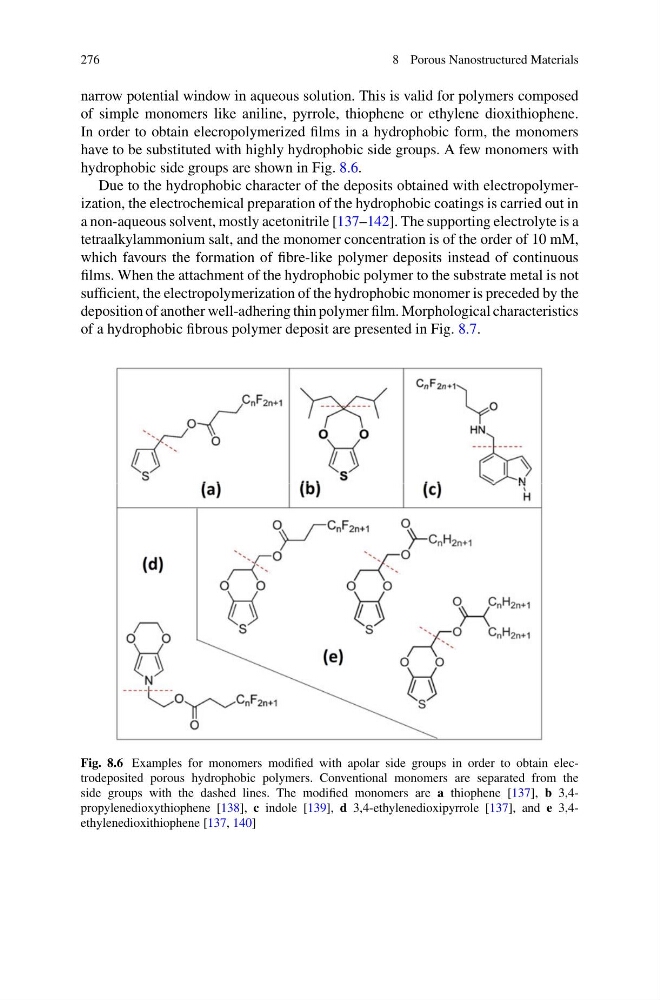
have to be substituted with highly hydrophobic side groups. A few monomers with
hydrophobic side groups are shown in Fig. 8.6.
Due to the hydrophobic character of the deposits obtained with electropolymerization, the electrochemical preparation of the hydrophobic coatings is carried out in
a non-aqueous solvent, mostly acetonitrile [137–142]. The supporting electrolyte is a
tetraalkylammonium salt, and the monomer concentration is of the order of 10 mM,
which favours the formation of fibre-like polymer deposits instead of continuous
films. When the attachment of the hydrophobic polymer to the substrate metal is not
sufficient, the electropolymerization of the hydrophobic monomer is preceded by the
deposition of another well-adhering thin polymer film. Morphological characteristics
of a hydrophobic fibrous polymer deposit are presented in Fig. 8.7.
Fig. 8.6 Examples for monomers modified with apolar side groups in order to obtain electrodeposited porous hydrophobic polymers. Conventional monomers are separated from the
side groups with the dashed lines. The modified monomers are a thiophene [137], b 3,4propylenedioxythiophene [138], c indole [139], d 3,4-ethylenedioxipyrrole [137], and e 3,4ethylenedioxithiophene [137, 140]
8 Porous Nanostructured Materials
narrow potential window in aqueous solution. This is valid for polymers composed
of simple monomers like aniline, pyrrole, thiophene or ethylene dioxithiophene.
In order to obtain elecropolymerized films in a hydrophobic form, the monomers
have to be substituted with highly hydrophobic side groups. A few monomers with
hydrophobic side groups are shown in Fig. 8.6.
Due to the hydrophobic character of the deposits obtained with electropolymerization, the electrochemical preparation of the hydrophobic coatings is carried out in
a non-aqueous solvent, mostly acetonitrile [137–142]. The supporting electrolyte is a
tetraalkylammonium salt, and the monomer concentration is of the order of 10 mM,
which favours the formation of fibre-like polymer deposits instead of continuous
films. When the attachment of the hydrophobic polymer to the substrate metal is not
sufficient, the electropolymerization of the hydrophobic monomer is preceded by the
deposition of another well-adhering thin polymer film. Morphological characteristics
of a hydrophobic fibrous polymer deposit are presented in Fig. 8.7.
Fig. 8.6 Examples for monomers modified with apolar side groups in order to obtain electrodeposited porous hydrophobic polymers. Conventional monomers are separated from the
side groups with the dashed lines. The modified monomers are a thiophene [137], b 3,4propylenedioxythiophene [138], c indole [139], d 3,4-ethylenedioxipyrrole [137], and e 3,4ethylenedioxithiophene [137, 140]