

230
7 Composites
of pH and ionic strength of the bath is visualized Fig. 7.2b. It clearly indicates that
the larger the ionic strength of a solution, the wider is the instability range in the pH
scale.
Since the plating baths are usually optimized to a very narrow pH range, it is
practically never a real option in the plating industry to tune the bath pH for making a
suspension stable. Instead, other types of countermeasures are applied for preventing
the coagulation of the particles, which will be detailed below in Sect. 7.2.5.
7.2.3 Theories of Particle Incorporation During
Electroplating
Codeposition of particles from suspensions is possible for both positively and negatively charged particles, which means that the force acting between the particle and
the metal plated is not electrostatic in nature; nevertheless, the binding mode is practically never known. Secondly, the stability of the suspensions is usually maintained
by applying an appropriate surfactant which, if it is ionic, can itself provide the sufficient surface charge. Besides, the adsorbed tenside layer prevents the formation of the
interaction of the core material of the particles. The preparation of stable suspensions
is often described as a lengthy process with continuous stirring or ultrasonication.
The bath agitation is necessary also during the plating process for the sake of both
the maintenance of the suspension stability and the sufficient mechanical transport
of the particles towards the growing surface.
The historical line of the models related to particle codeposition during electroplating has been summarized in a number of works [58–64]. Here, the essential details
are given below with referring the interested readers to the original publications. An
overview of the incorporation process is presented in Fig. 7.3.
Early notions on the incorporation of the suspended particles were based on a
simple mechanical entrapment theory. This was later exceeded by claiming that the
residence time of the particles at the surface of the growing metal has to be longer than
during a free motion [65], i.e., an adsorption step is necessary for the immobilization
at the surface prior to the incorporation itself. The pivotal point of the quantitative
description of the particle codeposition was Guglielmi’s work [66] in which a twostep adsorption model was proposed. The two stages of adsorption are characterized
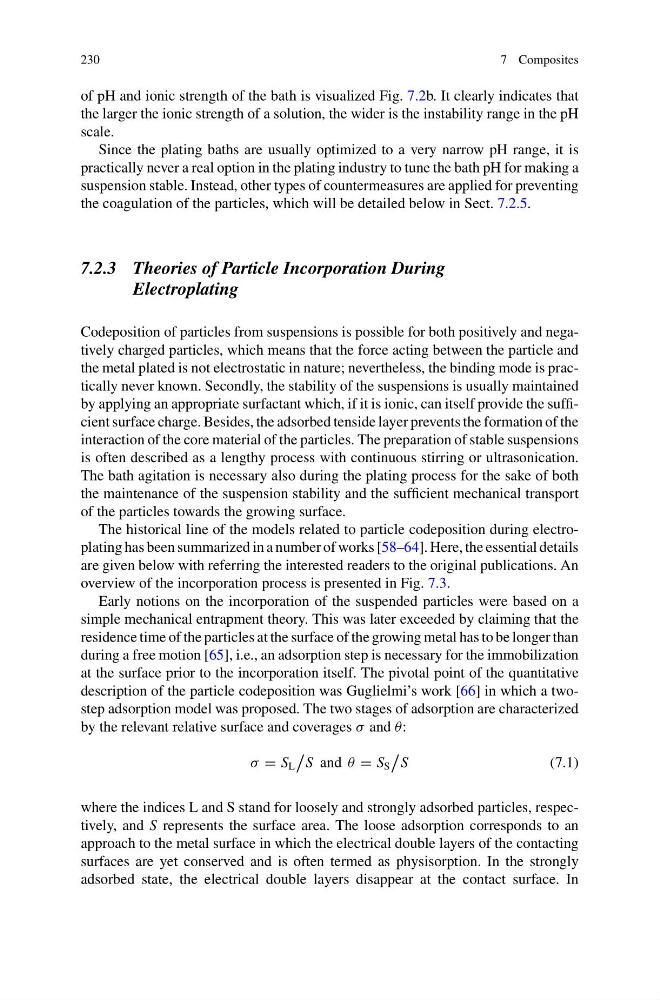
by the relevant relative surface and coverages σ and θ:
σ = S L
S and θ = S S
S
(7.1)
where the indices L and S stand for loosely and strongly adsorbed particles, respectively, and S represents the surface area. The loose adsorption corresponds to an
approach to the metal surface in which the electrical double layers of the contacting
surfaces are yet conserved and is often termed as physisorption. In the strongly
adsorbed state, the electrical double layers disappear at the contact surface. In
7 Composites
of pH and ionic strength of the bath is visualized Fig. 7.2b. It clearly indicates that
the larger the ionic strength of a solution, the wider is the instability range in the pH
scale.
Since the plating baths are usually optimized to a very narrow pH range, it is
practically never a real option in the plating industry to tune the bath pH for making a
suspension stable. Instead, other types of countermeasures are applied for preventing
the coagulation of the particles, which will be detailed below in Sect. 7.2.5.
7.2.3 Theories of Particle Incorporation During
Electroplating
Codeposition of particles from suspensions is possible for both positively and negatively charged particles, which means that the force acting between the particle and
the metal plated is not electrostatic in nature; nevertheless, the binding mode is practically never known. Secondly, the stability of the suspensions is usually maintained
by applying an appropriate surfactant which, if it is ionic, can itself provide the sufficient surface charge. Besides, the adsorbed tenside layer prevents the formation of the
interaction of the core material of the particles. The preparation of stable suspensions
is often described as a lengthy process with continuous stirring or ultrasonication.
The bath agitation is necessary also during the plating process for the sake of both
the maintenance of the suspension stability and the sufficient mechanical transport
of the particles towards the growing surface.
The historical line of the models related to particle codeposition during electroplating has been summarized in a number of works [58–64]. Here, the essential details
are given below with referring the interested readers to the original publications. An
overview of the incorporation process is presented in Fig. 7.3.
Early notions on the incorporation of the suspended particles were based on a
simple mechanical entrapment theory. This was later exceeded by claiming that the
residence time of the particles at the surface of the growing metal has to be longer than
during a free motion [65], i.e., an adsorption step is necessary for the immobilization
at the surface prior to the incorporation itself. The pivotal point of the quantitative
description of the particle codeposition was Guglielmi’s work [66] in which a twostep adsorption model was proposed. The two stages of adsorption are characterized
by the relevant relative surface and coverages σ and θ:
σ = S L
S and θ = S S
S
(7.1)
where the indices L and S stand for loosely and strongly adsorbed particles, respectively, and S represents the surface area. The loose adsorption corresponds to an
approach to the metal surface in which the electrical double layers of the contacting
surfaces are yet conserved and is often termed as physisorption. In the strongly
adsorbed state, the electrical double layers disappear at the contact surface. In