

7.2 Composite Deposition from Particle Suspensions
231
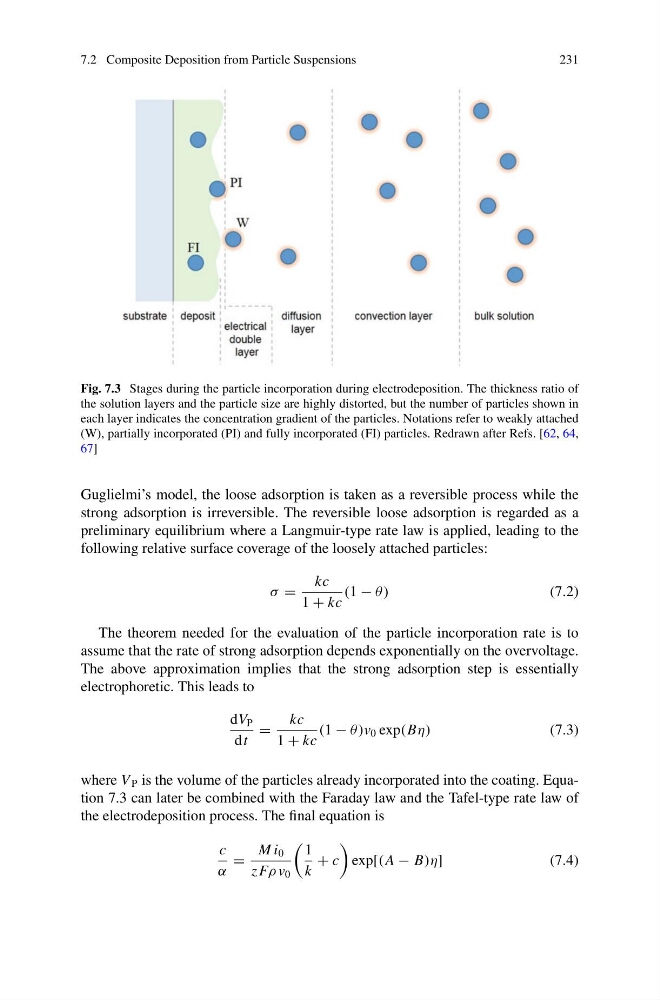
Fig. 7.3 Stages during the particle incorporation during electrodeposition. The thickness ratio of
the solution layers and the particle size are highly distorted, but the number of particles shown in
each layer indicates the concentration gradient of the particles. Notations refer to weakly attached
(W), partially incorporated (PI) and fully incorporated (FI) particles. Redrawn after Refs. [62, 64,
67]
Guglielmi’s model, the loose adsorption is taken as a reversible process while the
strong adsorption is irreversible. The reversible loose adsorption is regarded as a
preliminary equilibrium where a Langmuir-type rate law is applied, leading to the
following relative surface coverage of the loosely attached particles:
σ =
kc
1 + kc
(1 − θ )
(7.2)
The theorem needed for the evaluation of the particle incorporation rate is to
assume that the rate of strong adsorption depends exponentially on the overvoltage.
The above approximation implies that the strong adsorption step is essentially
electrophoretic. This leads to
dV P
dt
=
kc
1 + kc
(1 − θ )v 0 exp(Bη)
(7.3)
where V P is the volume of the particles already incorporated into the coating. Equation 7.3 can later be combined with the Faraday law and the Tafel-type rate law of
the electrodeposition process. The final equation is
c
α
=
M i 0
z Fρ v 0
1
k
+ c
exp[(A − B)η]
(7.4)
231
Fig. 7.3 Stages during the particle incorporation during electrodeposition. The thickness ratio of
the solution layers and the particle size are highly distorted, but the number of particles shown in
each layer indicates the concentration gradient of the particles. Notations refer to weakly attached
(W), partially incorporated (PI) and fully incorporated (FI) particles. Redrawn after Refs. [62, 64,
67]
Guglielmi’s model, the loose adsorption is taken as a reversible process while the
strong adsorption is irreversible. The reversible loose adsorption is regarded as a
preliminary equilibrium where a Langmuir-type rate law is applied, leading to the
following relative surface coverage of the loosely attached particles:
σ =
kc
1 + kc
(1 − θ )
(7.2)
The theorem needed for the evaluation of the particle incorporation rate is to
assume that the rate of strong adsorption depends exponentially on the overvoltage.
The above approximation implies that the strong adsorption step is essentially
electrophoretic. This leads to
dV P
dt
=
kc
1 + kc
(1 − θ )v 0 exp(Bη)
(7.3)
where V P is the volume of the particles already incorporated into the coating. Equation 7.3 can later be combined with the Faraday law and the Tafel-type rate law of
the electrodeposition process. The final equation is
c
α
=
M i 0
z Fρ v 0
1
k
+ c
exp[(A − B)η]
(7.4)