

7.2 Composite Deposition from Particle Suspensions
229
closest approach
without coagulation
secondary minimum
(reversible attachment)
energy term from the
electrostatic force
(repulsion)
Total interparticle intetaction
energy (a.u.)
Particle separation distance (a.u.)
energy term from the
van der Waals force
(attraction)
total energy
primary
minimum
(coagulation)
(a)
(b)
too fast decay of the electrostatic
repulsion force
unstable suspension
stable suspension
ionic strength of
the solution (a.u)
pH
isoelectrical point
of the particle
too small surface charge
stable suspension
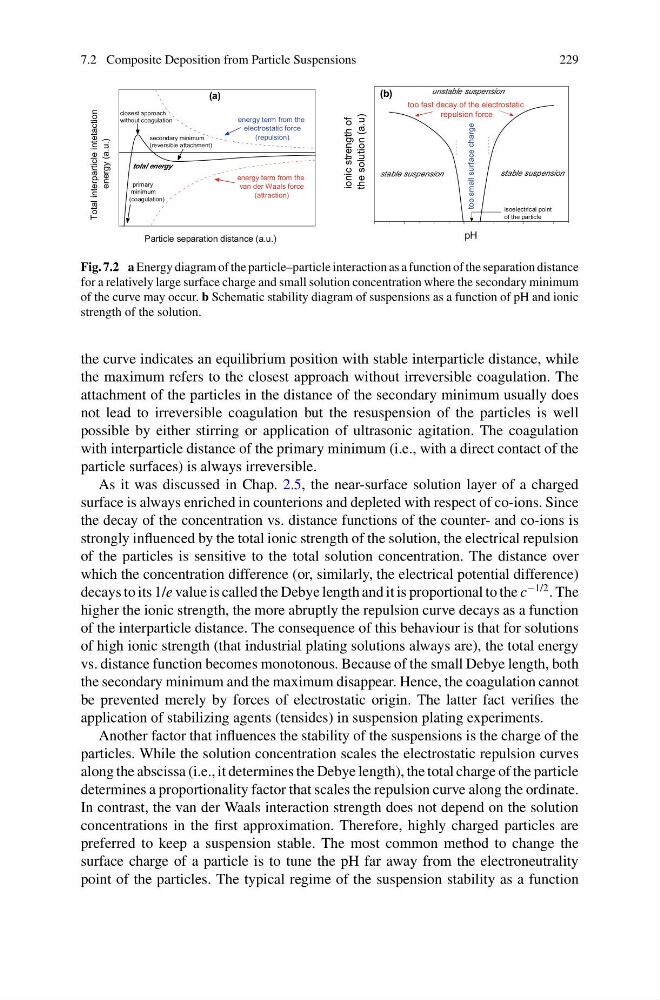
Fig. 7.2 a Energy diagram of the particle–particle interaction as a function of the separation distance
for a relatively large surface charge and small solution concentration where the secondary minimum
of the curve may occur. b Schematic stability diagram of suspensions as a function of pH and ionic
strength of the solution.
the curve indicates an equilibrium position with stable interparticle distance, while
the maximum refers to the closest approach without irreversible coagulation. The
attachment of the particles in the distance of the secondary minimum usually does
not lead to irreversible coagulation but the resuspension of the particles is well
possible by either stirring or application of ultrasonic agitation. The coagulation
with interparticle distance of the primary minimum (i.e., with a direct contact of the
particle surfaces) is always irreversible.
As it was discussed in Chap. 2.5, the near-surface solution layer of a charged
surface is always enriched in counterions and depleted with respect of co-ions. Since
the decay of the concentration vs. distance functions of the counter- and co-ions is
strongly influenced by the total ionic strength of the solution, the electrical repulsion
of the particles is sensitive to the total solution concentration. The distance over
which the concentration difference (or, similarly, the electrical potential difference)
decays to its 1/e value is called the Debye length and it is proportional to the c
−1/2 . The
higher the ionic strength, the more abruptly the repulsion curve decays as a function
of the interparticle distance. The consequence of this behaviour is that for solutions
of high ionic strength (that industrial plating solutions always are), the total energy
vs. distance function becomes monotonous. Because of the small Debye length, both
the secondary minimum and the maximum disappear. Hence, the coagulation cannot
be prevented merely by forces of electrostatic origin. The latter fact verifies the
application of stabilizing agents (tensides) in suspension plating experiments.
Another factor that influences the stability of the suspensions is the charge of the
particles. While the solution concentration scales the electrostatic repulsion curves
along the abscissa (i.e., it determines the Debye length), the total charge of the particle
determines a proportionality factor that scales the repulsion curve along the ordinate.
In contrast, the van der Waals interaction strength does not depend on the solution
concentrations in the first approximation. Therefore, highly charged particles are
preferred to keep a suspension stable. The most common method to change the
surface charge of a particle is to tune the pH far away from the electroneutrality
point of the particles. The typical regime of the suspension stability as a function
229
closest approach
without coagulation
secondary minimum
(reversible attachment)
energy term from the
electrostatic force
(repulsion)
Total interparticle intetaction
energy (a.u.)
Particle separation distance (a.u.)
energy term from the
van der Waals force
(attraction)
total energy
primary
minimum
(coagulation)
(a)
(b)
too fast decay of the electrostatic
repulsion force
unstable suspension
stable suspension
ionic strength of
the solution (a.u)
pH
isoelectrical point
of the particle
too small surface charge
stable suspension
Fig. 7.2 a Energy diagram of the particle–particle interaction as a function of the separation distance
for a relatively large surface charge and small solution concentration where the secondary minimum
of the curve may occur. b Schematic stability diagram of suspensions as a function of pH and ionic
strength of the solution.
the curve indicates an equilibrium position with stable interparticle distance, while
the maximum refers to the closest approach without irreversible coagulation. The
attachment of the particles in the distance of the secondary minimum usually does
not lead to irreversible coagulation but the resuspension of the particles is well
possible by either stirring or application of ultrasonic agitation. The coagulation
with interparticle distance of the primary minimum (i.e., with a direct contact of the
particle surfaces) is always irreversible.
As it was discussed in Chap. 2.5, the near-surface solution layer of a charged
surface is always enriched in counterions and depleted with respect of co-ions. Since
the decay of the concentration vs. distance functions of the counter- and co-ions is
strongly influenced by the total ionic strength of the solution, the electrical repulsion
of the particles is sensitive to the total solution concentration. The distance over
which the concentration difference (or, similarly, the electrical potential difference)
decays to its 1/e value is called the Debye length and it is proportional to the c
−1/2 . The
higher the ionic strength, the more abruptly the repulsion curve decays as a function
of the interparticle distance. The consequence of this behaviour is that for solutions
of high ionic strength (that industrial plating solutions always are), the total energy
vs. distance function becomes monotonous. Because of the small Debye length, both
the secondary minimum and the maximum disappear. Hence, the coagulation cannot
be prevented merely by forces of electrostatic origin. The latter fact verifies the
application of stabilizing agents (tensides) in suspension plating experiments.
Another factor that influences the stability of the suspensions is the charge of the
particles. While the solution concentration scales the electrostatic repulsion curves
along the abscissa (i.e., it determines the Debye length), the total charge of the particle
determines a proportionality factor that scales the repulsion curve along the ordinate.
In contrast, the van der Waals interaction strength does not depend on the solution
concentrations in the first approximation. Therefore, highly charged particles are
preferred to keep a suspension stable. The most common method to change the
surface charge of a particle is to tune the pH far away from the electroneutrality
point of the particles. The typical regime of the suspension stability as a function