

124
4 Ultrathin Layers
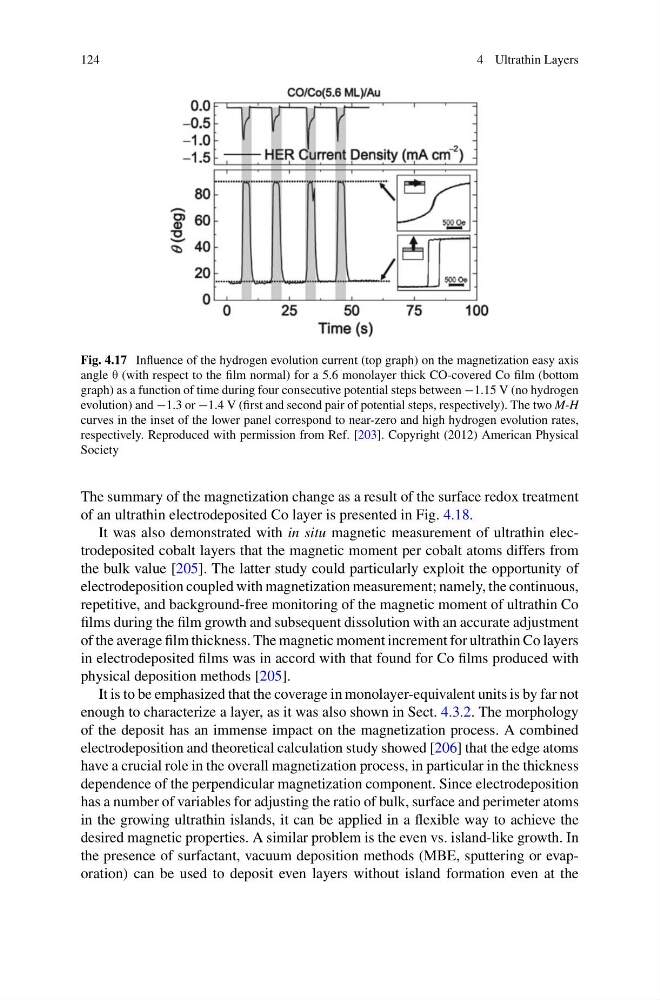
Fig. 4.17 Influence of the hydrogen evolution current (top graph) on the magnetization easy axis
angle θ (with respect to the film normal) for a 5.6 monolayer thick CO-covered Co film (bottom
graph) as a function of time during four consecutive potential steps between −1.15 V (no hydrogen
evolution) and −1.3 or −1.4 V (first and second pair of potential steps, respectively). The two M-H
curves in the inset of the lower panel correspond to near-zero and high hydrogen evolution rates,
respectively. Reproduced with permission from Ref. [203]. Copyright (2012) American Physical
Society
The summary of the magnetization change as a result of the surface redox treatment
of an ultrathin electrodeposited Co layer is presented in Fig. 4.18.
It was also demonstrated with in situ magnetic measurement of ultrathin electrodeposited cobalt layers that the magnetic moment per cobalt atoms differs from
the bulk value [205]. The latter study could particularly exploit the opportunity of
electrodeposition coupled with magnetization measurement; namely, the continuous,
repetitive, and background-free monitoring of the magnetic moment of ultrathin Co
films during the film growth and subsequent dissolution with an accurate adjustment
of the average film thickness. The magnetic moment increment for ultrathin Co layers
in electrodeposited films was in accord with that found for Co films produced with
physical deposition methods [205].
It is to be emphasized that the coverage in monolayer-equivalent units is by far not
enough to characterize a layer, as it was also shown in Sect. 4.3.2. The morphology
of the deposit has an immense impact on the magnetization process. A combined
electrodeposition and theoretical calculation study showed [206] that the edge atoms
have a crucial role in the overall magnetization process, in particular in the thickness
dependence of the perpendicular magnetization component. Since electrodeposition
has a number of variables for adjusting the ratio of bulk, surface and perimeter atoms
in the growing ultrathin islands, it can be applied in a flexible way to achieve the
desired magnetic properties. A similar problem is the even vs. island-like growth. In
the presence of surfactant, vacuum deposition methods (MBE, sputtering or evaporation) can be used to deposit even layers without island formation even at the
4 Ultrathin Layers
Fig. 4.17 Influence of the hydrogen evolution current (top graph) on the magnetization easy axis
angle θ (with respect to the film normal) for a 5.6 monolayer thick CO-covered Co film (bottom
graph) as a function of time during four consecutive potential steps between −1.15 V (no hydrogen
evolution) and −1.3 or −1.4 V (first and second pair of potential steps, respectively). The two M-H
curves in the inset of the lower panel correspond to near-zero and high hydrogen evolution rates,
respectively. Reproduced with permission from Ref. [203]. Copyright (2012) American Physical
Society
The summary of the magnetization change as a result of the surface redox treatment
of an ultrathin electrodeposited Co layer is presented in Fig. 4.18.
It was also demonstrated with in situ magnetic measurement of ultrathin electrodeposited cobalt layers that the magnetic moment per cobalt atoms differs from
the bulk value [205]. The latter study could particularly exploit the opportunity of
electrodeposition coupled with magnetization measurement; namely, the continuous,
repetitive, and background-free monitoring of the magnetic moment of ultrathin Co
films during the film growth and subsequent dissolution with an accurate adjustment
of the average film thickness. The magnetic moment increment for ultrathin Co layers
in electrodeposited films was in accord with that found for Co films produced with
physical deposition methods [205].
It is to be emphasized that the coverage in monolayer-equivalent units is by far not
enough to characterize a layer, as it was also shown in Sect. 4.3.2. The morphology
of the deposit has an immense impact on the magnetization process. A combined
electrodeposition and theoretical calculation study showed [206] that the edge atoms
have a crucial role in the overall magnetization process, in particular in the thickness
dependence of the perpendicular magnetization component. Since electrodeposition
has a number of variables for adjusting the ratio of bulk, surface and perimeter atoms
in the growing ultrathin islands, it can be applied in a flexible way to achieve the
desired magnetic properties. A similar problem is the even vs. island-like growth. In
the presence of surfactant, vacuum deposition methods (MBE, sputtering or evaporation) can be used to deposit even layers without island formation even at the