

4.3 Non-UPD Deposition of Ultrathin Metallic Layers
123
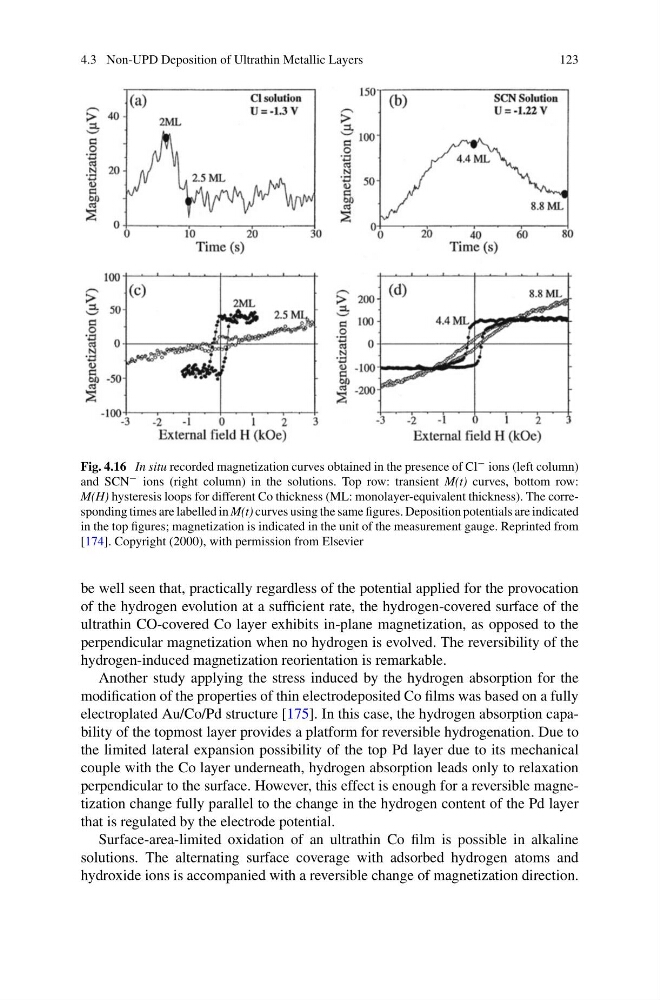
Fig. 4.16 In situ recorded magnetization curves obtained in the presence of Cl − ions (left column)
and SCN − ions (right column) in the solutions. Top row: transient M(t) curves, bottom row:
M(H) hysteresis loops for different Co thickness (ML: monolayer-equivalent thickness). The corresponding times are labelled in M(t) curves using the same figures. Deposition potentials are indicated
in the top figures; magnetization is indicated in the unit of the measurement gauge. Reprinted from
[174]. Copyright (2000), with permission from Elsevier
be well seen that, practically regardless of the potential applied for the provocation
of the hydrogen evolution at a sufficient rate, the hydrogen-covered surface of the
ultrathin CO-covered Co layer exhibits in-plane magnetization, as opposed to the
perpendicular magnetization when no hydrogen is evolved. The reversibility of the
hydrogen-induced magnetization reorientation is remarkable.
Another study applying the stress induced by the hydrogen absorption for the
modification of the properties of thin electrodeposited Co films was based on a fully
electroplated Au/Co/Pd structure [175]. In this case, the hydrogen absorption capability of the topmost layer provides a platform for reversible hydrogenation. Due to
the limited lateral expansion possibility of the top Pd layer due to its mechanical
couple with the Co layer underneath, hydrogen absorption leads only to relaxation
perpendicular to the surface. However, this effect is enough for a reversible magnetization change fully parallel to the change in the hydrogen content of the Pd layer
that is regulated by the electrode potential.
Surface-area-limited oxidation of an ultrathin Co film is possible in alkaline
solutions. The alternating surface coverage with adsorbed hydrogen atoms and
hydroxide ions is accompanied with a reversible change of magnetization direction.
123
Fig. 4.16 In situ recorded magnetization curves obtained in the presence of Cl − ions (left column)
and SCN − ions (right column) in the solutions. Top row: transient M(t) curves, bottom row:
M(H) hysteresis loops for different Co thickness (ML: monolayer-equivalent thickness). The corresponding times are labelled in M(t) curves using the same figures. Deposition potentials are indicated
in the top figures; magnetization is indicated in the unit of the measurement gauge. Reprinted from
[174]. Copyright (2000), with permission from Elsevier
be well seen that, practically regardless of the potential applied for the provocation
of the hydrogen evolution at a sufficient rate, the hydrogen-covered surface of the
ultrathin CO-covered Co layer exhibits in-plane magnetization, as opposed to the
perpendicular magnetization when no hydrogen is evolved. The reversibility of the
hydrogen-induced magnetization reorientation is remarkable.
Another study applying the stress induced by the hydrogen absorption for the
modification of the properties of thin electrodeposited Co films was based on a fully
electroplated Au/Co/Pd structure [175]. In this case, the hydrogen absorption capability of the topmost layer provides a platform for reversible hydrogenation. Due to
the limited lateral expansion possibility of the top Pd layer due to its mechanical
couple with the Co layer underneath, hydrogen absorption leads only to relaxation
perpendicular to the surface. However, this effect is enough for a reversible magnetization change fully parallel to the change in the hydrogen content of the Pd layer
that is regulated by the electrode potential.
Surface-area-limited oxidation of an ultrathin Co film is possible in alkaline
solutions. The alternating surface coverage with adsorbed hydrogen atoms and
hydroxide ions is accompanied with a reversible change of magnetization direction.