

122
4 Ultrathin Layers
Table 4.4 Thickness corresponding the onset of magnetization (d ON ) and that corresponding to the
onset of spontaneous in-plane magnetization direction (d*) in electrodeposited metals as obtained
with in situ observations. Data completed after Table 1 of Ref. [201]
Substrate
Deposit
d ON /ML
d*/ML
Conditions
References
Au(111)
Ni
6
N/A
[192]
Co
1.6
6.2–7.2
Cu-capped
[179, 192]
1.6
20
SO 4
2− –solution
solution, pH = 8.5
[199]
N/A
N/A
1.5–2
4–5
Cl − –solution
SCN − –solution
[174]
2
N/A
8
2
η = −0.68 V, Cu-capped
η = −0.18 V, Cu-capped
[180, 196]
N/A
>8
Au-capped
[200]
Fe
1
2
N/A
SO 4
2− –solution
Cu-capped
[172, 192, 197]
Ag(poly)
Co
<5.5
<15
[198]
Cu(001)
Co
N/A
1.5
SO 4
2− –solution
[186, 188]
1.5
2
SO 4
2− –solution
[195]
Fe
2
8
SO 4
2− –solution
[195]
this opens a new opportunity for tuning the magnetic properties of the ultrathin Co
deposits. It was observed already in a very early study that the spontaneous magnetization direction depends on the deposition potential [196]. This was attributed to the
formation of hcp Co islands at high overpotential, although no direct evidence was
available for this assumption. The occurrence of the in-plane magnetization at low
deposition overpotential is in agreement with other observations when the deposition
potential was not thought to be of high importance [188, 189, 195]. The hcp versus
fcc ratio proved to be a decisive factor for the thickness range below about 100 nm,
above which the deposition rate and the solution used was much less crucial [202].
The analysis of the contribution of various anisotropy factors to the spontaneous
magnetization direction can be found in the relevant literature and is much beyond
the scope of this work.
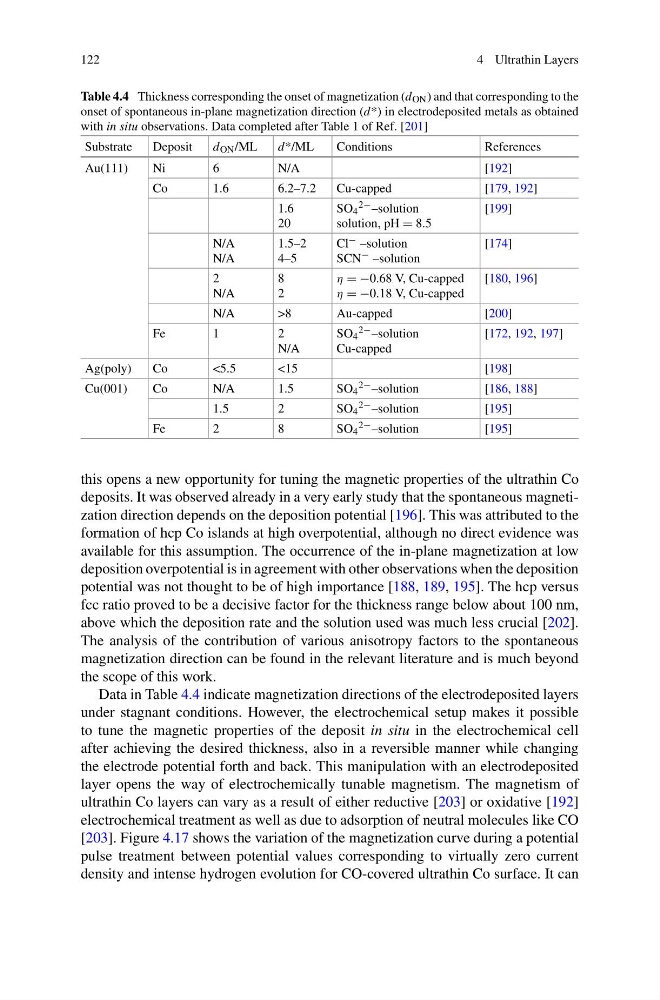
Data in Table 4.4 indicate magnetization directions of the electrodeposited layers
under stagnant conditions. However, the electrochemical setup makes it possible
to tune the magnetic properties of the deposit in situ in the electrochemical cell
after achieving the desired thickness, also in a reversible manner while changing
the electrode potential forth and back. This manipulation with an electrodeposited
layer opens the way of electrochemically tunable magnetism. The magnetism of
ultrathin Co layers can vary as a result of either reductive [203] or oxidative [192]
electrochemical treatment as well as due to adsorption of neutral molecules like CO
[203]. Figure 4.17 shows the variation of the magnetization curve during a potential
pulse treatment between potential values corresponding to virtually zero current
density and intense hydrogen evolution for CO-covered ultrathin Co surface. It can
4 Ultrathin Layers
Table 4.4 Thickness corresponding the onset of magnetization (d ON ) and that corresponding to the
onset of spontaneous in-plane magnetization direction (d*) in electrodeposited metals as obtained
with in situ observations. Data completed after Table 1 of Ref. [201]
Substrate
Deposit
d ON /ML
d*/ML
Conditions
References
Au(111)
Ni
6
N/A
[192]
Co
1.6
6.2–7.2
Cu-capped
[179, 192]
1.6
20
SO 4
2− –solution
solution, pH = 8.5
[199]
N/A
N/A
1.5–2
4–5
Cl − –solution
SCN − –solution
[174]
2
N/A
8
2
η = −0.68 V, Cu-capped
η = −0.18 V, Cu-capped
[180, 196]
N/A
>8
Au-capped
[200]
Fe
1
2
N/A
SO 4
2− –solution
Cu-capped
[172, 192, 197]
Ag(poly)
Co
<5.5
<15
[198]
Cu(001)
Co
N/A
1.5
SO 4
2− –solution
[186, 188]
1.5
2
SO 4
2− –solution
[195]
Fe
2
8
SO 4
2− –solution
[195]
this opens a new opportunity for tuning the magnetic properties of the ultrathin Co
deposits. It was observed already in a very early study that the spontaneous magnetization direction depends on the deposition potential [196]. This was attributed to the
formation of hcp Co islands at high overpotential, although no direct evidence was
available for this assumption. The occurrence of the in-plane magnetization at low
deposition overpotential is in agreement with other observations when the deposition
potential was not thought to be of high importance [188, 189, 195]. The hcp versus
fcc ratio proved to be a decisive factor for the thickness range below about 100 nm,
above which the deposition rate and the solution used was much less crucial [202].
The analysis of the contribution of various anisotropy factors to the spontaneous
magnetization direction can be found in the relevant literature and is much beyond
the scope of this work.
Data in Table 4.4 indicate magnetization directions of the electrodeposited layers
under stagnant conditions. However, the electrochemical setup makes it possible
to tune the magnetic properties of the deposit in situ in the electrochemical cell
after achieving the desired thickness, also in a reversible manner while changing
the electrode potential forth and back. This manipulation with an electrodeposited
layer opens the way of electrochemically tunable magnetism. The magnetism of
ultrathin Co layers can vary as a result of either reductive [203] or oxidative [192]
electrochemical treatment as well as due to adsorption of neutral molecules like CO
[203]. Figure 4.17 shows the variation of the magnetization curve during a potential
pulse treatment between potential values corresponding to virtually zero current
density and intense hydrogen evolution for CO-covered ultrathin Co surface. It can